
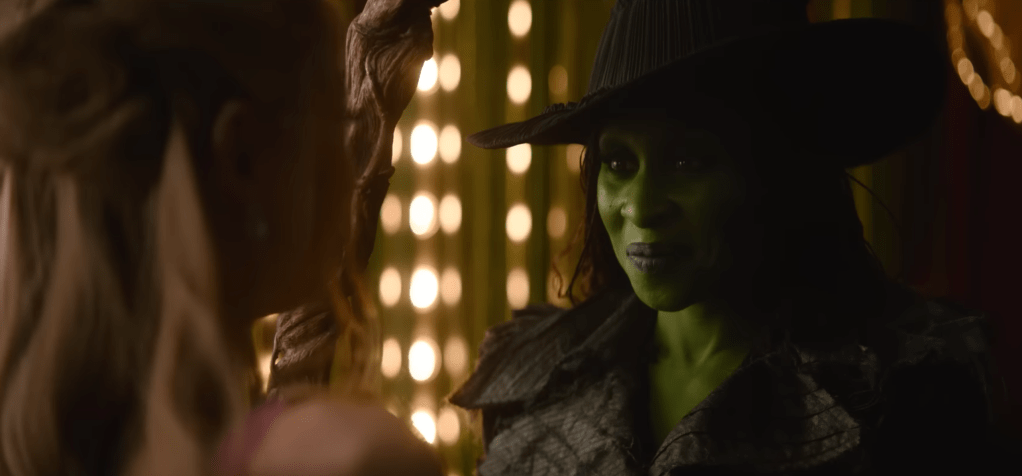
Directed by Jon M. Chu — Screenplay by Winnie Holzman and Dana Fox.
The wait is over for musical theater fans all over the world. The long-awaited sequel to 2024’s Wicked, both based on the musical theater show of the same name, has hit theaters and is already one of the biggest hits of the year. Still directed by In the Heights director Jon M. Chu, Wicked: For Good is an adaptation of the second half of the aforementioned musical theater show and is thus one of the decade’s key part two films. The sequel follows the wrongly villainized Wicked Witch of the West, Elphaba (played by Cynthia Erivo), known for her green skin and her magical powers, some time after the events of the first film, which culminated in an instantly iconic performance of “Defying Gravity,” as Elphaba escaped the Emerald City and left her best friend, Galinda ‘Glinda’ Upland (played by Ariana Grande-Butera), to become ‘Glinda the Good,’ a pinkly-dressed faux-witch and key representative of the Wizard of Oz (played by Jeffrey Goldblum) and his empire. The film sees our main duo step into their roles as opposing forces, hoping for reconciliation and a better future for Oz, with Elphaba being particularly focused on improving the rights of animals and anyone else who may lose their ability to speak up as a result of the Wizard’s regime.
Look, let’s be clear, there are a lot of things that work at a very high level here. Like with the previous film, the costumes and production design are outstanding and spellbinding. Although there are drastically fewer memorable songs, there are still effective songs to be found (the two songs that were newly created for the film have thematic power, even if they’re not super catchy), and the titular hit “For Good” is particularly great and, despite underwhelming choreography, is one of the film’s most emotionally engaging moments. Plus, as you would imagine, the two co-lead performances from Cynthia Erivo and Ariana Grande-Butera carry the film with dedication to their craft and the vision of the storytellers. The sequel gives more room for Grande-Butera to expand on her character, while it must be said, Erivo’s character is not quite as active in the second film as she was in the first film, which is, frankly, one of the problems with the film. However, both Erivo and Grande-Butera elevate the film to heights that are often really easy to latch onto and be engrossed in. Whenever they’re on-screen together, the film is completely transfixing and often deeply emotionally involving. However, when they’re apart, the film doesn’t succeed. I will add that Jonathan Bailey, who is still good here, is given frustratingly little to do, and I constantly wanted more of him in this.
This gets me to some of the lesser elements of the film. It starts with Michelle Yeoh, who, despite being a top-notch actress, is just completely miscast here. Yeoh can’t match her co-stars’ singing ability and, unfortunately, she feels rather unnatural in the part throughout this film. Really, the writing hurts her, as it doesn’t know how to involve the supporting characters in ways that allow them to feel like fully-formed individuals rather than mere one-note characters. I also think the film fails to make the main character’s arc feel satisfying. The film wants to end on a hopeful note, but I can’t get away from the fact that (and this is a bit of a spoiler, but I’m told it’s the same ending as in the long-running theater show) the film expects us to accept the fact that the it exiles our lead, who is at no point reclaimed as a heroic figure in the world. The character basically opts to go against the core principle she preached in her new song, written specifically for the film, titled “No Place Like Home,” which I interpreted to be about choosing to fight to better your home rather than accepting exile. Some may call it bittersweet or a tragic sacrifice, but I think unsatisfying is the word I’m going with, because it didn’t feel true to the character or the aspirations of the film, to me. That is my main gripe with how the film concludes the narrative arc.
Another one of the major issues here is that the pacing is all off in the sequel. I already criticized the pacing in my review of the first film, but the pacing issues are even more impactful in the second film. Here, the first act lacks narrative forward momentum, so it feels meandering, and, later in the third act, the speed picks up to such an extent that it can be difficult to pick up on the exact passage of time, and characters that need to be more fleshed out have no room for such necessary additions. Structurally, it handles the plot of the classic The Wizard of Oz, which overlaps this film’s story, by having the main plot of that classic film stay in the background, behind closed doors, or entirely off-screen, despite the fact that it thus leaves Wicked: For Good feeling incomplete. I imagine that young viewers who haven’t actually seen The Wizard of Oz will be very confused by what’s happening, while those, like myself, who have seen the classic will be left puzzled by the decisions made here to both step out of the way of the classic and darken characteristics of certain individuals and retconning elements through plot contrivances that are sometimes head-scratchers. I don’t think it works despite what are probably good intentions on the part of the filmmakers. Strangely, as a result of all of this, the film feels both longer than it is (and feels longer than the previous film despite actually being shorter), but also feels like it has no time to handle everything with nuance and thus leaves no room for supporting characters to be more than one-dimensional.
There are still a lot of great things about Jon M. Chu’s Wicked: For Good that have carried over from the first part, but, for the sequel, the highs are not as high, while the lows are much lower and more frequent. As such, it takes a few steps back from the spellbinding first film. The central performances are still extraordinary, but the pacing is off, the story feels incomplete, and the conclusion to the narrative arc is not as satisfying as the storytellers hoped it would be; rather, it feels like a bit of a cop-out.
5.7 out of 10
– Review written by Jeffrey Rex Bertelsen.

 I'm Jeffrey Rex
One thought on “Wicked: For Good (2025) | REVIEW”