
Directed by Jon M. Chu — Screenplay by Winnie Holzman and Dana Fox.
Sometimes I like to think of myself as an ‘unrealized musical theater kid,’ since I do, and always have, enjoyed performances, musicals, and whatnot but didn’t really have school programs or friends to help steer me in a fulfilling direction when I was younger. As such, it sometimes feels like I’m behind on a couple of musical theater touchstones that I undoubtedly would’ve loved when I was younger. Although I knew of “Defying Gravity,” through, I think, Glee, Wicked has been a little bit of a blind-spot for me, despite my love and appreciation for The Wizard of Oz. In early 2024, I did express some doubt about this entire big-screen adaptation project of the musical theater phenomenon, as the adaptations of Cats and Dear Evan Hansen appeared to have only lessened the reputations of those shows. So, I openly asked, on the social media platform formerly known as Twitter, if this was something people actually wanted to see? Wicked die-hard fans were quick to respond with a clear and obvious ‘yes.’ Now that I’ve seen the big-screen adaptation, I can happily say that I totally get the excitement. Although I, admittedly, don’t think it’s perfect or the best movie musical of the last ten years, I found Wicked to be utterly delightful. I understand why it is, ahem, popular.
Based on both Stephen Schwartz and Winnie Holzman’s musical stage play of the same name and Gregory Maguire’s 1995 novel of the same name, as well as the iconic 1939 classic The Wizard of Oz, Jon M. Chu’s Wicked, or Wicked: Part One, is a musical film that tells the first half of the story of Elphaba Thropp (played by Cynthia Erivo), also known as the Wicked Witch of the West. In Wicked, the green-skinned Elphaba is ostracized due to her unnatural skin color and for having magical abilities that she isn’t in full control over. However, when she drops off her sister Nessarose (played by Marissa Bode) for university, an incident occurs which leads to Elphaba using her powers and causing a scene. As a result, Elphaba is approached by Madame Morrible (played by Michelle Yeoh), the Dean of Sorcery Studies, and is officially enrolled in the university. Though they initially butt heads over their differences in looks, popularity, and priorities, Elphaba eventually gets to know the popular girl Galinda (played by Ariana Grande-Butera), and, after some time, together they head to the mystical Emerald City. However, while this all happens, Elphaba is horrified by the way talking animals are treated by people in power, including at the university.
In discovering what this narrative is all about, it was interesting to learn that this is essentially equal parts a film about a ‘from enemies to friends’ relationship complete with its own makeover musical sequence, as well as a film about authoritarianism and the cruel subjugation of a minority group. That also means that, at the heart of the film, there is a tonal balancing act between a fairly simple formula and deeply serious and timely themes that merit a proper focus. Thus, I can understand if other critics feel that it doesn’t have enough of a focus on the horrifyingly timely themes, but, for what it’s worth, I thought the film, from a screenplay by Winnie Holzman and Dana Fox, did a good job of baking these themes into the more cutesy narrative and unveiling it as the central point of the main character’s journey. I am hopeful that the second part will lean into these elements more, but here I felt the balancing act mostly made sense, as the authoritarianism, or rather who is responsible, is essentially made to be a reveal that the film unveils (though it could’ve been more of a mystery). I think this film is going to get a lot of people to think about these important themes, and I think it is really special for a blockbuster to aim for that. From a narrative standpoint, my main gripe with this film, which I think is pretty strong and often wonderful, is that it is, from what I understand, an unnecessary part one. Although it doesn’t exactly feel its length, it is overlong and it does suffer from pacing issues (it stays at the university for much too long). It is baffling to me that the film adaptation of the first half of the story is basically as long as the entire stage show.
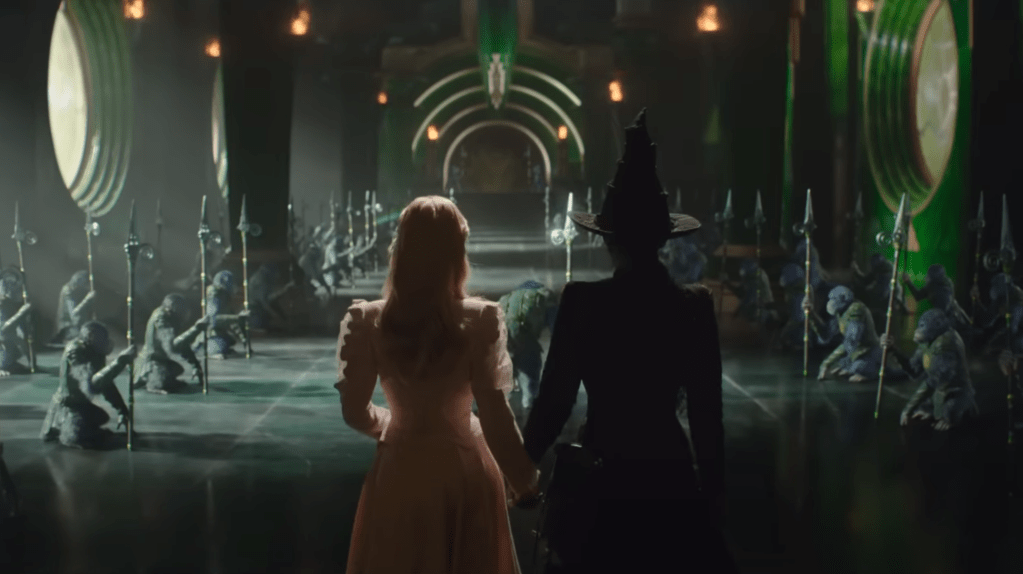
It is, however, a really well-made film from a technical standpoint, or, at the very least in most aspects, as Paul Tazewell’s costumes are so detailed and have so much character and life to them, and the production and set design are jaw-droppingly good, as they have built so many elements here that help to really nail the world-building, especially in the Emerald City section of the film (the train and the mechanized face really stood out to me). What is, however, a little bit strange are certain scenes and sequences that visually look a little bit too dull, washed out, or desaturated and thus don’t get enough vibrancy out of the material. Of course, the music is often incredible, but, really, it should be given they’ve all been sung on Broadway for years. The choreography has its moments, with “What is this Feeling?” being a particular highlight in that regard, but I thought the choreography was much less inventive than it was in Chu’s In the Heights adaptation.
What really elevates the songs to me, however, are the performances. Jeff Goldblum’s short song has a lot of him in it, so to speak, Jonathan Bailey’s charisma really makes the, frankly, overlong “Dancing Through Life,” work, and then there are the two central performances that blow everyone else out of the water. No one should be surprised that Cynthia Erivo, who is an Oscar short of an EGOT status, not only gives a phenomenal acting performance (she gives so much emotion and seriousness to her character that I greatly enjoyed) but her fully committed singing performance in “Defying Gravity,” is just pitch-perfect and is completely overpowering in the best way. Then there’s Ariana Grande-Butera, the multiple Grammy-winning artist, who it’s easy to forget actually had a really successful Nichelodeon-acting career. However, what Grande does here is so much better than anything I thought she was capable of as an actor. Her funny bone and pitch work are outstanding, her singing is great, and her chemistry and rapport with Erivo make this film really special. Their scenes together are often electric and completely transfixing, and, in important moments, they manage to move you to tears.
So, in conclusion, Jon M. Chu’s Wicked is a really strong musical film adaptation with important themes, outstanding production and costume designs, and central acting performances that manage to make the entire project feel special, despite it being needlessly overlong and cut in two. Musical theater kids, I hope you’re happy. As for part two, titled For Good? Well, I have to admit that I do have some concerns, but I hope we’ll all be happy in the end.
8 out of 10
– Review Written by Jeffrey Rex Bertelsen.

 I'm Jeffrey Rex
One thought on “Wicked (2024) | REVIEW”