
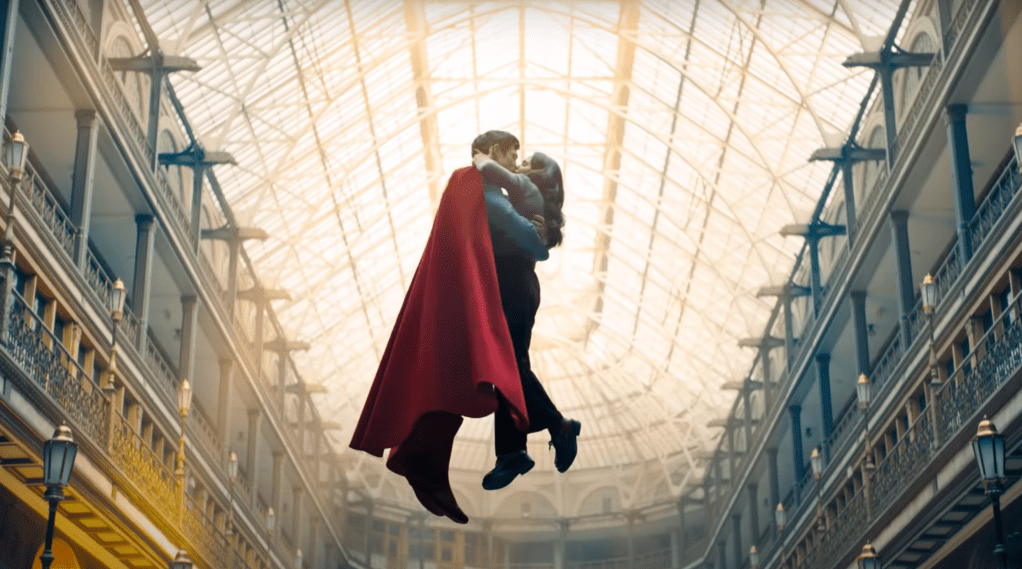
Directed by James Gunn — Screenplay by James Gunn.
I can’t stress enough how significant it is that the first image of the new live-action Superman is of him lying defeated in the snow, in need of healing and a pick-me-up, and, importantly, bleeding out of his mouth due to all the fighting he has just been through. It is an immediate act of flipping the switch on the modern cinematic understanding of what and who Superman is. When Marvel Studios launched a cinematic universe at the same time that Christopher Nolan was making self-contained and critically lauded Batman films for DC, they gradually set in motion a trend that Warner Bros. was eager to imitate. The head honchos at the studio gave filmmaker Zack Snyder the keys to their comic book movie empire, and, with his epic but divisive Man of Steel, he gave us a Superman born of a gritty, slow-mo heavy universe wherein he was presented as an Alien with god-like powers that was often paired with Christ-like imagery. Snyder notably had a character ask the godlike alien with an ‘S’ on his chest: “Tell me, do you bleed?”
With the crumbling of the initially Snyder-shepherded DCEU (the generally accepted abbreviation for the Warner Bros./DC Comics shared cinematic universe kickstarted by Man of Steel), a new cinematic universe rose out of the debris. The all-new DCU (the chosen abbreviation for the relaunched cinematic universe) is overseen by Guardians of the Galaxy director James Gunn, and it is from his hands that this new vulnerable interpretation of Superman comes. If, in Superman, Snyder saw Kal-El, Gunn sees Clark Kent. If Snyder saw a god, Gunn sees a man (or, you know, a metahuman). If Snyder was interested in godliness, Gunn is interested in goodness. This interpretive change is pivotal; it is felt throughout the film, and it is announced, as I set up with my opening line, in the character’s very first scene. It is just one of the many decisions that I think make James Gunn’s Superman a refreshing, warm, and joyful new superhero movie. Though not without faults, 2025’s Superman, like many of James Gunn’s films, wears its heart on its sleeves and is all the better for it. Long-time readers will know that I’ve long hoped for an iteration of the titular character that could evoke the same adoration I feel for Richard Donner’s Superman: The Movie or the series Smallville. This film gets the job done.
As is made clear from the opening on-screen text, James Gunn’s Superman takes place after the titular character’s well-known, oft-told origin story. In Gunn’s DCU, Superman, though certainly the most powerful, is one of several superpowered individuals known as ‘metahumans.’ As the film starts, in medias res, Superman (played by David Corenswet) — the Kansan Kryptonian, also known as Clark Kent or Kal El, who needs no introduction — is in the middle of battling — and struggling to defeat — the so-called ‘Hammer of Boravia,’ an armored metahuman fighting on behalf of the US ally nation, Boravia. You see, weeks earlier, Superman made a unilateral intervention to prevent Boravia from invading the neighbouring country of Jarhanpur, and now, he has come under a lot of fire for it both in the media and, well, physically above Metropolis. Unbeknownst to Superman and the world, tech-billionaire Lex Luthor (played by Nicholas Hoult) is secretly in cahoots with Boravia and has orchestrated this brawl in Metropolis by disguising one of the metahumans in his employ. Luthor, as he is wont to do, wants to expose and take down the good-hearted and well-intentioned Superman, and when, while distracting the ‘Last Son of Krypton,’ Luthor infiltrates the Fortress of Solitude, he procures a key piece of intel with which he may forever taint the Man of Steel’s reputation.
In bringing his take on Superman to the big screen, writer-director James Gunn draws from a wide variety of influences and inspirations. These include the original Donner film (more than just the wonderful original theme) and a plethora of comic book interpretations. But he also pulls from both his own life and the real world. There is no denying that the film feels quite politically timely. This is a film about an immigrant being told he doesn’t have the same rights as citizens, about a tech billionaire influencing governments at home and abroad, about intentionally-harmful social media targeting, and about a US ally nation invading a neighbouring country and threatening the lives of its people in the process. It is fairly easy to connect the dots between the film’s elements and the real-world individuals or countries on which they are inspired. At the same time, you also get the feeling that a certain plotline involving a public outcry, partially as a result of an online smear campaign carried out by Lex Luthor’s ‘minions,’ is somewhat inspired by the far-right online campaign to get Gunn cancelled that led to his public firing from Disney (before he was later reinstated). It all makes for a fascinating film with a lot on its mind.
Gunn not only has a lot to say, but he also has a lot of characters and elements he wants to insert into his narrative. There’s Green Lantern (Guy Gardner, played by Nathan Fillion), there’s Mr. Terrific (played by Edi Gathegi), there’s Hawkgirl (played by Isabela Merced), there are all of Lois Lane (played by Rachel Brosnahan) and Clark Kent’s colleagues at the Daily Planet, there are Lex Luthor’s sidekicks and employees, there’s Superman’s furry friend Krypto the Superdog, and I could go on. It is filled to the brim, and, given that comic book-based filmmaking has a long history of overcrowded and unfocused films, I was admittedly nervous about how this would turn out. I was pleasantly surprised to find out that, despite featuring so many characters, the film flows really well (it is fairly briskly paced, as a direct result of forgoing the retelling of the familiar backstory, which, back in the day, took up more than 40 minutes of Donner’s Superman: The Movie) and the vast majority of these character get satisfying moments to shine or enjoyable quirks. Gunn opted for a runtime of 129 minutes, which is light these days, where so many blockbusters get much closer to the three-hour mark, and yet he has found room for the many characters. The main reason is that their main purpose is to convey the feeling that this is a living, breathing world that you’re getting a glimpse into. Gunn wants it to feel like its world didn’t just start spinning the moment the first scene came up on the big screen. It really does feel like you’re just dropping in on the latest issue of DC Comics’ Superman and can naturally follow along.
It also feels a lot like you’re watching a so-called Superman-centric Saturday-morning cartoon. Like many others, I grew up watching the Spider-Man, X-Men, Batman, Superman, and Justice League animated series, and it really did feel like I was getting a live-action version of those kinds of shows. It’s partially due to the various characters, their world coming alive, and the type of action (that is both intense, funny, and inherently James Gunn). But it’s also because James Gunn’s sensibilities and comic book movie tone have always leaned towards embracing comics’ lovable quirks rather than, as has been the case in previous eras, outright omitting them. So, how does James Gunn’s light but emotional, sometimes goofy but open-hearted, and sincere tone match the Superman character? It’s, honestly, a really good fit. There are admittedly Marvel-esque comedic moments from which Zack Snyder’s films were steering away, and there is a small handful of moments when the titular character is a little bit too unnaturally jokey, but for the vast majority of scenes, Gunn’s interpretation of the character is more naturally sincere than silly. Gunn manages to strike the right balance with his vulnerable take on the main character (who also has deeply serious moments where he is pleading his case or showing deep frustration) and outsources most of the goofy humor to supporting characters.
There are also moments when James Gunn’s writing comes to the forefront for all the right reasons. Gunn has crafted a couple of killer monologues for Lex Luthor and Superman in the third act that emphasize his understanding of both characters. Though my personal favorite moment in the film comes in a slightly earlier scene, when, in a strong but playful one-to-one scene with his girlfriend Lois Lane about what it means to be ‘punk rock,’ Clark remarks that perhaps choosing to see the best in people and caring is actually punk rock. This is Gunn’s thesis statement for the movie. He sees a cynical world where it’s become mainstream to be mocking or dismissive or expressing dislike, and he positions Superman as the antidote, the shining beacon of sincerity and kindness. Perhaps it is a little bit corny or dorky to some, but that kind of writing shows a deep understanding and appreciation for the character of Superman.
The three central performances from Corenswet, Brosnahan, and Hoult are also a huge part of the reason why the film works so well. Although he also auditioned for the titular role, Nicholas Hoult here proves that he was the ideal choice to play Lex Luthor, as he turns in the kind of evil, petty, pathetic, but genius character traits through his performance that instantly make him feel like the quintessential take on the character. Relative newcomer David Corenswet takes on the title role with a steady hand. Corenswet’s take on the character still has the vanilla-boy scout aspects that Superman is partially beloved for, but he also makes the emotional outbursts and his moral compass in this film really shine. Unlike Man of Steel‘s Amy Adams, Rachel Brosnahan’s Lois Lane actually gets a lot to do in this film. Through it all, she perfectly embodies the type of confident, competent, and charming character that Margot Kidder was so wonderful as in the original film. Arguably, the best thing about this film is Brosnahan and Corenswet’s dynamic. You love seeing them together, and Gunn’s script gives their rapport enough complexities that make the relationship feel real. The film is, in general, well-cast from top to bottom with effective supporting turns from Nathan Fillion, Edi Gathegi, Skyler Gisondo, and Pruitt Taylor Vince as Jonathan Kent (in general, I loved how down-to-earth the Kents were in this). Oh, and there’s also a memorable instance of stunt casting here that really works.
It isn’t perfect, though, and I can definitely see where some people might struggle to be fully won over by it. It is, indeed, more concerned with building a universe than telling a self-contained story, but this really only bothered me in a late and unnecessary scene that, kind of, gets in the way of the smoothness of the otherwise lovely ending. Without going into spoilers, I’ll say that it is a moment that feels designed to be a backdoor pilot, of sorts, to a spin-off film. Though I think the scene would’ve fit in better as an after-credits scene. I also think that it is fair to say that some of the events in the film are wrapped up and resolved in a way that feels too easy. But, really, my personal biggest issue with the film is a section of the second act in which the film gets a little bit too science fiction with its environments. This doesn’t usually bother me, but the scene was too reliant on CG-visual noise, and, for a couple of minutes, it felt less like a Superman movie and more like a detour to a visually unappealing sci-fi-esque Minecraftian netherworld.
Several months before it actually happened in 2022, I wrote that “the smartest thing DC Comics and Warner Bros. could do right now would be to hand the keys to their superhero cinematic universe over to Gunn.” James Gunn’s Superman proves that they made the right call by doing so. His film smartly flips the switch on our modern cinematic understanding of the character by embracing his heart, his sincerity, and his inherent goodness and goofiness. This is a loving and lovable interpretation of the character that doubles as a distinctly modern superhero film with timely politics and something to say. In that process, he makes the warm interpretation of the character a punk rock antidote to our cynical world. Like James Gunn is wont to do with his superhero films, the film is heavily focused on our relationship with our parental figures, a large assortment of characters, and even superpowered furry friends. But, importantly, despite the film being quite busy, Gunn’s sensibilities don’t get in the way of telling a good Superman narrative; rather, they help to amplify the core messages at the heart of the film. It is also just a hugely entertaining and extremely well-paced summer blockbuster movie that sends you out the door with a huge smile on your face. I loved it.
8.5 out of 10
– Review written by Jeffrey Rex Bertelsen.

 I'm Jeffrey Rex
A wonderful review. I appreciate the fact that you pointed out things you liked and didn’t like about the film in an objective manner. It’s easy to fall prey to hype. Personally, I am really excited to see the film soon. I am a huge fan of the 1978 film. For me, Christopher Reeve will always be the best Superman. But I am curious to see how a new version would turn out to be.
Here’s my thoughts on the 1978 movie:
Thank you so much for the nice comment!
I’m also a big fan of the original and Reeve’s iconic performance 🙂