
Directed by Denis Villeneuve — Screenplay by Denis Villeneuve and Jon Spaihts.
I don’t know if I’ve ever told this story before, but I have this vivid memory where — when I was probably around the age of ten — I looked up at my mother and asked her a question. I had either just seen The Lord of the Rings: The Return of the King, or else it was about to come out and I knew it was going to be the last film in the trilogy. With a note of sadness in my voice, I looked up at my mother and asked her something along the lines of “What happens after the Lord of the Rings? Will we ever get anything as good as that ever again?” You have to understand that in those early 2000s, we were being treated to fantasy filmmaking of the highest order with Peter Jackson’s Tolkien adaptations, while Sam Raimi was hard at work on Spider-Man 2 following the success of the first one, and after George Lucas’ Star Wars: Episode II — Attack of the Clones, we all knew that there was only a single film left in the so-called prequel trilogy. At the age of ten, I was blown away by what I was seeing, but I could also see an end to what we were getting. I wasn’t quite sure if this was a once-in-a-lifetime kind of perfect storm for fantasy and blockbuster filmmaking or not. Of course, in the years to come, Hollywood would go on to shovel dozens upon dozens of films with similar aims down our collective pop culture gullet, in an attempt to recapture what was so addicting and marvelous about Jackson, Raimi, and Lucas’ films. Hollywood, we must admit, often failed to recapture that. Now, it’s not like the Lord of the Rings, Star Wars, or Spider-Man is dead and buried — not by a long shot — but there is an argument to be made that none of those franchises have ever been afforded the same level of creative freedom for its principal filmmakers as was the case back then. So, what did my mother say? Well, with generosity and kindness in her voice, she assured me that, of course, major motion pictures with that sense of scale, scope, and artistry were not going away for good. She assured me that I had so much more to look forward to. My mother was right. Every so often something comes along that both feels like a throwback to the days when creative freedom was to be expected for filmmakers but which also feels like the perfect utilization of modern sensibilities and technical mastery. Denis Villeneuve’s two-part adaptation of Frank Herbert’s iconic science-fiction novel Dune is the perfect modern example of that. I feel so lucky. Now more than twenty years after my mother reassured me about the future of filmmaking — though perhaps not in as many words as I put it above — I have had the wonderful opportunity to watch Denis Villeneuve’s Dune: Parts One and Two in theaters with my mother, and both times the French-Canadian filmmaker has managed to both transport us to another world full of fantasy and science-fiction wonders, but also remind us — both mother and son in love with film’s transportive power — of the kind of storytelling that we love with all of our hearts.
Denis Villeneuve’s Dune: Part Two picks up the storyline right where Part One left off. Young Paul Atreides (played by Timothée Chalamet), the son of the assassinated Duke Leto Atreides, is with his pregnant mother Lady Jessica (played by Rebecca Ferguson), a Bene Gesserit witch, in the desert of Arrakis after having befriended a group of Fremen, the indigenous people of the desert planet Arrrakis. These Fremen, led by the deeply religious Stilgar (played by Javier Bardem), are bringing the last members of House Atreides to Sietch Tabr, where they will be invited into their local community following the Harkonnen attack on Arrakis. When Paul and Jessica reach Sietch Tabr, it becomes clear that they are a divided group of people, with one group being deeply devoted to a religion (and a belief that Paul is the prophesied messiah that will make Arrakis into a paradise) and another group — which includes the Fremen warrior Chani (played by Zendaya), who Paul has had visions of since before he even set foot on the desert planet — being extremely suspicious of religion, as well as of the true intentions of the Atreides duo. Paul and Jessica also walk different paths in that regard. While Lady Jessica is adamant that they must buy into the religious fundamentalists’ beliefs and exploit that trust for political power and safety, Paul remains fearful of his visions and the destiny that seems to have been manufactured for him but is also frustrated with the religious propaganda that Bene Gesserits have been spreading, which is now paving the way towards something that he’s not sure that he can control. Meanwhile, Baron Vladimir Harkonnen (played by Stellan Skarsgård) oversees the gladiatorial birthday party for his young sociopathic nephew, Feyd-Rautha (played by Austin Butler), who the Bene Gesserits also have plans for.
With Dune: Part One, Denis Villeneuve proved for all to see that his approach was founded in deep admiration and love for the source material. His work in Frank Herbert’s universe is defined by an attention to detail, a consideration for the intentions of the original text, and a final product that takes everything about the universe seriously. All of this is true for Part Two as well, but I also think it is clear to see that in focusing so much on set-up in the exceptional first film, he has allowed his second film to be a more emotionally charged and riveting experience. This is in part seen in how Javier Bardem’s Stilgar especially brings some appreciated occasional levity to the overall gravitas of the picture through the character’s insistence on having events match the local religion no matter how trivial said event may seem. This isn’t to say that this film’s humor is meant to be a correction on the first film — not at all. Denis Villeneuve’s Dune films continue to feel like the modern and serious antidote to the kind of tongue-in-cheek approach that lesser superhero fare and the Fast and the Furious films have infected Hollywood filmmaking with. But it isn’t just the seriousness that is at an appropriate level, the skill and artistry in storytelling reaches a level that only a select few films in the genre do. Frankly, even though I love the first two films of the Star Wars sequel trilogy, these two Dune films put modern Star Wars to shame, which should mean a lot coming from someone who grew up on and loves Star Wars so much. Denis Villeneuve’s Dune is just on another level entirely for this generation of films.
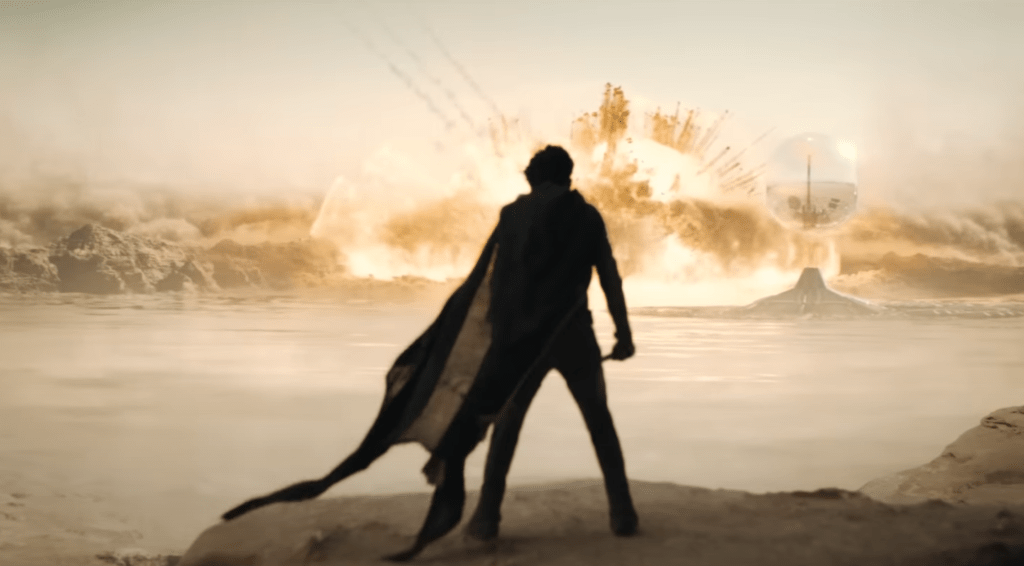
Like with the first film, every inch of Dune: Part Two showcases state-of-the-art creative accomplishment. Hans Zimmer’s score is just as transportive, otherworldly, and overpoweringly moving in the best way as it was in the first film. Jacqueline West’s costumes continue to dazzle as certain outfits are so detailed, distinctive, or elaborate that they tell stories of their own worthy of lengthy study (I constantly think back to what Rebecca Ferguson and Florence Pugh’s characters are wearing in pivotal scenes). The action is riveting (worth the price of admission on its own) and the third act is absolutely majestic. The cinematography and world-building is genuinely breathtaking and chill-inducing, as the film emphasizes scale, scope, spectacle, and science-fiction verisimilitude that is perfectly welded together with worlds and environments that are ‘out of this world.’ Arrakis just feels so real and the perfectly timed reintroduction to the Harkonnen homeworld of Giedi Prime livens up the film both visually through its environmental black-and-white or monochromatic look and atmospherically with its snake-like characters, uncomfortable and inappropriate appetite and urges, and its remix of one of the first film’s absolute best scenes. In every single way, from a technical standpoint, this is an extraordinary film in which, as the saying goes, every single frame could be a painting.
Along with returning co-writer Jon Spaihts, Denis Villeneuve’s writing embraces and front-loads, and is thus unafraid of, the complexities and the tragedy at the heart of this otherwise fairly familiar hero’s journey (and is all the better for it). Ever since Part One opened with a voice-over from Zendaya’s character that included the line: “Who will our next oppressors be?” It has been relatively clear that Denis Villeneuve isn’t telling a story meant to be perceived as a white savior narrative. This isn’t exactly an addition to the story meant to line up with modern sensibilities but rather a focus on one of the central interests and focal points of Herbert’s narratives. If that first part was all about set-up and promises to be fulfilled later on, then Villeneuve fully lives up to the promises of his first film. Here he invests a lot of time in the Chani character, who was only briefly introduced in the first film, and through Chani and Paul’s interactions — which are the primary focal point of the first half of this second part — Villeneuve and Spaihts not only properly introduce you to the ways and world of the Fremen, but they also inject the film with the kind of cultural and character arc complexities that are needed for the film’s powerful but conflicted emotions of the climax to land as elegantly as they ultimately do. Here is a film deeply concerned about the true nature of prophecy and religion, the frightening power of warfare fuelled by religion, how religion can be used as a way to legitimize one’s own position in the world, and how religion can be a tool with which oppressors and other politically motivated individuals may further enslave or exploit people. Like this story should be, it remains a fascinating coming-of-age film about destiny, paths others set us on, and prophecy, but Villeneuve’s vision smartly emphasizes the cautionary tale of Herbert’s narratives, even though it may not sit right with certain audience members. Just like the first film set up with its first lines, in Denis Villeneuve’s vision and interpretation of the story, a cycle of oppression is an essential theme to the story of Dune, and Villeneuve’s film smartly focuses its attention on Chani’s perspective, which has been tweaked a fair bit for the adaptation, to illustrate that in crucial moments.
Now with Arrival, Blade Runner 2049, and both Dune films — all of which are exceptionally good and all have something to say — the auteur filmmaker has set his name in stone as a genuine master of science-fiction, and if he should go on to make an equally good third chapter in the Dune series — the Dune: Messiah adaptation that he supposedly wants to do — then there can be no doubt that he would be catapulted into the kind of auteur stardom that would put him into the pantheon of exceptional science-fiction filmmakers. Of course, no film is perfect, and if there are false notes that come through with Dune: Part Two, then they relate to pacing (the first hour or so is deliberately paced, whereas the remaining film is relatively fast-paced, which may be overwhelming given the density of the text) and the act of cramming certain things into such an extent that it slightly obscures our understanding of exactly how much time passes between scenes. Also, certain scenes later could maybe do with more room to breathe (though, I suspect that, at the same time, some of these nitpicks or issues might be less noticeable on subsequent viewings). Villeneuve makes really smart choices with regard to axing certain things and characters or changing their placement in the unfolding of the narrative. Ultimately, like Roger Ebert once noted, no good movie is too long — and, frankly, one might say that, if there is a problem with the film, then it is that Dune: Part Two isn’t even longer. Like with the first film, it’s the kind of immensely immersive and powerful experience that science-fiction enthusiasts would happily want to stay in for even longer.
As was evident even in the first film, Villeneuve has been blessed with an incredible cast of recognizable actors, and it is even more incredible in Part Two. Although the film is chiefly concerned with Chalamet’s Paul Atreides and Zendaya’s Chani, both Rebecca Ferguson, Javier Bardem, and Austin Butler have more than enough scenes with which to make their mark. While Bardem’s Stilgar is perhaps a little bit more comedic in this second part, Ferguson shines in part through her decidedly more dark and unemotional character path here. Austin Butler, who rose to stardom as the titular character in Baz Luhrmann’s Elvis, is unrecognizable as Feyd-Rautha — i.e. the character once played by Sting in David Lynch’s adaptation from 1984. When Elvis was making the rounds during its awards season, a lot was made of Butler’s attachment to his Elvis Presley accent even past the release of the film, but what he does here could not be less like his Elvis. Butler’s Feyd-Rautha is demonic, aggressive, full of urges, and decidedly creepy — and every single scene he is in is made better because of his take on the performance, which even includes a voice not dissimilar from Skarsgård’s approach. Although they aren’t in the film as much as some of the other actors I’ve mentioned, Lea Seydoux, Charlotte Rampling, and Florence Pugh also leave positive impressions. But, of course, this is a movie that rests on the shoulders of Timothée Chalamet and Zendaya, and they do not disappoint whatsoever. The success of this film largely rests on whether you buy into their relationship as well as the conflicted emotions they both have about Paul’s role in it all. Paul Atreides’ arc eventually allows for Chalamet to bring an energy to the character that has outright startling moments — including in one especially hair-raising scene as he speaks defiantly to his followers — and Zendaya makes both the tragic and romantic scenes emotionally engaging. Make no mistake, Zendaya, and her character, is the glue — or the linchpin — that holds Villeneuve’s thematic vision together.
Once upon a time, Frank Herbert’s Dune was regarded as one of those unadaptable science-fiction films. Jodorowsky and Lynch’s attempts only seemed to confirm that idea. But, like a long-awaited voice from the outer world, Denis Villeneuve has dispelled those doubts by making a two-part adaptation of Dune that collectively is nothing short of a masterpiece. Dune: Part Two is epic transportive science-fiction filmmaking of the highest order. It is the kind of genre filmmaking event that we get a couple of times every decade if we are lucky. Like the very best films of its kind, it features impeccable world-building, gripping performances, riveting action, and state-of-the-art filmmaking. Furthermore, its fearlessly conflicted climax — full of both triumph and tragedy — is worthy of admiration. I will be forever grateful to have experienced yet another one of these special transportive blockbuster masterpieces with someone who I love more than life itself.
10 out of 10
– Review Written by Jeffrey Rex Bertelsen.

 I'm Jeffrey Rex
Excellent reviews as always. I’m really anxious to see this one soon. I was such a massive fan of the first “Dune” which I consider one of the greatest science-fiction movies ever made. I loved that film because it portrayed the Middle East with such authentic manners. I’m curious to see whether this sequel could possibly surpass the original in sheer quality. Sequels rarely ever live up to quality of their predecessors. The reviews have me convinced that it’s true, but I guess I’ll just have to see for myself. Here’s why I adored the 2021 sci-fi blockbuster:
Thank you so much for the nice comment! Part One is so good, I’ve seen it so many times and it never disappoints. I’d be interested to know what you think of the sequel. I hope you have a great time with it!