
Directed by Kristoffer Borgli — Screenplay by Kristoffer Borgli.
The Drama is one of the most heavily anticipated wedding films in recent years. But it isn’t just any wedding film; it is also the third feature film from Norwegian filmmaker Kristoffer Borgli, best known for his sophomore effort (and English-language debut), Dream Scenario, starring Nicolas Cage, about a university professor who, much to his surprise, starts popping up in people’s dreams around the world. His latest film has a similarly fascinating premise, but one that is much more grounded in reality. The Drama is an American-set dark, cringe rom-com with psychological elements about relationships, performativity, outrage, and the skeletons in our closets. It has all the makings of what could very well end up being one of the most hotly debated and divisive films of the year, partly due to the way it touches on difficult and very dark subject matter. On first viewing, I found it to be an intriguing conversation starter that also manages to be a thoroughly entertaining film, perhaps especially because of one of the particularly well-tuned central performances, but also because of key and clever visual and textual storytelling decisions.
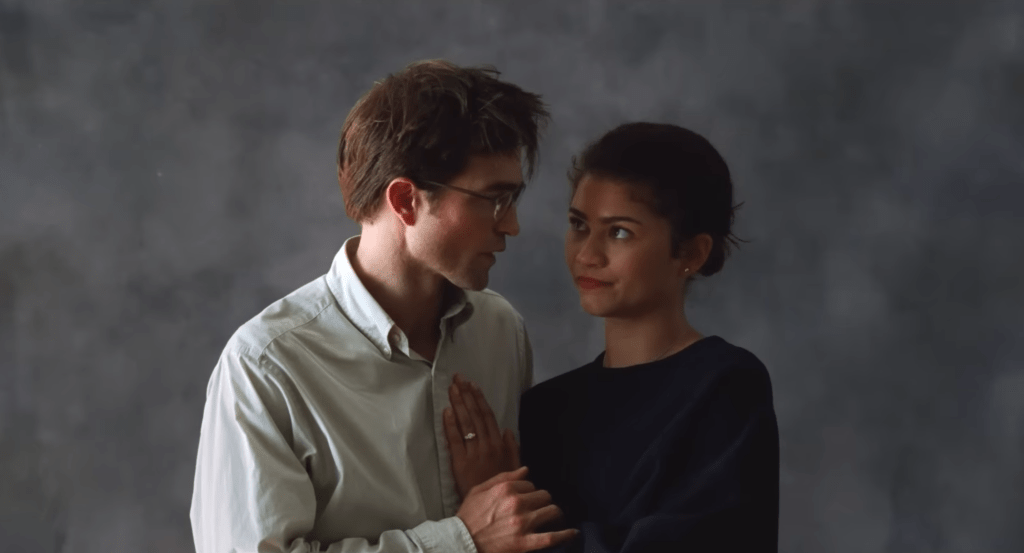
The Drama follows the soon-to-be married couple of Charlie (played by Robert Pattinson), a British museum director, and Emma (played by Zendaya), an American bookstore clerk, as they are getting ready for the wedding by practicing their wedding dance, writing their wedding speech declarations of love for one another, and wine-tasting. During their wine-tasting, which they partake in alongside both the best man (Mike, played by Mamoudou Athie) and the maid of honor (Rachel, played by Alana Haim), who just so happen to be a married couple themselves, they all take part in a game of telling each other the worst thing they’ve ever done. When it is, eventually, Emma’s turn, she, thinking it is a safe space, reveals her deepest, darkest secret. But then, after she’s told it, the vibe shifts drastically as Rachel, in particular, is deeply offended. Both shocked, but for different reasons, the engaged couple at the heart of the film now must figure out what comes next. Emma is concerned that she has irrevocably fractured her relationship, while Charlie grows increasingly uncertain about what type of person he is marrying, as questions come spilling out of him.
Though I’ll admit that I wasn’t head-over-heels in love, I greatly appreciated what Borgli was going for with his last English-language feature. Dream Scenario had a great concept and a really strong turn from Nicolas Cage. I thought that it ran out of steam towards the end of that film, but it was still a fascinating, reality-bending, you-have-to-see-it-to-believe-it type of film. I was particularly impressed by how it told a great narrative about both modern celebrity and, perhaps more importantly, the way other people perceive you (and how easy it can be to lose control of how other people see you). This last point seems to be a particularly important theme for Borgli, as his new wedding film is deeply rooted in performativity (of a wedding, of marriage, of relationships, but also how we frame events in our lives and how we react to things), lines you can’t uncross, and whether you can ever really know someone for who they really are (but also what that really means or if you even want to be fully known).
The Drama feels like such a cleverly designed Rorschach test for those who watch it, as the film invites you, during the film itself, to negotiate your own reaction to the secrets you hear. I think it may reveal a lot about you when it comes to which character you feel the most sorry for, which deep, dark secret you think is the worst, and how much of a difference it makes whether you actually did something or merely considered it, thought about it, planned it, were fascinated by it, and whatnot. It could have you consider your own answer to the centerpiece ‘game’ that the two couples play, but it will make you think about what your own boundary is, or where your relationship revelation red line is. I wouldn’t be surprised to learn that Borgli wants to make a space for himself in the group of renowned but divisive Scandinavian provocateur filmmakers (like Ruben Östlund and Lars Von Trier). With this American-set, English-language Scandi-provocation, Borgli reveals himself to be mischievously interested in cinematic secret-keeping, the performances that go into abiding by social norms, and controlling the narrative. It’s fascinating to see this type of film come out as a lavish April release, because it has all the ingredients of an awards season release or a film festival conversation starter.
It is toe-curlingly and awkwardly funny, uncomfortably disturbing, and playfully cut together. One of my biggest laughs here was seeing how unknowingly inappropriate the wedding photographer’s choice of words was, but there is also something to be said for Borgli’s clever use of imagination and flashback (these definitely aren’t always funny, but when they are, it’s really effective). Borgli plays around with perspective, as he blurs the line between imagined reality and the actual goings-on (and trusts his audience to read it correctly), for example, in the scene where Emma imagines Athie’s character making an aggressive suggestion to Charlie as a solution to resolving things. This is most effective when we see Charlie imagine himself looking dead inside as he walks around with a younger version of Emma (played by Jordyn Curet), i.e., because he now sees her as her younger self who ‘did’ the worst thing she’s ever done, or when we see the younger version of Emma struggle with computer and webcam updates in flashbacks. Borgli and editor Joshua Raymond Lee also do this smart thing where, in certain scenes, they have all the noise of the public fall away so that you have to make up your mind as to whether this is solely an indication that we’re listening from Emma’s perspective (as she is deaf in one ear) or if this is actually a rom-com appropriate choice to indicate that all they see (and hear) is each other.
The film wouldn’t work as well as it does if it weren’t for the performances that the actors at the center of the film turn in. Zendaya is really good as the female lead, even though she doesn’t get as much to do as Emma, as I thought she might when I first saw the trailer. She plays the guilt, the shame, and the paranoia of her character really well. Alana Haim turns in the most memorable supporting performance with a piercing, judgmental stare and the way she delivers her character’s anger with stinging venom. But this really is Robert Pattinson’s film, and he makes the most out of it. After his time in the Twilight films, the dashing Brit has made many fascinating career and performance choices, as he has taken on crazy accents (to extremely entertaining effect), fascinating and unforgettable indie projects, and roles that have changed many people’s perspective on him. Although he doesn’t do any inventive and novel accent work here, he fully embraces the cringe-comedy aspect of the film and the tortured, jittery aspect of his character. Seeing him crumble into pieces, make chaotic shifts in confidence in multiple scenes, and negotiate how he should feel is extremely entertaining because Pattinson plays it so perfectly. If you didn’t already think he was a fascinating actor, this performance should win you over. Fans of his will find plenty to chew on.
I think there is a good chance that some people will take offense to Borgli’s rom-com ‘cringe’ and somewhat satirical approach to a deeply serious subject matter that I can’t really reveal without going into spoilers, which I’d rather not (even though this is less of a twist and more of an early revelation). Those feelings are valid, but I don’t personally find his approach to be as ruinous to the film as others may. I do have some issues with the film. Although, unlike with Dream Scenario, I don’t think the film runs out of steam, it does get very close to stretching the premise beyond its limits when it becomes full-on cringe comedy in the final act. I don’t necessarily think the switch in focus to someone else’s secret, which happens here, is a flaw (I think it is all a part of Borgli’s viewer’s Rorschach test), but it does feel like it becomes a slightly different movie. I would’ve liked for Borgli’s film to do a little bit more with Zendaya’s character beyond the revelation scene than it ultimately does. I think it is fair to say that even though it textually comments on the identity characteristics through a couple of lines of dialogue in certain scenes (e.g., the great scene where Charlie confronts the maid of honor with the potential of there being cultural differences, or in one of the Emma flashbacks when her acquaintances propose that she has the better ‘face’ for the campaign), more could have been done here to make it an even richer and more incisive text by giving more weight to certain characteristics.
Because of its more disturbing and cringe-comedy elements, it definitely isn’t your average pre-wedding jitters rom-com. Rather, it felt to me like a darkly comedic and fascinating thought-experiment (or Rorschach test, as I’ve put it elsewhere in my review) that made me think of everything from American sociologist Erving Goffman’s dramaturgical analysis of human interaction (front stage, back stage, etc.) to the Danish saying “tanker er toldfri,” which essentially means that thoughts are free (technically, the more literal translation would be duty-free). The Drama is a step up in pretty much every respect from Dream Scenario for Kristoffer Borgli, as this particular concoction of genre-bending Scandi-provocation is both thought-provoking and quite entertaining. It also helps that it contains a fantastic Robert Pattinson performance that further cements him as one of the most interesting thespians of his generation.
8.5 out of 10
– Review written by Jeffrey Rex Bertelsen.

 I'm Jeffrey Rex