
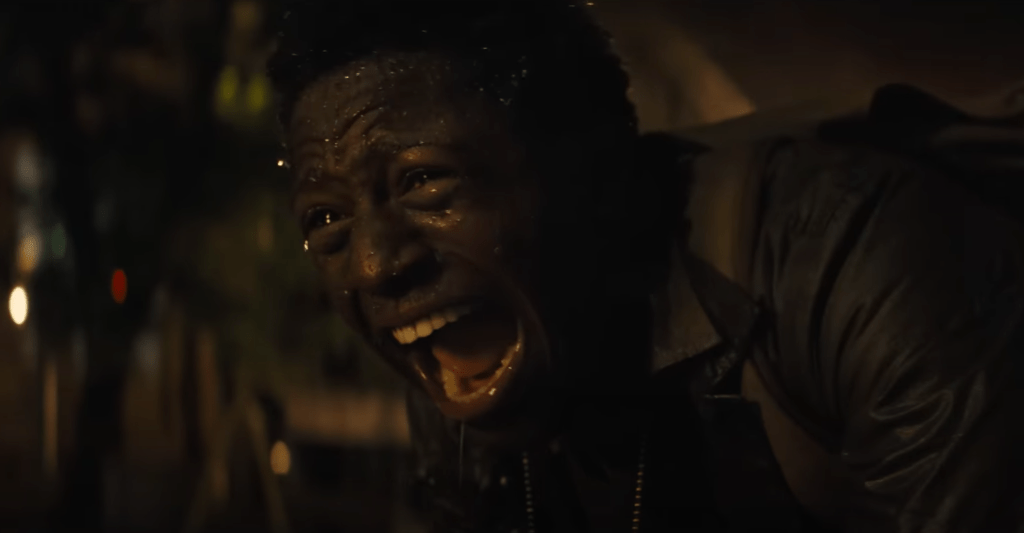
Directed by Francis Lawrence — Screenplay by J.T. Mollner.
Based on the 1979 Stephen King novel of the same name (published under King’s pseudonym Richard Bachman), Francis Lawrence’s The Long Walk is set in a dystopian America under a totalitarian military regime, which holds an annual event referred to as, you guessed it, ‘the Long Walk.’ During this event, fifty young men, one from each state, must take part in a coordinated walk of potentially hundreds of miles, while they’re escorted by the military, which also broadcasts the event live. Those who stop walking, or fall below a dictated pace, will receive three warnings (that eventually replenish) and, should they fail to get back to the right pace in time, be executed. The event will only end once a sole victor remains left standing and alive, and the winner will receive not only an overwhelming cash prize, but also a single wish that the regime must grant. Lawrence’s film follows Maine-born participant Ray Garraty (played by Cooper Hoffman), who quickly befriends a group of young men led by the charismatic Peter McVries (played by David Jonsson). However, we soon learn that there is a secret reason why Ray is taking part in the event.
Although I can’t say that I’ve read the book on which it is based, from what I understand, the central metaphor was supposed to be about the Vietnam War, and the futility of signing up for potentially false promises, only to see the people you sign up with and befriend die in the process. At the same time, and speaking to more universal connections, I think it’s pretty obvious that the film speaks to the central metaphor that, in certain nation-states, even stepping out of line or disrupting the flow, even daring to halt the processes slightly, is not allowed or tolerated. In the film, they specifically mention that in the world of the narrative, there’s an epidemic of boredom, there’s a focus on censorship, and we see, from the beginning, the next generation being sacrificed. There are even hints here and there that Mark Hamill’s military antagonist, known only as the Major, is, at least in part, inspired by current political movements (I believe they talk about making the country great again, though with slightly different words). For as much as it may sound didactic, I didn’t find this film to be that. Sure, its central metaphor isn’t the most subtle thing in the world, and its political aspirations are also pretty obvious. But at the same time, I thought that the film did a good job of telling a story about how we only have each other. For as much as this film is bleak, there are also little drops or glimpses of a light at the end of the tunnel, in the distance. It’s a film about a lie in the capitalist American dream, propped up so the next generation can be treated like cannon fodder, but, at the same time, Francis Lawrence manages to insert some hope, some love, and some friendship into this film that makes it, frankly, touching in moments. Although parts of the film can be repetitive, I still found it to have a beating heart, and it did get me choked up for a minute.
But it really must be said that, for as good as the movie is, it is still a one-track, somewhat monotonous film. You know exactly what it’s gonna be from the moment you sit down in the theater to watch it, and it doesn’t ever really change, other than for one or two flashbacks. Whether or not that monotonous quality will be a dealbreaker for you will be up to you, but I can understand if you find this film to be less cinematic than you imagined. For me, the film overcame its repetitive, monotonous quality by virtue of the strength of the central performances carried out by David Jonsson and Cooper Hoffman. Jonsson’s charismatic and hopeful performance occasionally manages to pierce through the pessimism of the film, and Hoffman is equally engaging. They partake in rich conversations that give weight to the supporting cast and help them to make fully formed characters of their roles. The film rests on their shoulders, and they shine in the process. I’ll admit that I expected a little bit more from Mark Hamill‘s antagonist role, though he really is only given a one-note character to work with. He becomes quite stereotypical, and it borders on unbelievably rigid and cartoony in his villainy. As for the horror in the film, the kills are absolutely brutal. It doesn’t care how sweet or small any character may be; the film will almost always extinguish them with a cruel, depressing, and cold severity. I found it to be particularly hard to take when characters briefly expressed parts of their character that we had not gotten the chance to learn enough about in their final moments onscreen. It felt like someone was being taken away from us, and with them their whole world.
There’s a lot to like about Francis Lawrence’s The Long Walk, and, while I liked a great deal about it despite its monotonousness, I will say that I found the ending to be a mixed bag. I can see what they’re going for, but the feeling that it leaves you with as the film comes to a close is not one that I would classify as satisfying in any respect. Here at the end of the review, I do want to comment on the fact that it feels so perfect for them to have gotten Francis Lawrence, the director of four (soon to be five) Hunger Games films, to direct this film, from a script by the Strange Darling writer-director, but it must be said that this film is not nearly as cinematic or dynamic as those films. Rather, it felt more like a Stephen King adaptation that, a few years ago, might’ve gotten a home on a streaming service rather than a big screen release. That doesn’t mean it’s bad, it just means that I think it may have a harder time winning over your average theatergoers than your average theatrically-released horror movie. That said, I think you should give this a chance, so long as you’re willing to meet the film on its own terms.
7 out of 10
– Review written by Jeffrey Rex Bertelsen.

 I'm Jeffrey Rex