
Directed by Jacques Audiard — Screenplay by Jacques Audiard.
As was already evident based on Julia Ducournau’s Titane and Coralie Fargeat’s The Substance, modern day French filmmakers sometimes gravitate toward these ambitious and unique films that defy genre conventions and classifications (and that are difficult to describe to acquaintances without getting strange looks) with great success. Un Prophet and Dheepan director Jacques Audiard, a Palme d’Or winning filmmaker, had similar aspirations recently with his Emilia Pérez, which is arguably most succinctly described as a gender transition musical crime film (mostly set in Mexico and mostly in Spanish) despite the fact that it contains even more sides than even that brief description encompasses. Emilia Pérez has already earned Audiard and his cast plenty of awards attention including the Jury Prize and Best Actress award (for its four female principal actresses) at the Cannes film festival. Nonetheless, the film has also been met with criticism from both Mexican audiences and the LGBTQ+ community. Setting aside all of the praise and all of the controversy, how good is the actual film itself? Well, let’s have a look.
Based on Boris Razon’s novel Écoute, and originally intended as an opera libretto, Jacques Audiard’s Emilia Pérez follows Rita (played by Zoe Saldaña), an underappreciated Mexican-based lawyer, who is taken as hostage by, confronted by, and hired by a dangerous male cartel lord (played by Karla Sofia Gascón), who needs Rita’s help to set in motion the process for the crime lord to undergo gender-affirming surgery as the criminal identifies as female. Years later, the crime lord, who has staged their own death, has now completed the transition and now calls herself Emilia Pérez (also played by Gascón). The titular character reconnects with Rita, as she wants to go back to Mexico to be with her wife (Jessi, played by Selena Gomez) and children again, none of whom know about her gender transition. Emilia presents herself as the crime lord’s wealthy cousin, but, since Jessi does not recognize Emilia (or know of this supposed cousin), Jessi finds the entire arrangement to be strange, and soon she begins to desire another life for her and her children, which angers Emilia.
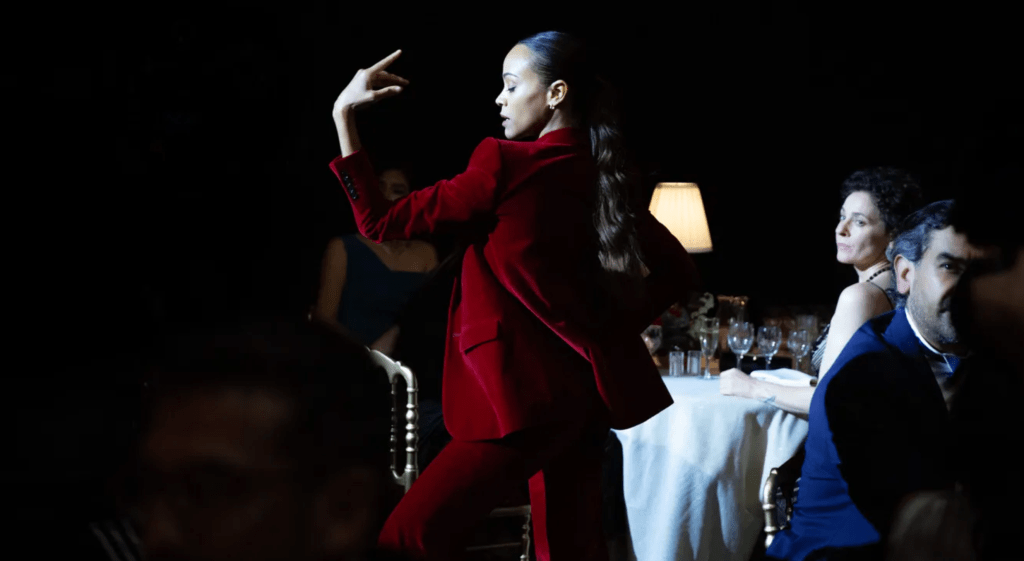
Emilia Pérez is a lot to take in. It is ambitious, audacious, and unique. It presents itself with a transgressive genre-fluidity and a tonal-balancing act that, although easy to respect on paper, is, frankly, hit-or-miss. Comparisons that liken it to a blend of Sicario and Ms. Doubtfire but with a transgender focus are not as wide off the mark as they may sound, but Audiard’s film is nowhere near as good as those films, frankly. When what Audiard is going for hits, it feels like an important and powerful film. However, when Audiard misses the mark even slightly, it results in baffling scenes and musical numbers that are goofy or outright insensitive. As such, whether you like the film or not, it is unquestionably somewhat messy. There can be both great musical films with subpar songs and choreography, as well as subpar musical films with great songs and choreography (with The Greatest Showman being an example of the latter of those two descriptions). But if you are someone who thinks a musical film is only as good as its music and its choreography, then you likely won’t find Emilia Pérez to be quite what you’re looking for. The film contains a great many musical numbers, including several superfluous and unmemorable songs. Some of these songs appear almost as if they’re included so as to function as a substitute for thematic depth, while some are basically just characters singing their speaking lines in scenes that only sometimes work. Again, while there are goofy musical numbers, there are, admittedly, also occasionally strong efforts that either showcase character vulnerability, emotion, or, intensity. The best of these musical numbers features Zoe Saldaña dancing provocatively and rapping in between, and on top of, tables.
Zoe Saldaña and Karla Sofia Gascón are essentially co-leads, and, though the writing for their characters isn’t quite up to scratch, their performances are by far some of the film’s best elements. Saldaña is especially good in the film’s first act and in select musical numbers. Saldaña is easily the central actress who comes across the best in the musical numbers due to her commitment to the choreography. Gascón, who is making waves as the first transgender actress to win awards at several notable awards ceremonies, also gives all of herself to the film, which she is clearly passionate about. Gascón plays both the pre- and post-transition versions of the character and she does a good job of communicating them both. The performance delivered by Selena Gomez, who is arguably the most well-known of them all, doesn’t come across as well as the film’s co-leads, and you get the feeling that she may have been miscast. Though, to be fair, her character is quite underwritten given her influence on the overall plot.
The film has been criticised for both cultural appropriation and for its portrayal of gender transition, and I urge you to seek out those think pieces, reviews, and essays from writers that are more knowledgeable about the transgender experience and about the culture that Audiard presents. That said, what I will say is that the film peaks early (arguably even before the title character returns to Mexico) and that it suffers from a general tendency to be superficial about its themes and subplots (including a subplot involving an NGO to benefit victims of the cartel). As if that wasn’t enough, the characterisations leave a lot to be desired, as you don’t get a complete idea of character interiority for its leads. Because of this inadequacy of characterisation, the arc of the central character towards being more of a celebrated, front-facing personality feels unearned.
On the whole, though it is not without its strengths — e.g. some scenes’ visuals and, in general, the central performances of its leads — Jacques Audiard’s Emilia Pérez is a bit of a mixed bag. Audiard swings for the fences with his film’s audacious genre-fluidity, but it lacks the depth required to live up to the incredible potential of its unique premise.
6 out of 10
– Review Written by Jeffrey Rex Bertelsen.

 I'm Jeffrey Rex