Awkwafina and Sandra Oh in Jessica Yu’s Quiz Lady — PHOTO: 20th Century Studios.
Directed by Jessica Yu — Screenplay by Jen D’Angelo.
Jessica Yu’s Quiz Lady follows Anne (played by Awkwafina), a young woman with social anxiety and an obsession with a certain game show named ‘Can’t Stop the Quiz.’ One day, she is informed that her mother has fled the home that she was in and left for Macau presumably to gamble and get out of her gambling debt in America. This information also reaches Anne’s older sister Jenny (played by Sandra Oh), who is a decidedly more outgoing party girl, and they reconnect for a few days. On one of those days, Jenny secretly records and uploads a video of Anne watching her favorite game show. It becomes an instant hit online as Anne knows every single answer to every single question.
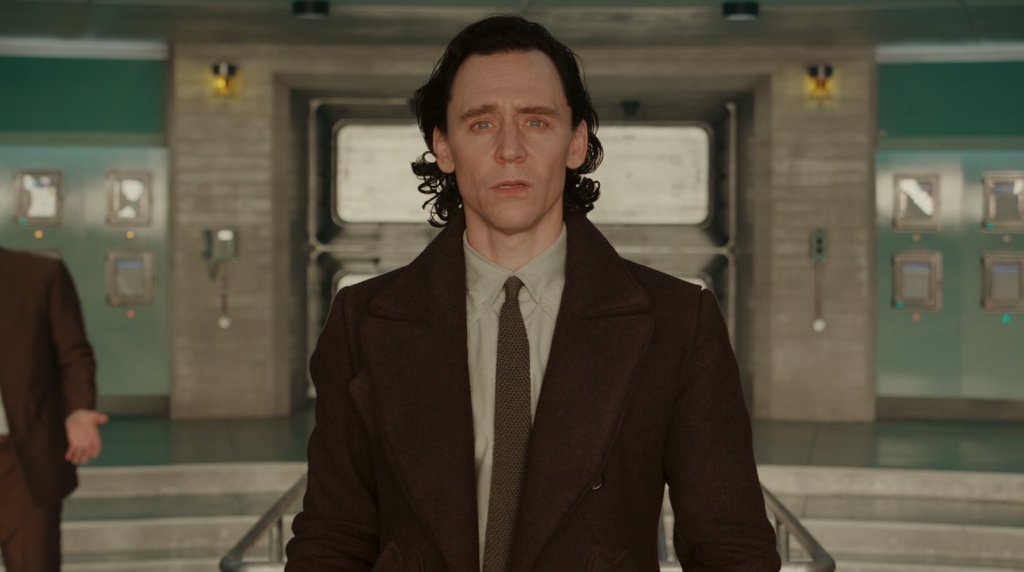
It’s no secret that since the launch of Disney+ required Marvel Studios to produce a litany of superhero series, the Marvel Cinematic Universe has been in a bit of an identity crisis, which is also partly due to how the Marvel films in the post-Avengers: Endgame era haven’t always felt like they were pushing the overarching story forward in exciting ways that also spoke to its characters and their growth. There are always exceptions — like Guardians of the Galaxy Vol. 3 on the film side or Wandavisionon the streaming series side — but Marvel Studios has lately been feeling like it’s been stuck in mud, with the release of the star-studded but already forgotten Secret Invasion, which crash-landed, being a notable attempt that failed to really find an audience or audience excitement. Because of all of this it feels really good to be able to say that Loki: Season 2 is a return to form for Marvel — it’s a great show and one of the very best things that’s been put out by Marvel Studios since the release of the outstanding Avengers: Endgame.
In October, Francesca Scorsese, whose father is the legendary Oscar-winning American filmmaker Martin Scorsese, posted a fun video on the social media application TikTok in which Martin Scorsese jokingly and playfully directs the family dog named ‘Oscar’ through an ‘audition’ for ‘a role.’ Explaining jokes defeats the purpose of the joke, but, for the purpose of this article, I should stress that the joke has nothing to do with the dog’s name — rather what is so funny and charming about the video is, first, the reveal that he’s talking to a dog, and, later, the family dog’s responses (or lack thereof) to his direction. I, and many others in the online film community, enjoyed the video quite a bit. Then, sometime thereafter, frequent Marvel collaborator and Avengers: Infinity War co-director Joe Russo posted a video response to Instagram, in which he said that he, too, has a Schnauzer as a pet, and then he makes note of the Scorsese family dog’s name before announcing that it’s ‘cute,’ but his dog’s name is Box Office.
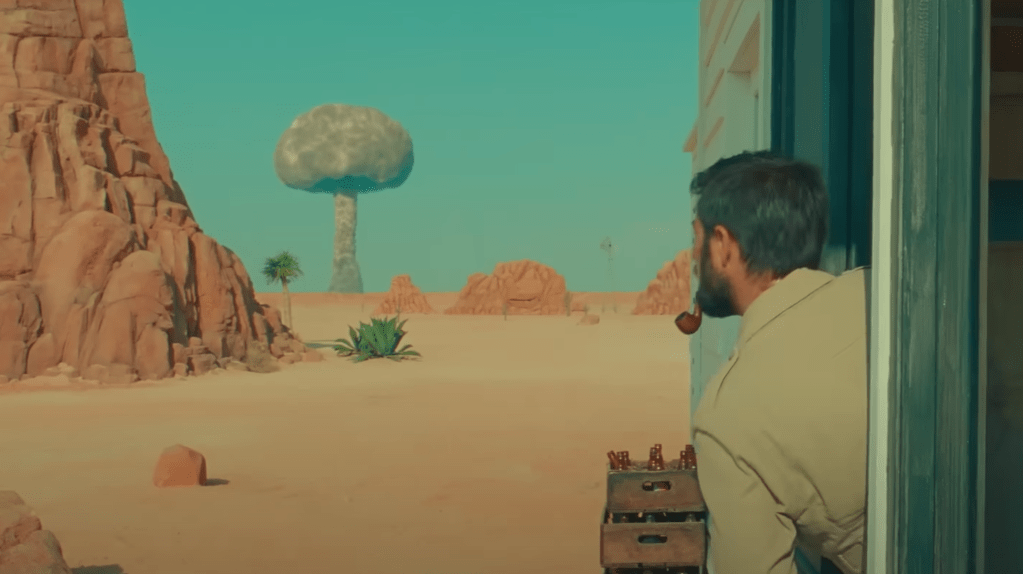
Jason Schwartzman’s Augie Steenbeck leaning out of a window in Wes Anderson’s ASTEROID CITY — PHOTO: Focus Features / Universal Pictures International.
Directed by Wes Anderson — Screenplay by Wes Anderson — Story by Wes Anderson and Roman Coppola.
Everyone who has ever seen one Wes Anderson film knows exactly what a Wes Anderson film looks like. His signature style has made him a lot of fans and admirers over the years, and it has also earned him some notable imitators. Nowadays, with the advent of AI, automatically generated images, and the like, a trend of recreating fake film trailers in the style of Wes Anderson has surfaced. You can now go online and find several videos hyping up fake Wes Anderson-style films with AI-generated images of well-known actors that don’t exactly look right (I even saw one for a fake American adaptation of the iconic Danish Olsen Gang films). With the emergence of such artificiality leading to so many conflicting emotions, might I suggest that you check out the real thing? Asteroid City, Wes Anderson’s eleventh feature-length film, is well worth seeking out. As a matter of fact, I think it might be one of his best.
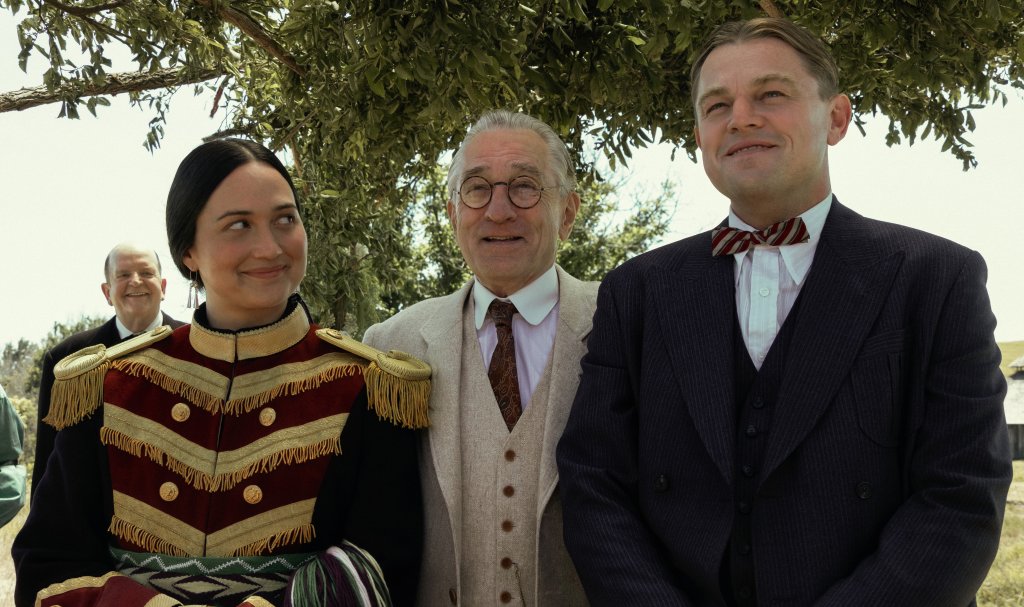
Recently, I’ve been especially interested in how films sometimes act as history lessons to those who watch them, as well as how this can both be a good and a bad thing. Ultimately, films can be made for a variety of purposes depending on which person involved with the project that you’re asking. With films, there is often a commercial goal or an interest in serving as a piece of entertainment, and these aims can sometimes lead to historical films blurring the lines between truth and fiction to such an extent that you do history a disservice. Other times artistic expression is of the utmost importance, and then, of course, there are, indeed, times when films primarily exist to inform and teach. Most of the time, though, the true purpose of a film is a mixture of all of these motivations. Sometimes the artistic expression combines with a purpose to inform and thus the output manages to stand as a reminder of how certain events have been swept under the rug through history by those in power. Because ultimately history books are as easy to manipulate as any other medium. In the case of Killers of the Flower Moon, we have a piece of historical filmmaking that takes an intense look at the moral rot of America in the 1920s and 1930s. It is a bold and epic film about greed, betrayal, complicity, and a disturbingly very real attempt at genocide. It is an American tragedy from a master storyteller who shows for all to see that he understands exactly what his role is in telling this story, as well as who should be telling it.
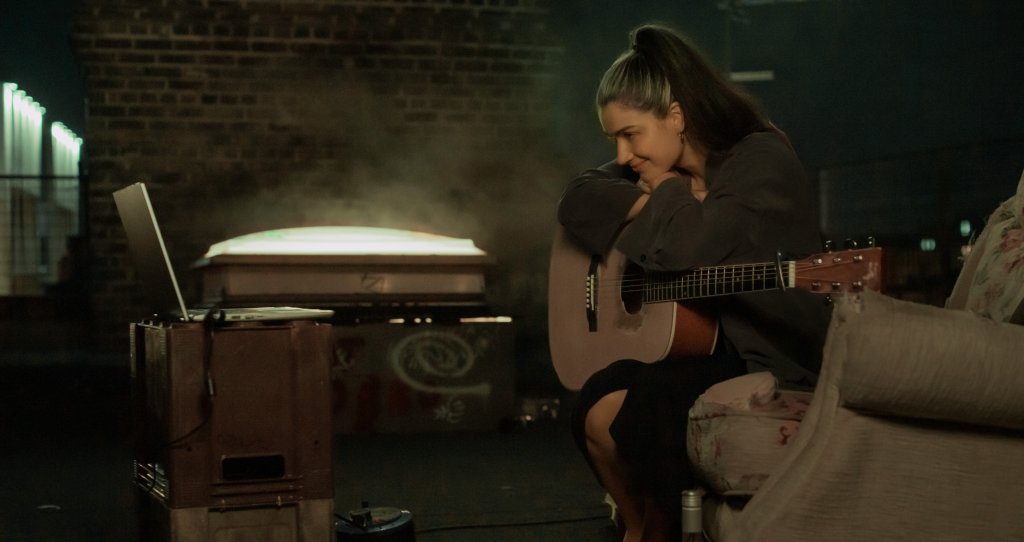
Eve Hewson in “Flora and Son,” now streaming on Apple TV+.
Directed by John Carney — Screenplay by John Carney.
Set in Dublin, Ireland, John Carney’s Flora and Son follows the titular characters — Flora (played by Eve Hewson) and her son Max (played by Orén Kinlan) — as the struggling mother makes an effort to grow closer to her son, who is on the wrong track and on the bad side of the law. Flora, who had her son when she was in her late teens, feels like life has passed her by. She doesn’t have a good relationship with her rebellious son or his father (played by Jack Reynor), and all she has to look forward to is going to a local nightclub to dance, drink, meet men, and start all over again. In an attempt to reach out to her son, she finds an old guitar in a waste container, has it restored, and presents it to her completely disinterested son. Flora decides to take part in online guitar lessons with Los Angeles-based Jeff (played by Joseph Gordon-Levitt), whom Flora is instantly smitten by. As the film goes forward, Flora and Max’s growing interest in music brings them closer together.
(L-R) Haunted Mansion (Walt Disney Studios Motion Pictures); Guy Ritchie’s The Covenant (Metro-Goldwyn-Mayer); Clerks III (Lionsgate); Mainstream (IFC Films); and Red, White, and Royal Blue (Amazon Prime Video).
In this edition of Additional Bite-Sized Reviews, I take a look at a handful of films that I checked out over the last couple of months. These films were interesting enough for me to have formulated notes about them that never materialized into extensive singular reviews — instead, here they are in bite-sized form. Are any of these worth your time? Well, let’s have a look.
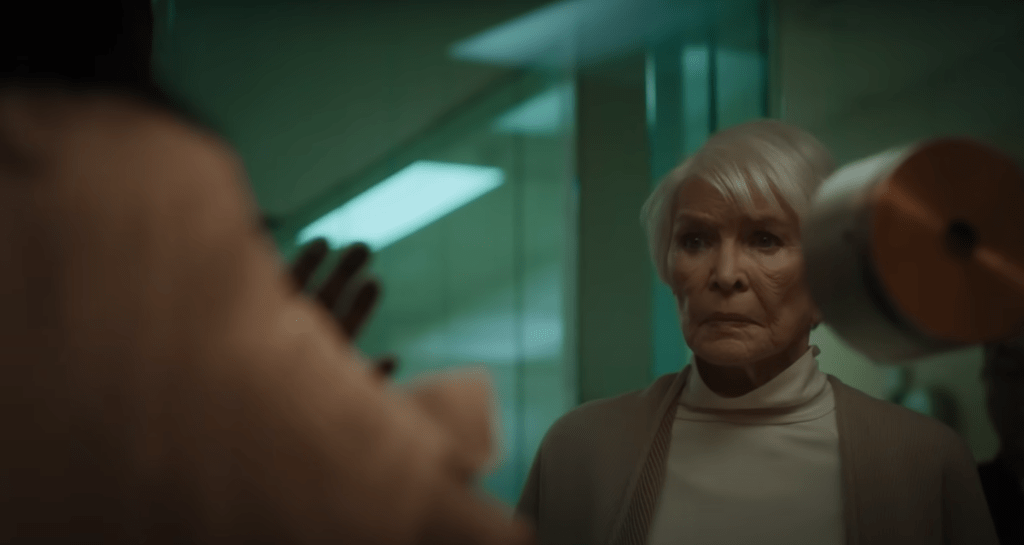
Ellen Burstyn in David Gordon Green’s THE EXORCIST: BELIEVER — PHOTO: Universal Pictures.
Directed by David Gordon Green (Halloween (2018); Halloween Kills; Halloween Ends) — Screenplay by Peter Sattler and David Gordon Green — Story by Scott Teems, Danny McBride, and David Gordon Green.
Based on the 1971 William Peter Blatty novel of the same name, William Friedkin’s 1973 film The Exorcist is often cited as one of the scariest films ever made. It is a brilliant film with unforgettable imagery, lines, and performances. Though what constitutes as being scary is ultimately subjective and can change over time, I think everyone with a working understanding of film history would agree that it is a culturally significant and iconic work of filmmaking that frightened audiences back then and, frankly, still does. Through sequels, attempts to recapture the immense power of The Exorcist largely failed. The original direct sequel Exorcist II: The Heretic is largely regarded as one of the worst films ever made, and attempts to make a prequel in the mid-to-early 2000s led to two versions of the same film, neither of which are remembered favorably. The one and only time it has worked — at least to some of us — to carry on with The Exorcist on the big screen was in 1990 when William Peter Blatty stepped behind the camera to craft a sequel with The Exorcist III, which features the always watchable George C. Scott in a lead role, as well as an unforgettable and effective jump-scare. Now, in 2023, studio heads have spent $400 million to distribute a sequel trilogy starting with this film, The Exorcist: Believer, from director David Gordon Green, who famously directed the recent Halloween sequel trilogy, which, like with this film, was also a Blumhouse-Universal collaboration. Now, while I wanted to like it, Green’s Halloween trilogy was a pretty significant disappointment to me. Similarly, I really wanted to like The Exorcist: Believer, but it, ultimately, doesn’t do enough to set it apart from other films like it. It’s a disappointingly inert start to the Exorcist sequel trilogy.
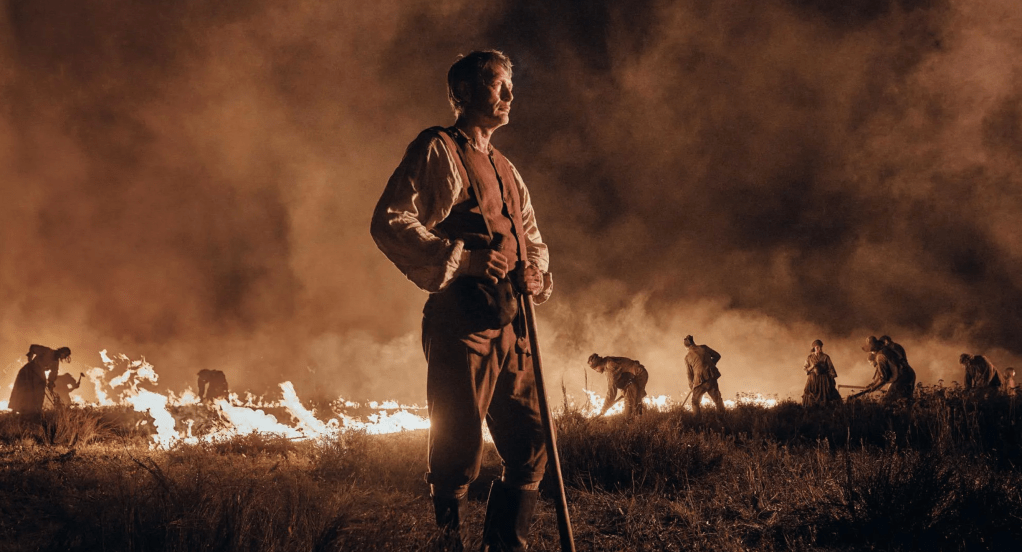
Mads Mikkelsen as Ludvig Kahlen, an impoverished soldier who desires nobility, in BASTARDEN // THE PROMISED LAND — PHOTO: Henrik Ohsten / Zentropa / Nordisk Film.
Directed by Nikolaj Arcel — Screenplay by Nikolaj Arcel and Anders Thomas Jensen (Retfærdighedens Ryttere).
Titles can be tricky. Titles are obviously an essential part of marketing as they clue audiences in on what they can expect to see. A poster can be manipulated. A trailer can be manipulated. But more often than not titles mean something to the creatives who worked on the film. Then, of course, there are International titles. In the case of this Danish historical epic, its original title is Bastarden, which literally means ‘The Bastard,’ but it is known internationally as The Promised Land. Frankly, both titles feel accurate. Then, of course, there is the title of the source material, which is a Danish historical novel from Ida Jessen titled The Captain and Ann Babara (originally Kaptajnen og Ann Barbara in Danish). Internationally, distributors went with The Promised Land, which I honestly think is a bit of a mistake as it is such a generic title that has been used over and over again. Now, The Bastard isn’t exactly completely original. Still, it feels less conventional and speaks to its two principal opponents, a person born out of wedlock and his despicable antagonist. Regardless of which title you find it under, this Danish epic is one that I highly recommend, as it features strong performances, gorgeous photography, and a fair bit of violence which keeps this period piece from ever feeling stuffy.
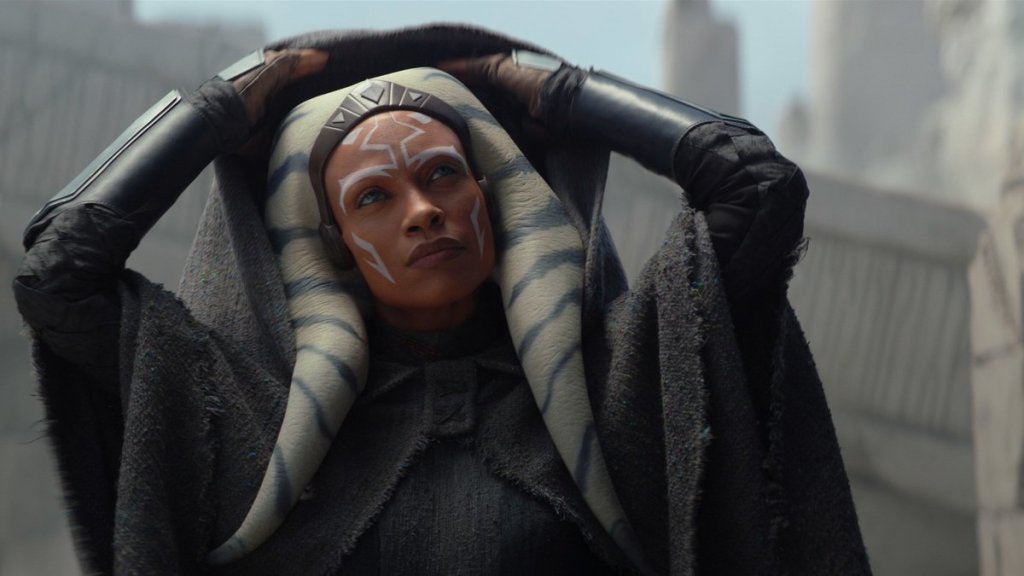
Rosario Dawson as Ahsoka Tano in AHSOKA — PHOTO: Disney+ / Lucasfilm.
Series created by Dave Filoni — Episodes directed by Dave Filoni, Steph Green, Peter Ramsey, Jennifer Getzinger, Geeta Vasant Patel, and Rick Famuyiwa.
Ever since the now-Disney-owned Star Wars franchise ended its sequel film trilogy to mixed reception in 2019, the stories about a galaxy of heroes set a long time ago have had its live-action portion relegated to streaming television, even though its films once revolutionized and forever changed Hollywood. On the one hand, it makes sense to try to grow the franchise on the small screen and win over new audiences that may one day follow the lasersword-wielding heroes back to the big screen. However, what I find to currently be the case is that rather than telling bold new stories to gain a new audience on the small screen, what the head honchos at Lucasfilm are doing is, instead, servicing die-hard fans. Now, this isn’t necessarily a bad thing if the shows are executed at a relatively high level, but, more often than not, what we have been getting are these almost vapid easter-egg-filled series that either don’t have enough meat on the bone to justify a full series (and thus ought to have been a film instead) or a series that doesn’t have enough episodes to have complete and rich story and character arcs.




 I'm Jeffrey Rex