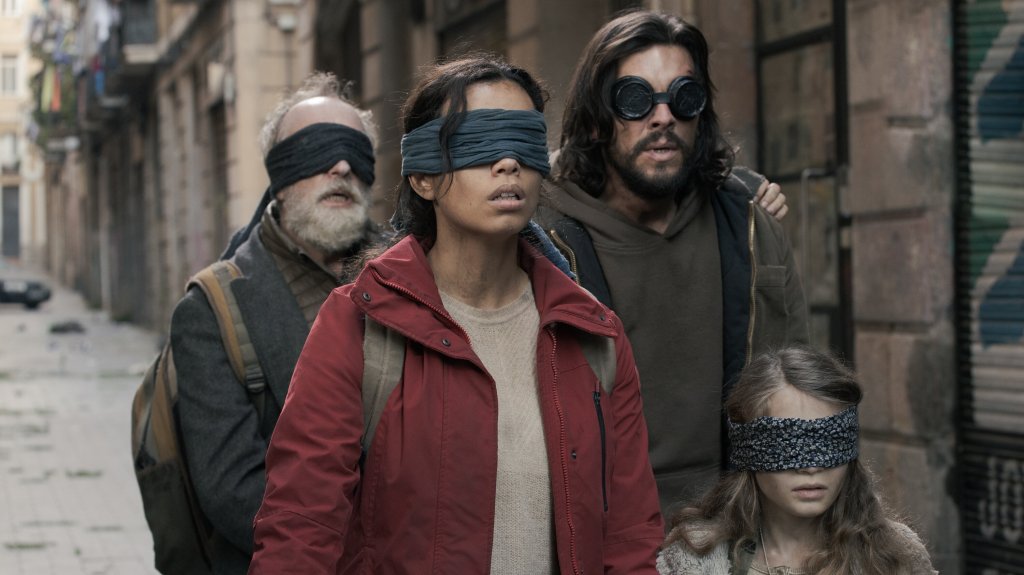
(L-R) Gonzalo De Castro, Georgina Campbell, Mario Casas and Naila Schuberth in BIRD BOX BARCELONA — PHOTO: Andrea Resmini / Netflix.
Directed by Álex and David Pastor — Screenplay by Álex and David Pastor.
In the late 2010s, sensory-based apocalyptic horror-thrillers were all the rage. John Krasinski’s A Quiet Place (2018) was a box office success, spawned a sequel, and was Oscar-nominated. Susanne Bier’s Bird Box (2018) was met with mixed reviews but was still a massive hit for Netflix yet it also inspired a hazardous and controversial social media blindfold challenge. Then there was something like John R. Leonetti’s The Silence (2019), which was another Netflix release, but Leonetti’s film was quite rough in most ways. Well, now Netflix has decided to cash in on the brand recognition of Bird Box by releasing its first sequel titled Bird Box Barcelona, a mostly Spanish-languaged spin-off that I don’t think has all that much new to say, unfortunately.
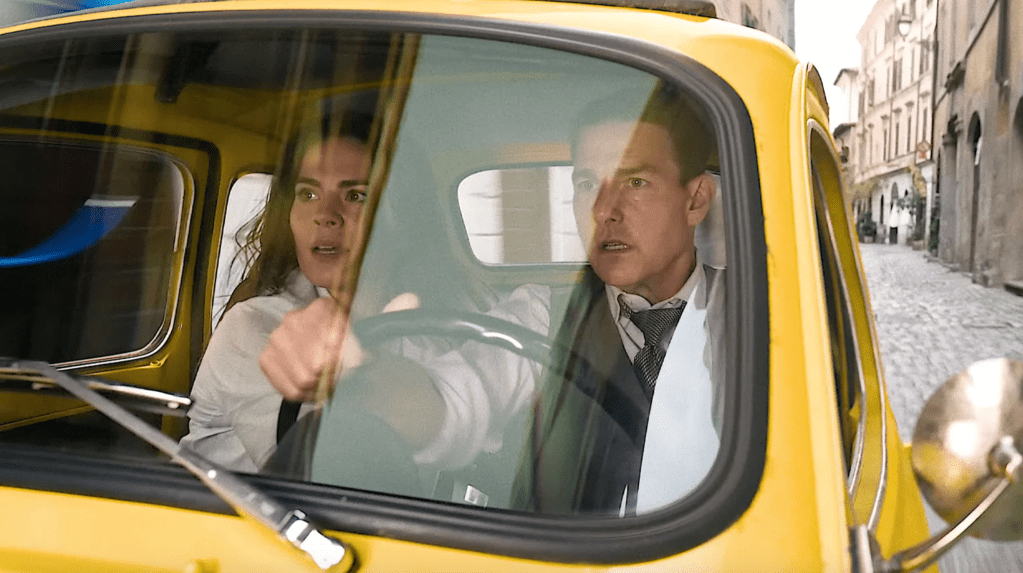
Hayley Atwell and Tom Cruise driving a yellow Fiat 500 through Rome in MISSION: IMPOSSIBLE – DEAD RECKONING, PART ONE — Photo: Paramount Pictures.
Directed by Christopher McQuarrie (M:I – Fallout) — Screenplay by Christopher McQuarrie and Erik Jendresen.
During, and in the immediate aftermath of, the COVID-19 pandemic, certain films tried and failed to bring loads of people back into theaters. When all else — including a pretty good and underappreciated Christopher Nolan film — failed to win back the moviegoing audience, Tom Cruise, in true Ethan Hunt fashion, accepted the mission to ‘save cinema.’ And, well, he sort of did. His and Joseph Kosinski’s Top Gun Maverick (in which Cruise’s hero, in a way, sets out to prove that human beings are more capable than unmanned fighter aircrafts) was such a hit that Steven Spielberg reportedly proclaimed that Tom Cruise, now 61 years of age, “saved Hollywood’s ass,” and that his film might have “saved the entire theatrical distribution.” “Is there anything Tom Cruise can’t do?” you might ask. He seems adamant to test that question out with the awe-inspiring stunts that he insists on doing each and every time he headlines a major motion picture nowadays. Now, with Mission: Impossible – Dead Reckoning, Part One, Tom Cruise, the savior of the theatrical industry, is back as Ethan Hunt, the IMF agent and so-called living manifestation of destiny, and this time he wants to fight back against AI and algorithms (some might even suggest he’s up against streaming algorithms, thus taking that saving cinema allegory even farther). That’s right, it’s the second Tom Cruise film in a row to be about a man fighting back against technological advancements, and, once again, it doesn’t disappoint. This movie is a lot of fun.
Jeremy Strong, Sarah Snook, and Kieran Culkin in HBO’s Succession — PHOTO: HBO.
It has been more than a month since Jesse Armstrong’s Succession, a highly addictive Shakespearian family comedy-drama, came to an end. Though I watched it week-by-week as it aired and even though I could’ve reviewed it right after the season finale was released, it never felt right to me to talk about this season of the show without actually diving in and talking about how the details of the season, how the ending of the show, and how its showstopping third episode all made this season what it actually ended up being. That meant that I had to give it some room to breathe so as to not spoil the conclusion to what I think is honestly one of the best shows of its era. One might have feared that, as the show moved into its final season, perhaps they didn’t know how to end it, that they didn’t how to do something new with it, or that what had once been so compelling and energetic about it would dim as the curtain call had been announced. Not so. In fact, I think Armstrong’s series wisely went out on a high (and presumably on its own terms) with a final season that understood that it was time to keep the promise inherent in the show’s title. It was an inevitable move, but it was also a move that ended up being risky exactly because of how early in the season it happened. Succession‘s fourth and final season is an example of a showrunner and a writer’s room understanding fully the ins and outs of a show so as to deliver a tragic but inevitable conclusion that will stick with its viewers for quite some time.
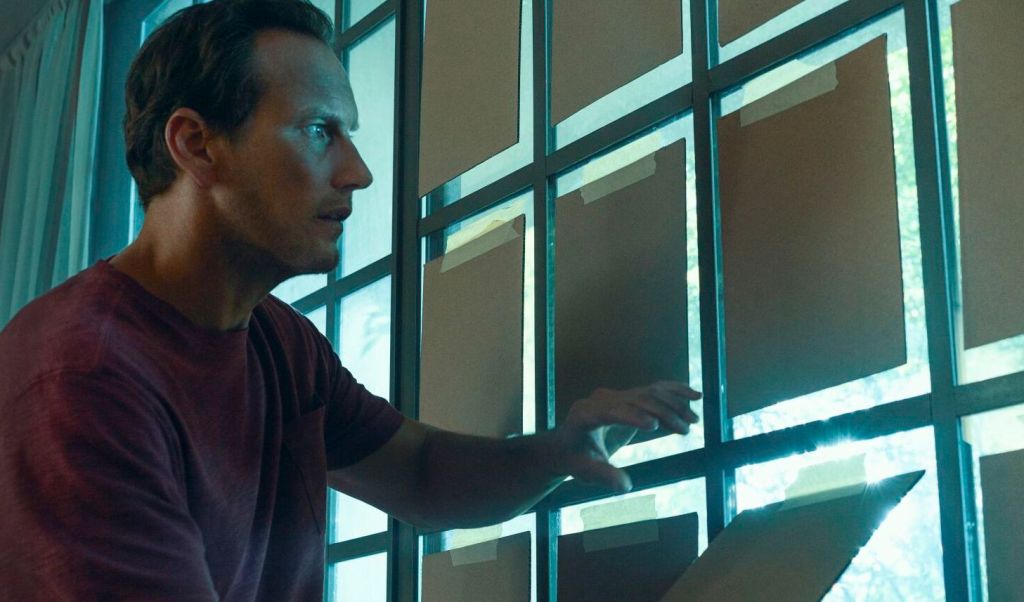
Patrick Wilson in Screen Gems’ INSIDIOUS: THE RED DOOR.
Directed by Patrick Wilson — Screenplay by Scott Teems — Story by Leigh Whannell and Scott Teems.
Insidious is just one of several horror film franchises kickstarted by modern horror icons James Wan and Leigh Whannell. Eventually, both Wan and Whannell have had to pass the director’s chair off to someone else whose job it is to not just continue the style of previous entries in these series but also someone careful and considerate enough to shepherd the values of the franchise. With 2018’s Insidious: The Last Key, the fourth film in the franchise, Wan and Whannell (who has a screenwriting credit on the film) passed the director’s chair to Adam Robitel, whose Insidious film was the second prequel film in the series, as well as the second prequel film in a row to abandon the Lambert family haunting in favor of focusing on the paranormal investigators and the psychic introduced in the first two films. But eventually, the Lambert family haunting narrative that Wan and Whannell made us so invested in with Insidious Chapters 1 and 2 (released in 2010 and 2013, respectively) had to continue. That’s where scream king and star of the original two films, Patrick Wilson, comes in — because he wasn’t just convinced to return in a significant role for the fifth and potentially final film, he also signed on for it to be his feature directorial debut.
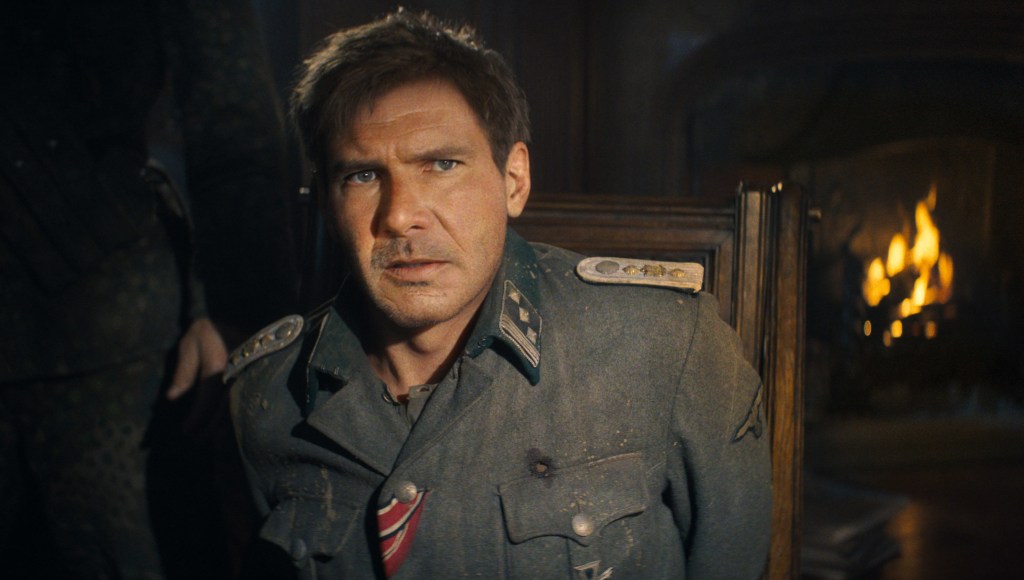
A de-aged Harrison Ford in INDIANA JONES AND THE DIAL OF DESTINY — PHOTO: Walt Disney Studios Motion Pictures.
Directed by James Mangold (Ford v Ferrari) — Screenplay by Jez Butterworth, John-Henry Butterworth, David Koepp, and James Mangold.
When it was first announced that Steven Spielberg was not going to direct this fifth and supposedly final Indiana Jones big-screen adventure, I’m sure I wasn’t the only one who was filled with a feeling of trepidation. After all, even though Indiana Jones and the Kingdom of the Crystal Skull — the fourth Indiana Jones film and the final of the bunch that was directed by Spielberg — was met with harsh criticism from vocal online parts of the fandom, it still occasionally has that infectious Spielbergian magic and bravura (and it isn’t as bad as its online reputation suggests). Lucasfilm instead lined up Logan and Ford v Ferrari director James Mangold to take over as director of a film that also wouldn’t have co-creator George Lucas as a credited screenwriter. So, these were definitely uncharted waters for Indiana Jones fans. It did feel wrong to see it go on without Spielberg and Lucas, but, based on his talent as a filmmaker and his excellent recent filmography, I honestly trusted James Mangold to be the steady hand this endeavor needed. Having now seen the film, I can say that while you definitely feel Spielberg’s absence, Mangold has managed to make a genuinely affecting action-adventure film. I really enjoyed it.
Harrison Ford as Indiana Jones standing next to the Golden Idol in RAIDERS OF THE LOST ARK — PHOTO: Paramount Pictures.
Putting into words exactly how much Indiana Jones means to me is not an easy feat. What I can say is that it holds a special place in my heart, and had the film series not existed I can say that I would have been a different person. Without Indiana Jones, I would not have pursued an archaeology school internship when I was very young. without Indiana Jones, I would not have been as excited to pursue academia. I can trace so many of my interests back to these films. They mean a lot to me. But I had never previously sat down to watch them with a critical eye and with the purpose of reviewing them. So, as Indiana Jones was set to make his return to the big screen this week with James Mangold’s Indiana Jones and the Dial of Destiny, I decided to finally review the four Indiana Jones films that Steven Spielberg directed.
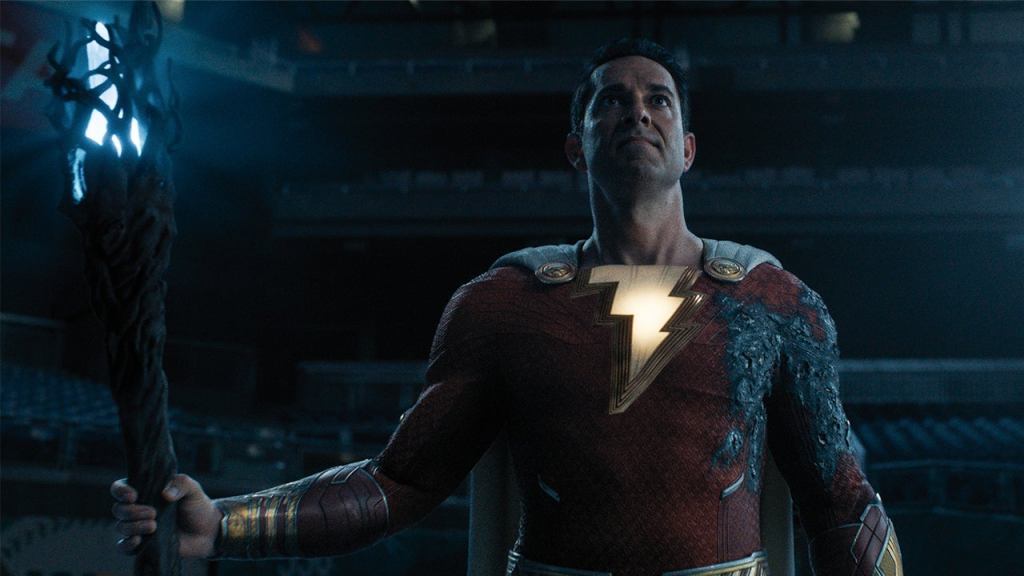
Zachary Levi as SHAZAM! in SHAZAM! FURY OF THE GODS — PHOTO: Warner Bros. Pictures.
Directed by David F. Sandberg — Screenplay by Henry Gayden and Chris Morgan.
Shazam! Fury of the Gods takes place four years after the events of the first film. Nowadays, Billy Batson (played by Asher Angel and Zachary Levi) and his Shazam Family of foster siblings are trying to balance being superheroes and being kids and teenagers at the same time. It’s not exactly going to plan as they are dubbed the ‘Philadelphia Fiascos’ by local media. Having grown older, the foster siblings are growing apart, and Billy is especially struggling with it, and right at this moment in time a trio of super-powered individuals appear. These are the daughters of the Titan Atlas — Hespera (played by Helen Mirren), Kalypso (played by Lucy Liu), and Anthea (played by Rachel Zegler) — they want revenge on the Wizard (played by Djimon Hounsou) and plan to remove the Shazam Family’s powers.
Song Kang-ho and Gang Dong-won in Hirokazu Kore-eda’s BROKER — PHOTO: Zip Cinema & CJ ENM Co, Ltd, All Rights Reserved.
Directed by Hirokazu Kore-eda — Screenplay by Hirokazu Kore-eda.
First released in competition at the Cannes Film Festival last year, Broker is the 15th narrative feature from Japanese filmmaker Hirokazu Kore-eda. The film takes place in South Korea, and it primarily follows Ha Sang-hyeon (played by Song Kang-ho) and Dong-soo (played by Gang Dong-won) as they steal a baby from a baby box (a concept that was new to me) — a box where mothers can leave their newborn babies and thus anonymously give them up for adoption or an orphanage — to sell it on the adoption black market. Soon, the young mother (played by Lee Ji-eun) who abandoned her child tracks them down and joins them on a road trip to help them interview the child’s potential parents. Meanwhile, the authorities are on their trail and trying to catch them in the act of selling the bay.
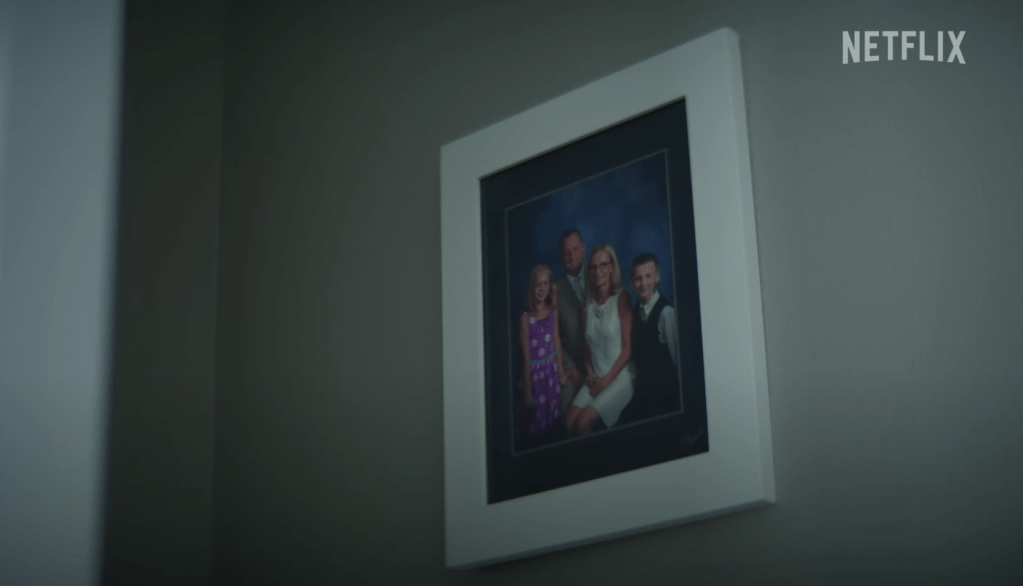
A framed photo of the Kowalski family — PHOTO: Netflix.
The Netflix documentary ‘Take Care of Maya’ was directed by Henry Roosevelt.
It goes without saying that when you are in need of medical attention, you shouldn’t have to be afraid to take yourself — or your loved ones — to the hospital. That said, this documentary is an excellent example of how broken some healthcare systems (and Florida’s child welfare system) can be. This is the kind of documentary that is so powerful and infuriating that it makes you want to write lengthy rants online, so as to complain about how utterly despicable some of the things the system apparently did to the family at the heart of this heart-rending documentary were.
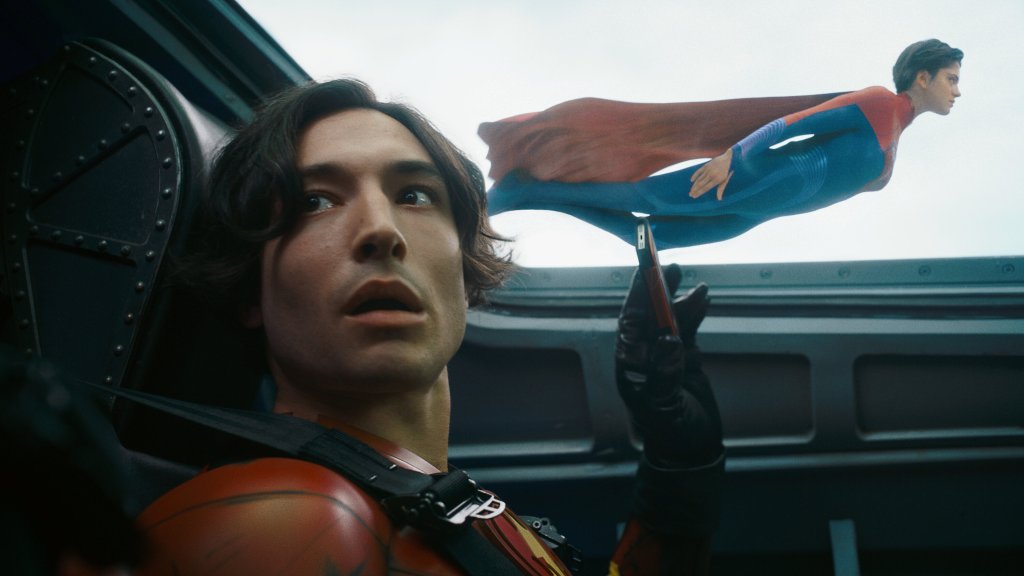
Ezra Miller as ‘younger alternate reality Barry Allen’ and Sasha Calle as ‘Supergirl’ in THE FLASH — PHOTO: Warner Bros. Pictures
Directed by Andy Muschietti (IT: Chapters One and Two) — Screenplay by Christina Hodson (Birds of Prey) — Story by John Francis Daley, Jonathan Goldstein, and Joby Harold.
Few films have had as storied and controversial pre-release periods as that of Andy Muschietti’s The Flash. A live-action solo film about DC’s speedster has supposedly been on the drawing board since the 1980s, back when no one had even thought to consider multiverse movies or toxic fandoms. Over the years, the idea changed shape multiple times (and went through multiple filmmakers’ hands) from solo film to team-up film to guest appearance and back to solo film within the Zack Snyder-orchestrated DC Extended Universe (DCEU), as one of the follow-ups to Snyder’s Man of Steel. While we waited for this film to materialize, The CW’s shared TV-DC Universe, the Arrowverse, came and went with Grant Gustin portraying The Flash in a nine-season-long series of the same name, which just ended this year (and which, notably, featured an appearance from Ezra Miller — the actor chosen by Warner Bros. to play the speedster on the big screen).




 I'm Jeffrey Rex