
Directed by Phil Lord and Christopher Miller (21 Jump Street; The LEGO Movie) — Screenplay by Drew Goddard (The Martian).
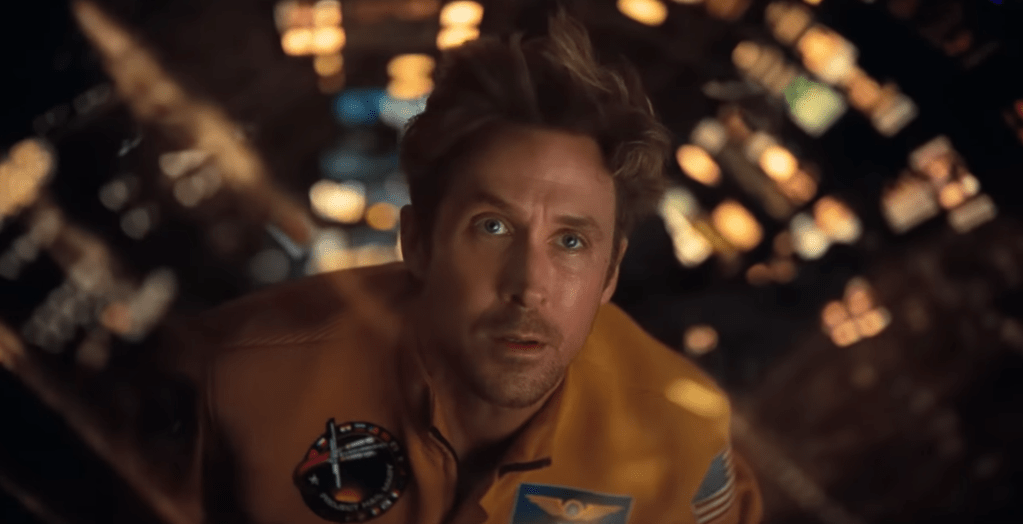
Based on the Andy Weir novel of the same name, Phil Lord and Christopher Miller’s Project Hail Mary follows Dr. Ryland Grace (played by Ryan Gosling), a former molecular biologist and middle school teacher, who wakes up on a spacecraft several light-years away from Earth with no memory of how he got there. As Grace’s memory slowly comes back to him, he investigates the spacecraft and finds that he is the sole survivor of a three-person crew sent out to find out how we can stop an extinction-level event from further harming Earth. A microorganism known as Astrophage, which is exponentially increasing its size, appears to be dimming our Sun and several stars in our solar neighborhood. The crew, including Grace, was sent out to figure out why Tau Ceti is the only unaffected star in the vicinity. Unsure about how to carry out his mission, Grace eventually comes into contact with an alien entity, which he dubs ‘Rocky,’ and its own glorious spacecraft. When Grace finds a way to communicate with Rocky, named so because of his ‘pile of rocks’-like body, Grace figures out that they’re there for the same reason. So, he now must figure out how to save lives at home and light-years away from our solar system.
Ryan Gosling is so charismatic that he can literally have chemistry with a rock. But it isn’t just any rock. Rocky will melt your heart, bring tears to your eyes, and etch his name into movie history thanks to puppeteering (he’s even voiced by lead puppeteer James Ortiz), its tactile alien design (the final performance is supposedly a blend of the puppeteers’ work and that of visual effects animators), and the instantly iconic bromance at the center of the film, which makes it one of the best sci-fi films about interspecies friendship since Steven Spielberg’s E.T.: The Extra-Terrestrial. In addition to that classic, it has hints of Interstellar, Stargate, and, yes, The Martian, the latter of which, of course, was also an adaptation of a popular Andy Weir novel (and adapted by Project Hail Mary screenwriter Drew Goddaard). Because this film is anchored around the aforementioned interspecies, human-alien bromance, directing duo Phil Lord and Christopher Miller make for an excellent fit, given their very funny Channing Tatum and Jonah Hill-led Jump Street films. This is easily their best live-action film, and it puts Gosling’s golden retriever-esque likability to great use, as he manages to carry so much of the film as not only its leading man but also being so in what is almost a single-hander of a film. He works relentlessly to earn laughs by any means necessary, while still balancing his performance in a way that makes him feel like more than a crowdpleaser’s construction. He doesn’t just earn laughs, but he sells the emotional weight and influence of the film’s most affecting scenes, which could’ve gone wrong, as so much of it is reliant on our attachment to an alien rock and his unlikely friendship with a teacher-turned-astronaut.
Although arguably its biggest strength is Gosling’s performance and rapport with Rocky, it doesn’t skimp on science-fiction visual effects. Both spacecraft are incredibly well-realized, with one being somewhat realistic and the other being quite difficult to explain and thus distinctly alien in build. There are great visualizations of sci-fi concepts, production design, and space. There’s a green planet that is designed in a way that is just breathtaking, and the action-adjacent space-walk sequences are both astonishing and filled with tension. Speaking generally about the writing of the film, it leans into the scientific focus, but perhaps not so much as The Martian did. It is never too handholdy nor, conversely, too technical. Lord and Miller inject their comedic sensibilities, which some may know best for their work in animation, into the film when it comes to visual language and performance rhythm, but it doesn’t overwhelm the sci-fi aspects or take away from your emotional investment in the characters or the narrative.
Although I am pretty much of the opinion that this movie has it all, no movie is perfect, and there are a couple of things that I think may work against the film on subsequent viewings. The film does have a somewhat curious structure. Because the narrative is designed in such a way that our main character slowly gets his memory back, the film has these recurring flashbacks that, although they add a lot to the experience, do, sort of, halt the forward momentum of the film from time to time. Furthermore, there are certain portions of the film that slow the pace, as Grace learns to communicate or waits for a miracle that, I guess, could possibly make the two-and-a-half-hour runtime feel like an issue on repeat viewings. I think it is also fair to say that even though this is a wonderful film, it isn’t really saying anything that is particularly unique. That doesn’t mean it feels like well-worn territory, but it just means that the film shines not because of original messaging or themes but because everything is executed extremely well.
It feels especially important to get a film like this at our current moment in time, because here is a movie about working together regardless of who we are, where we come from, and what language we speak to form alliances and friendships, but also to overcome and solve shared issues. It is an incredibly charming and heartfelt film that front-loads a story about friendship and loyalty (it even becomes a delightful movie about roommate hijinx for a sequence or two) without ever losing the majesty of its epic space adventure that it is built around. I am also so delighted by the sense of cheerful curiosity that the storytellers’ approach brings to the film, which is felt in every interaction between Grace and Rocky. It all means that Project Hail Mary is a wonderful and infectiously joyful film.
9 out of 10
– Review written by Jeffrey Rex Bertelsen.

 I'm Jeffrey Rex