
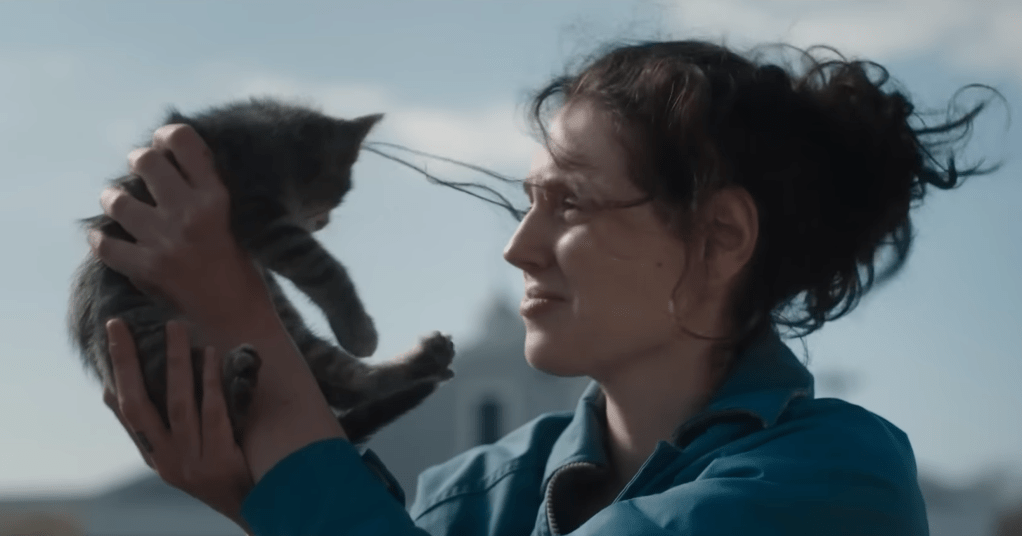
Directed by Eva Victor — Screenplay by Eva Victor.
Earlier this week, I sat down to finally watch one of the most discussed and praised directorial debuts of 2025. Eva Victor’s Sorry, Baby has already been celebrated by the National Board of Review as the best directorial debut of last year, and it was recognized with nominations at both the Indie Spirit Awards, Critics’ Choice Awards, the DGA Awards, and the Golden Globes. As such, it is one of the most high-profile independent films of last year, which comes with some pretty high expectations. So, I was naturally very intrigued by it, and, as the film came to a close, I was also very impressed by the narrative and the incredible multi-hyphenate at the center of it.
Eva Victor’s Sorry, Baby follows Agnes (played by Eva Victor), a literature professor in rural New England, who is struggling with depression and reclusivity following a traumatic experience that happened to her while she was working on her thesis years earlier. The film focuses in on her friendship with her best friend Lydie (played by Naomi Ackie) and her mental state following the traumatic event from her past. It is a really well-delineated character study told through a non-linear narrative structure.
This is a really effective comedy-drama, emphasis on the drama, with a breakthrough performance at the center of it from its actor-writer-director triple threat. Though I initially was unsure about the first section, I warmed to the structure of the film. It is somewhat slow-moving, but the writing is profound, and the central filmmaker does a lot with a little. Victor is tremendous in specific scenes that speak to a certain experience in ways that have the performance leap off the screen, either through line delivery or still scenes with her staring into the middle distance. I found it to be really emotional at times, sometimes without saying a word. It is really cleverly designed, especially for an indie debut. There’s definitely something offbeat about it that sometimes takes you out of it. Some of that is in performance, but it feels deliberate as both Victor and the jealous colleague/classmate, played by Kelly McCormack, both have this offbeat thing to them. The supporting cast is also quite good. Lucas Hedges, who I’ve missed seeing in prestige dramas, and Naomi Ackie leave strong impressions, while John Carroll Lynch turns in a one-or two-scene performance so well-tuned that he almost runs away with the movie.
It is designed to be a dramedy, i.e., a drama and a comedy, but the comedy comes and goes, and I think the film is stronger when it is more of a straight-faced drama. Though there are times when the comedy hits, the comedy is not really as much of a strength for me as it seems to be for others (it is probably my biggest complaint with the film, other than a few academic nitpicks), but there are moments when the tonal tightrope act really works both dramatically and comedically. I’m thinking specifically of the big jury duty questioning scene. I really like how the questioning is cut together; the confusion on the part of the questioning attorney, the way they cut to the stenographer who stops, thinks, and then retypes after hearing that Agnes doesn’t think the law makes sense. But then it deftly switches to serious, as she explains her complicated emotions. I don’t know what it is, but it brought tears to my eyes. Maybe it’s the traumatized realisation spoken out loud that she does, her numbness, or the uncomfortable and vulnerable confession, which brings into question what she can allow herself to think of her assailant, herself, and the world. I think it is the best scene in the film.
Here at the end, I also want to highlight how intelligent and evocative the visual subtext is in Sorry, Baby. I want to highlight the image of her putting her thesis draft up on the window panes of one of the rooms in her house, which partially illustrates a feeling of being confined by the work that someone has forever changed her relationship to, as her ownership of her life’s work is tarnished due to her assailant’s attachment to it. That only begins to scratch the surface of the many thoughts the visual subtext and the well-designed dialogue bring to mind throughout the film, which is a fantastic debut that fully deserves the praise and recognition it has been getting. I highly recommend it.
8 out of 10
– Review written by Jeffrey Rex Bertelsen.

 I'm Jeffrey Rex