
Directed by Nia DaCosta (Candyman) — Screenplay by Alex Garland (Annihilation; Civil War).
Just seven months after the release of Danny Boyle’s long-awaited 28 Years Later, we already have a direct sequel. This second part in a proposed three-part follow-up to 28 Days Later and 28 Weeks Later is, notably, not directed by Danny Boyle, despite Alex Garland still having penned the screenplay. Instead, the director of 28 Years Later: The Bone Temple is Nia DaCosta, the Candyman (2021) and The Marvels director, who now must try to recapture the spirit of one of the most iconic zombie, or zombie-adjacent, film series ever made. Having been shot back-to-back, but by different filmmakers, it is only natural that some would be concerned about whether or not they could pull it off successfully. But, thankfully, Nia DaCosta has turned in what is easily her best franchise film. Despite its January release date (a release window most known for being filled with less-than-pleasing films), 28 Years Later: The Bone Temple is not only a worthy follow-up to Boyle’s sequel, but it is also the first great film of the year.
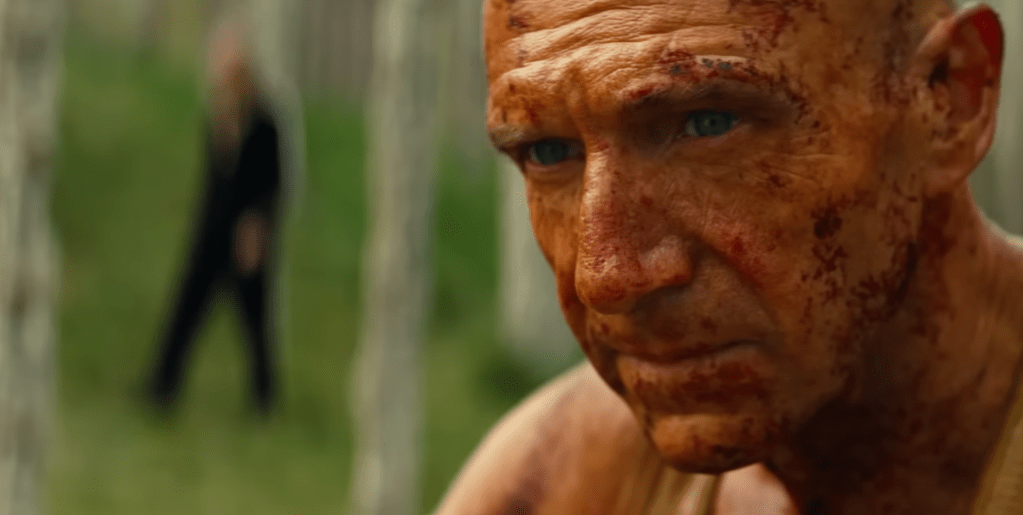
Nia DaCosta’s 28 Years Later: The Bone Temple takes place shortly after the events of Danny Boyle’s 28 Years Later. After having been ‘saved’ by them at the end of the previous film, our young protagonist, Spike (played by Alfie Williams), has been threatened and forced into joining the Fingers, a satanic cult that worships their leader Jimmy Crystal (played by Jack O’Connell) and ‘Old Nick,’ i.e., Satan, who Crystal refers to as his father. All dressed in colorful track suits and with blonde wigs (presumably so as to resemble Jimmy Saville), they roam the British wilderness to cause chaos and punish innocent survivors. Meanwhile, the empathic solitary medical professional, who built the titular ‘bone temple,’ Dr. Ian Kelson (played by Ralph Fiennes), is conducting an experiment on a rage-virus alpha, whom he has dubbed Samson (played by ?), as he believes the naked giant is intentionally letting himself be sedated by Kelson’s blow darts. As Kelson attempts to see if Samson can become more docile, Jimmy’s cult is gradually getting closer and closer to an inevitable confrontation between the satanic cult and the humanist doctor covered in iodine from head to toe.
When you switch director, editor, score composer, and cinematographer from one film to the next, it is only natural that the films will feel stylistically distinct from one another, and they certainly do. Really, the only slight downgrade, in my mind, from 28 Years Later to The Bone Temple is that the sequel feels more conventional stylistically. Although some audiences didn’t warm to it, the editing style, distinct visuals (and warm colors), and hauntingly beautiful music (from Young Fathers) of 28 Years Later all make that entry feel special. Again, The Bone Temple looks and sounds more conventional. DaCosta’s film looks less experimental, with colors that don’t pop as much as in Boyle’s film. Although Hildur Guðnadóttir’s score is competent, it is overshadowed by the use of pre-existing songs from Duran Duran, Radiohead, and Iron Maiden. I will say, though, that the pre-existing songs are used in extremely satisfying ways. Also, one visual element that I particularly liked here was the way it uses birds-eye-view shots to give you a good idea of the lay of the land and the distance between characters.
I’ve used the word ‘downgrade’ to describe the stylistic switch, but that may sound harsher than I mean it. Because, frankly, I think The Bone Temple is sensational. It isn’t filled to the brim with ideas on and off-screen like the previous film, but that isn’t to say that it is without ideas. Rather, The Bone Temple just feels more subtle about its political, real-world allusions (even though one late scene makes one key message quite obvious), as well as more straightforward about its themes. It is a film that explores two competing paths in an unsteady, broken world. One is defined by reason, humanity, science, and the desire to heal, and another is defined by demagoguery, the weaponization of faith, the cult of personality, and a desire for chaos and exploitation. These competing paths are seen through the two parallel storylines in the film that eventually converge the two in a fiery, quasi-psychedelic musical act that will leave an imprint on your movie memory, leaving an indelible mark for all the right reasons.
Although Alfie Williams’ Spike remains a key part of the film, The Bone Temple is really Jack O’Connell and Ralph Fiennes’ film. O’Connell has, with his turn in these films and in Sinners, proved himself to be particularly eye-catching, mischievous, and frightening with these larger-than-life horror movie parts. His character takes the film to dark places, as DaCosta’s film, in certain portions, looks more like a Funny Games, The Strangers, or A Clockwork Orange film than a zombie-adjacent film. Though it does have some acts happening off-screen, we see some terrible, demented acts take place in this film that make it particularly horrifying to watch. O’Connell’s performance helps to add effective tension to film scenes. There is a lot of suffering to be found in this film due to what the Jimmy cult gets up to, but, for as horrifying and gnarly as this film can be, it also earns great laughs and sweet moments of recaptured humanity. A lot of this comes from Ralph Fiennes, who, with 28 Years Later and The Bone Temple, has successfully etched Dr. Ian Kelson’s name into horror movie canon, as one of the best and most caring individuals to have ever appeared in a zombie, or zombie-adjacent, movie. There is a playfulness, a gentleness, an occasional joy, and a deep attention to the needs of others in the performance that Fiennes makes sure is captured on-screen by DaCosta and her crew. I don’t think I’ve ever smiled as much at a horror movie that also made me avert my eyes in horror as I did with The Bone Temple, and that joy is all down to Fiennes’ stellar performance and his great rapport with the silent giant called ‘Samson’ played by Chi Lewis-Parry. Lewis-Parry, Emma Laird, and Erin Kellyman are the secondary performers who leave the strongest impressions, though for very different reasons.
Like Danny Boyle’s film, Nia DaCosta’s The Bone Temple is yet another truly inspired legacy sequel that isn’t afraid to take big swings. It is exactly the kind of franchise sequel that you want to champion. The latest film in the series is not only the first great film of 2026, but it also features the first truly note-perfect film performance of the year. To add to that, it culminates in a bizarre but brilliant and instantly iconic sequence of fire, music, showmanship, and performance that is worth the price of admission alone. You genuinely don’t want to miss that, and the same goes for the epilogue that pushes the narrative in a direction that should make long-time fans of these films very excited. I, and the person I brought along to see it, saw the film in an empty auditorium, but this is the kind of film that deserves large crowds. Don’t skip it.
8.5 out of 10
– Review written by Jeffrey Rex Bertelsen.

 I'm Jeffrey Rex