
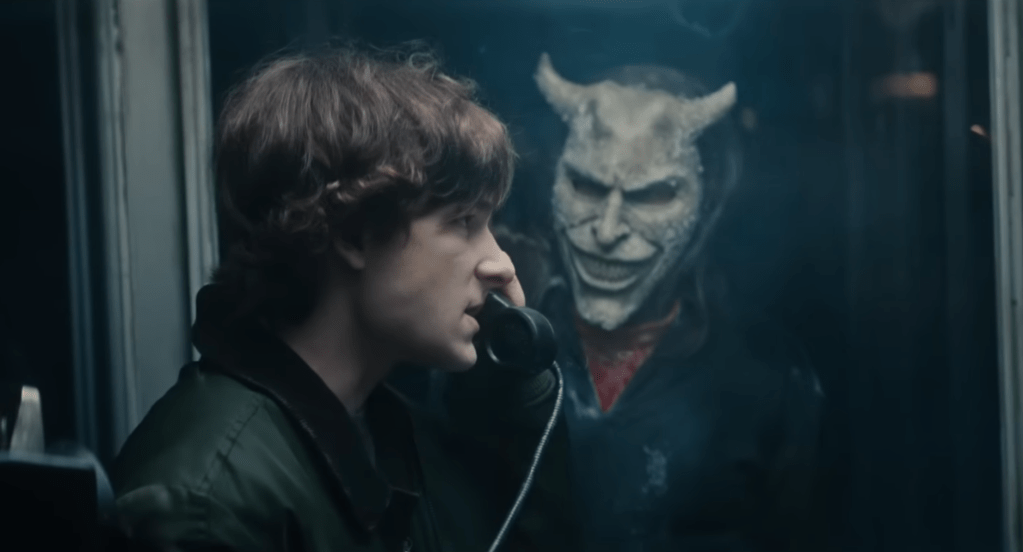
Directed by Scott Derrickson — Screenplay by Scott Derrickson and C. Robert Cargill.
Earlier this year, director Scott Derrickson gave us Apple TV+’s The Gorge, which I found to be a gripping genre-blender with two fun leads. Now, Derrickson, the Doctor Strange and Sinister director, is back with a direct continuation of one of the cinematic horror worlds he helped bring to life with a sequel to 2021’s The Black Phone. When I first saw the 2021 effort, I described it as another gripping horror home run from Derrickson, who has previously shone as a horror filmmaker with Sinister and The Exorcism of Emily Rose being, arguably, his best horror efforts. Although I have had some doubts about how they could continue the story of The Black Phone, given its ending, I’ve been excited to see it for some time. Now that I’ve seen the sequel, I can report that, admittedly, it doesn’t feel like as much of a neatly balanced horror outing as some of his best films, but it does represent a jump up in violence from the previous film, as Derrickson and his frequent collaborator and co-writer C. Robert Cargill have infused the sequel with a giddiness when it comes to implanting genre references and upping the intensity a notch. It mostly works, even if there are some issues along the way.
Set four years after the events of 2021’s The Black Phone, Scott Derrickson’s Black Phone 2 once again follows siblings Gwen (played by Madeleine McGraw), who sees special visions in her dreams, and Finney Blake (played byMason Thames), the only known survivor of the serial killer known as the Grabber (played by Ethan Hawke), who Finney killed at the end of the previous film. Now, Finney has grown into an angry young man who lashes out at the world and whose trauma still haunts him. Meanwhile, Gwen is starting to experience new dreams (and is regularly sleepwalking!) wherein she is in conversation with her late mother years earlier over the phone. Desperate to uncover the clues her dreams may be pointing her to, Gwen convinces Finney and Ernesto (played by Miguel Mora), the younger brother of another one of the Grabber’s victims, to go with her to the snowy Alpine Lake Camp, where Gwen and Finney’s mother once worked. As they start to investigate the events teased in Gwen’s dreams, her visions become more violent and, all of a sudden, Finney discovers that the Grabber is trying to have his revenge from beyond the grave.
The extent to which you enjoy this film will likely depend on how much you liked the characters from the first film. For me, I thought Derrickson’s film did a good job of setting up the kid characters in the first film, so it was good to see that this film leaned into its focus on Mason Thames and Madeleine McGraw, the latter of whom proved herself to be a quite convincing young actor and crier in the first film. For Derrickson’s second go-around, he spends a lot of time building on that foundation. I genuinely care about what happens to these characters. I also think they both do a fairly good job in the sequel, in which Madeleine McGraw got a lot more focus than I had expected. The film focuses a lot on her viewpoint as we go into her dreams, and plenty of them. To bring them to life, Derrickson opts for a visual homage to his own work, as we often get these grainy 16mm dreams (but also visions of other young characters in trouble) that really resemble Sinister’s videotapes. It is a solid addition to this world, and it is one of the elements that exemplify how Black Phone 2 is a much more violent, disturbing, and bloody horror movie. Derrickson definitely kicked things up a notch or two, and in doing so, he makes good use of his cineliteracy, as his film borrows elements (and pays homage to) everything from A Nightmare on Elm Street to IT. This act of changing horror gears is especially evident in the second half of the film, where rules are bent and violence runs wild. For me, though, my favorite element of the movie may have been the score crafted by Atticus Derrickson (Yes, Scott Derrickson’s son). The score, when appropriate, hits that Sinister-esque disturbing and gnarly sound, but there are also moments when it sounds spacey.
What will maybe hold the film back for some, though, is the length of the film, which you really feel. Black Phone 2 suffers from pacing issues. Scenes run long, and the film can fairly easily be chopped into two halves. There are also moments where the dialogue chosen feels forced (e.g., forcing in words like ‘radical’ when it doesn’t feel natural). It also may not be all that scary. It didn’t ever frighten me, and it didn’t help that it has a couple of jump scares that are more annoying than exciting (the film does a better job of setting up creepy and sad images, like Finney seeing visions of the Grabber while the young man is outside smoking). It should be said that there’s a retcon introduced here that makes the universe smaller, and I think it sort of makes the first film less effective as a direct result, which was a disappointment. I’ll add that I thought it was odd that the film set up these tarot-like cards only to never use them. It did make me wonder if there was a lot of material left on the cutting room floor.
Scott Derrickson tries to elevate the horror of Black Phone 2 by leveling up the violence and the dreams in his sequel. This mostly works despite some issues here and there (in addition to what has already been said, it felt to me like the cold of winter only had an effect when the plot wanted it to), as Derrickson also effectively focuses on the upcoming young stars that the first film introduced to the world. On the whole, it’s, ultimately, a little bit rougher and messier than the rock-solid first film, but it has its moments.
6 out of 10
– Review written by Jeffrey Rex Bertelsen.

 I'm Jeffrey Rex