
Directed by David F. Sandberg (Lights Out) — Screenplay by Gary Dauberman (‘Salem’s Lot) and Blair Butler (The Invitation).
After years and years of middling-to-poor video game adaptations, it seems we’re finally at a moment in time when Hollywood is confidently turning video games into beloved and/or successful films or series. We’ve got The Last of Us, Fallout, Sonic the Hedgehog, and The Super Mario Bros. Movie, just to name a few. Now, of course, there are still some duds out there, such as Eli Roth’s Borderlands adaptation, which was largely regarded as one of the worst movies of last year. The latest attempt at turning a popular video game into a successful movie is David F. Sandberg’s Until Dawn from Sony Pictures, with which the studio is hoping to find low-budget horror movie success, like certain studios have become quite known for on a regular basis, but with a video game adaptation. In a lot of ways, Until Dawn makes a lot of sense for that model, and, heck, it should be a success given the horror movie veterans — like Gary Dauberman and David F. Sandberg — they’ve hired to get the job done. But does Until Dawn succeed as a video game adaptation? Frankly, I think it’ll divide opinion.
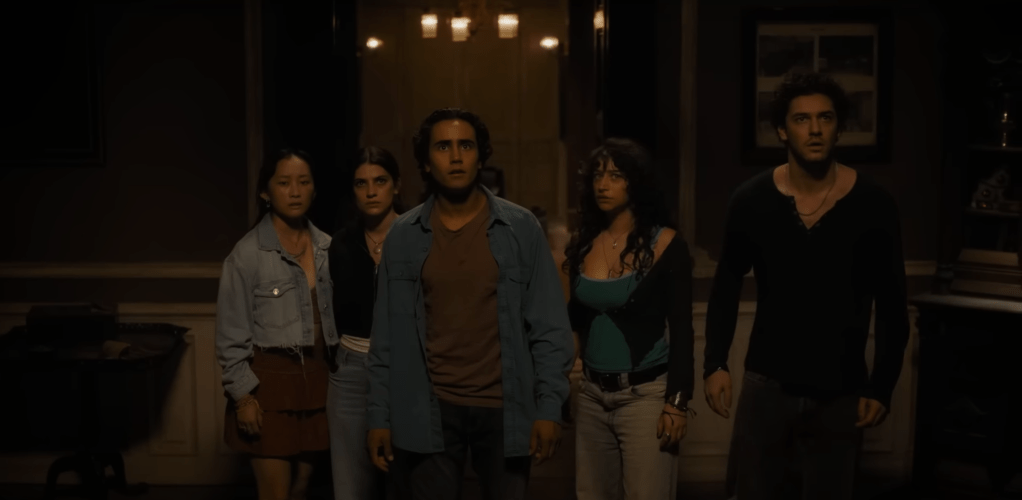
Based on the video game series of the same name, David F. Sandberg’s Until Dawn follows a group of friends led by Clover (played by Ella Rubin), who is looking for her missing sister Melanie (played by Maia Mitchell). Her supportive group of friends include Clover’s ex-boyfriend Max (played by Michael Cimino), Clover’s friend Megan (played Ji-young Yoo) who claims to be psychic, and Nina (played by Odessa A’zion), who has also brought along her boyfriend Abe (played by Belmont Cameli), as they try to find Melanie in the middle of nowhere. Following a conversation with a mysterious stranger (played by Peter Stormare), their search brings them to an abandoned house in the woods, wherein they find signs that Melanie has been there, but also that a great many people appear to have been missing in the vicinity.
Inside the abandoned house, the group also finds a mysterious hourglass that automatically starts itself upon their arrival. The hourglass is counting down until dawn, hence the title, and with each turning of the hourglass, some individual, monster, or supernatural element starts to hunt them down and kill them. When they die, the hourglass resets, and they come back to life. To escape, they must survive until dawn before they’ve reset too many times and become stuck there or are permanently killed or changed.
So, that is essentially the central hook of the film adaptation. Gary Dauberman and Blair Butler’s script has taken a video game built around playing a horror movie and getting to choose or control the actions, dialogue, and final outcome for the characters in the game and they’ve essentially turned it into a jumpscare-laden time loop horror movie. Now, I partially understand this approach. For one, unless you’re Netflix doing Black Mirror: Bandersnatch, it’s difficult to really do interactive films, and I have a tough time seeing how they’d do it successfully in a movie theater. So that was always going to be near impossible to do with an adaptation. Notably, the writers also opted to do an entirely new story with only blink-and-you’ll-miss-them easter egg references to the video games (or through certain creatures included in the film), plus one returning actor, whose appearance is memorable, even if I’m not sure it fully works within the unclear rules of the film. What, however, doing it as a time loop horror movie does is, sort of, get to the feeling of restarting a level because you’re not happy with what you just did in a game, which, frankly, feels very true to these types of games.
Speaking more broadly about the film as a horror flick, the concept also makes for a good genre exercise for its competent director, whose horror films I tend to like, and who knows how to do great horror build-up and how best to execute practical effects. For other fans of David F. Sandberg, the Swedish filmmaker has inserted references to his other horror films, though without it ever feeling unsubtle, which I thought was really nice to see (e.g. a room full of dolls or the flickering red lights late in the film). It’s also just super fun to see him try to use effects and monsters from various different types of horror films, which, I suspect, must’ve been really fun for the filmmaker who likes to experiment with his horror movie effects. There’s certainly an element of this film that will remind horror movie fans of the many potential horror movie outcomes teased in The Cabin in the Woods, though that film has far better horror-comedy writing and meta-dialogue, hence why that film has become a beloved recent film in the genre.
Unfortunately, I doubt Until Dawn will ultimately have the same fate, as there are a quite a few things holding it back. Where The Cabin in the Woods was a playful take on a generic horror movie formula with great meta-commentary, Until Dawn, despite its playful concept, feels more like a generic horror movie. It is chock-full of genre tropes and, though there is one moment wherein a character speaks to the fact that many movies have similar formulas, it feels more like a band-aid placed on top of its failings than the clever moment it may have been aiming to be. Particularly in the early stages of the film, the dialogue is rough, with jokes landing with a thud. Frankly, it is only really funny when Sandberg deliberately goes over-the-top for one sequence.
It doesn’t help that, at one point, it genuinely feels like the film gets impatient. Not only do you, as an audience-member, kind of sit around and wait for the characters to reset their scenario for the umpteenth time, the characters also get tired of waiting for themselves to die. And then the film itself gets tired of its own concept and jumps all the way to one of, if not, their final attempt, and pairs it with a smartphone video recording montage that only somewhat works. As such, I don’t think it gets enough out of its own concept, and, frankly, you don’t really feel the ticking clock element baked into the central concept, which feels like a mistake.
David F. Sandberg’s Until Dawn is a so-so video game adaptation that makes a somewhat necessary decision to forgo the video-gamey multiple-choice concept of the game in favor of a time-loop model that only sometimes works well as a vehicle for the central filmmaker to play around in this de facto horror movie sandbox. Whether or not you’re into its jumpscare-heavy approach will depend on your individual preference, but I found it to be slightly annoying in the long run. It’s an, ultimately, relatively unremarkable horror film with too many generic elements (and some questionable internal narrative logic) that tend to overwhelm its otherwise playful concept.
5 out of 10
– Review written by Jeffrey Rex Bertelsen.

 I'm Jeffrey Rex