
Directed by Ryan Coogler — Screenplay by Ryan Coogler.
Ryan Googler should be a household name. He burst onto the scene with his incredible feature debut Fruitvale Station, revitalized the modern American sports drama (and an iconic franchise) with Creed, broke box office records with the iconic superhero film Black Panther, and took on the daunting task of making a sequel to his superhero epic, even though it would be without its leading man with Black Panther: Wakanda Forever, following Chadwick Boseman’s tragic passing. Coogler has proven himself to be a commercially viable filmmaker with something on his mind and the skill with which to pull off his ideas breathtakingly. But now he’s finally made something unique and original, despite the genre tropes his film willingly embraces, following years upon years of working with true stories, established characters, or within the Marvel machine. Ryan Coogler’s Sinners is an original vampire period film of which he insisted on having full creative control and future ownership, with a deal that resembles what Quentin Tarantino, among others, have done before him. That was a deal worth fighting for, because Sinners is the kind of instant classic original genre film that will blow people away.
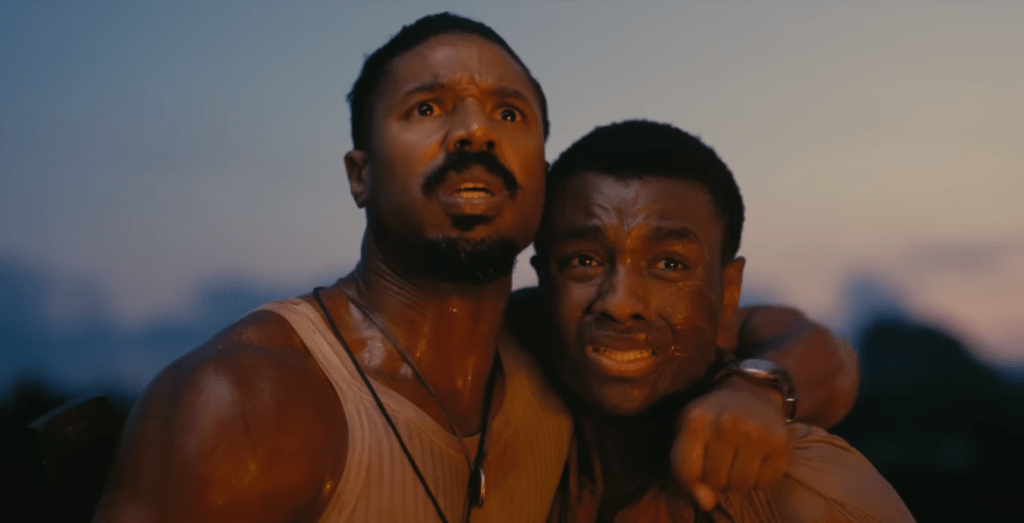
Set in 1932 in the so-called Mississippi Delta of America, Ryan Coogler’s Sinners follows a young, aspiring African-American blues guitarist named Sammie (played by Miles Caton), who defies his pastor father’s wishes when his cousins return to Mississippi after having spent years in Chicago. His cousins are known as Smoke and Stack (both played by Michael B. Jordan), both World War One-veterans turned gangsters. Smoke and Stack have bought land that houses an old saw mill from a racist landowner, and they hope to quickly recruit enough of their acquaintances to launch a Juke-joint for their local community using the money that they have somehow come by following their exploits in Chicago. On their opening night, they get the kind of party atmosphere that they had hoped to inspire, but that is until Sammie’s transcendent blues music attracts an Irish-vampire (played by Jack O’Connell) who is quickly transforming locals and who has a thirst for Sammie and his musical capabilities.
One of my first thoughts as I left the theater after viewing the film last Friday was that Ryan Coogler’s Sinners is essentially equal parts Steve McQueen’s Small Axe: Lovers Rock, Robert Rodriguez’s From Dusk till Dawn, and, arguably, Martin Scorsese’s Killers of the Flower Moon, but with the musical urban legend of the Delta blues devil at the crossroads as a clear inspiration for its narrative framework and lifeblood. It’s a film that celebrates the main characters’ distinct cultural heritage, the musical mythologies of certain cultures and their transcendent power, for the first hour, or so, it’s essentially an early 20th Century gangster movie (that, among other things, occasionally made me think of the Killers of the Flower Moon-line “Can you find the wolves in this picture?”). For the second act, it becomes an infectious party film with an alarming sense that something is coming, and then in the final act, it fully embraces its horror inspirations, as Coogler leans fully into genre elements with vampire lore and a clear and obvious reference to The Thing.
As such, it is a film that, in spite of a couple of early jump scares, gradually morphs into the genre film its marketing is built on. Coogler’s film, however, doesn’t rush into anything or waste our time, as the first hour sets up the many characters and themes, which the film is later fully diving into, with detail, effective world building, fascinating and heartbreaking sound design choices (e.g. the sounds we hear when Delroy Lindo’s character is telling a story to Stack and Sammie in a car), and strong character beats that set up the emotional stakes for the various characters. It’s a thrilling but deliberately paced opening that it’s easy to sink your teeth into, even though the genre elements are only occasionally shown in the first hour.
That first hour features set-up effectively in ways that only the best filmmakers can do, and the final act isn’t shy about leaning into well-trodden vampire lore (my one nitpick in the third act is that it is a tad too handholdy in that the film ought to have trusted its audience to remember previous scenes rather than to cut to shots from earlier in the film to make sure we connect the dots). While these acts are tremendous, it is in the second act (as well as in a mid-credits scene that you simply must stick around for) that the film takes that next step into instant classic territory. This happens with an audiovisual feast that almost makes it feel like the smoke of the cigarettes is leaping off the screen. The film is practically dripping with sweat, attraction, sex, and musical grandeur (Ludwig Göransson’s score is sensationally good and cements him as one of the film composition voices and stars of his generation). It is in these moments that Coogler puts to the screen one of the biggest swings of his career. It is an incredibly ambitious and audacious long-take scene in which the blues music performed by Miles Caton’s character not only blows you away but also reaches through space and time with a ‘barn burner’ of a track that emphasizes the timelessness of music and its transportive power. Without going further into detail, I’ll say that it is the most bold sequence I’ve seen in any film thus far this year, and that the way it worked in anachronistic elements with love kind of made me think of the old Marty McFly quote: “I guess you guys aren’t ready for that yet. But your kids are gonna love it.”
From a performance perspective, there’s quite a lot to love as well. Michael B. Jordan turns in distinct dual performances that allow him to play multiple facets of both of his characters to incredibly entertaining effect. Miles Caton turns in a star-making debut performance that makes you think: “Where has he been hiding?” Jack O’Connell perfectly nails his character’s allure, musicality, and frightening side. The compliments and praise extend to the rest of the ensemble cast, which also uses Delroy Lindo to perfection, so as to both have him be a rich and deep supporting character with an emotional backstory that you can feel, as well as be the film’s comic relief from time to time. Then there’s Wunmi Mosaku, whose chemistry with Michael B. Jordan is communicated perfectly — she’s terrific. I could go on and on, as everyone from Hailee Steinfeld to Omar Miller does good work here. Coogler is great at getting the most out of his cast.
Ryan Coogler’s Sinners is a sensationally good genre film powered by timeless and transcendent blues music, dripping with sweat and sexiness, and oozing style. It even manages to bend the genre with musical elements without them feeling superfluous. It is at one and the same time both a musical, a horror movie, a historical gangster film, and a film about the racial history of the American South, and he weaves it all together with relative ease and impressively. It’s an instant classic barn-burner of a genre film — an ambitious and audacious original film that makes you want to both sink your teeth into it and shout its name from the rooftops.
9 out of 10
– Review written by Jeffrey Rex Bertelsen.

 I'm Jeffrey Rex
4 thoughts on “Sinners (2025) | REVIEW”