
Directed by Anthony and Joe Russo — Screenplay by Christopher Markus and Stephen McFeely.
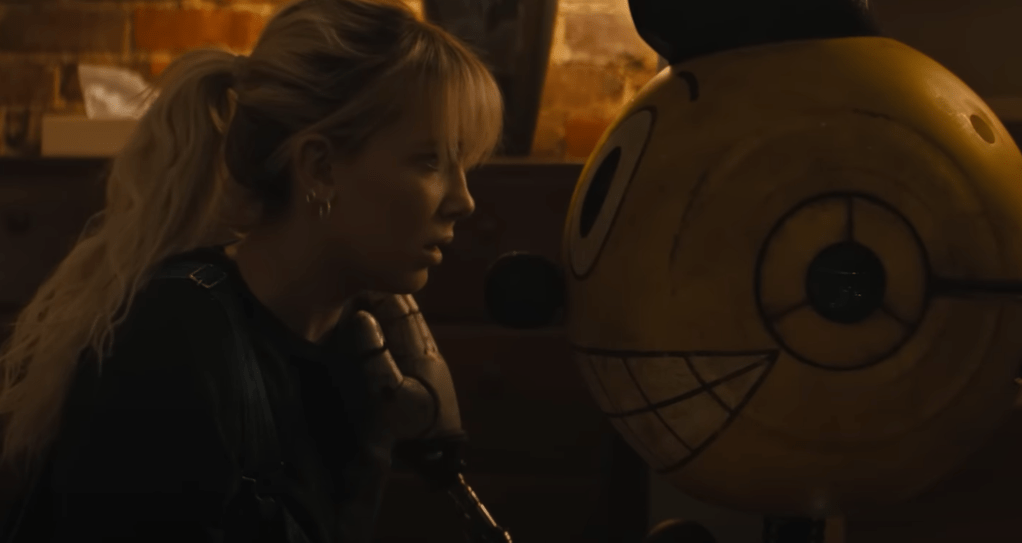
Based on Simon Stålenhag’s retro-futurist illustrated novel Passagen (international title: The Electric State), Anthony and Joe Russo’s The Electric State is set in the 1990s after the events of a war between humans and robots (who were apparently created by Walt Disney in this universe), which has changed our world immensely. Humanity won the war and banished all robots into an exclusion zone, while humanity decided to become sedentary with VR helmets (called Neurocasters) that allow you to upload your mind and control drone robots, as avatars for yourself in the real world. In this world, we meet Michelle (played by Millie Bobby Brown), who lost her family in a car crash and who refuses to wear these modern helmets. One day, she meets and befriends a robot named Cosmo (voiced by Alan Tudyk). Together, they team up for a mission that will take them across the dystopian world and into the exclusion zone. Along the way, she meets and befriends a war veteran, Keats (played by Chris Pratt), who has a very good friendship with a robot named Herman (voiced by Anthony Mackie).
When you hear a film is one of the most expensive movies ever made, as is the case with The Electric State and its $320 million budget, you naturally expect something quite sensational. It even logically makes sense that the film directors have experience handling these massive budgets, as they directed both Avengers: Infinity War and Avengers: Endgame. But the Russos arguably had Marvel training wheels with the Avengers films, and more than a dozen films that had led up to that moment, so people were already bought in. Now, with The Electric State (also written by their frequent collaborators Christopher Markus and Stephen McFeely) they don’t have that assistance. Since leaving the profitable Marvel machine (which they’ve announced they’ll be returning to with their next films), they’ve made three films, including this one, and they’ve all been widely panned or, at the very least, been quite forgettable and generic films. It seems that without the bumpers of Marvel, they keep throwing gutter balls. At least, that’s the feeling that I think a lot of people are hit with after seeing their latest Netflix venture.
It’s the kind of film where the corporate big bad repeatedly says “who cares?” in a big scene late on. The film features dialogue that feels artificial, which is likely both due to stilted writing and sub-par performances. The first act is riddled with exposition, the comedy feels worn-out and unoriginal, and the character set-up is rushed. It features one-dimensional characterizations that its relatively capable stars fail to enliven. The wig-wearing leads, Millie Bobby Brown and Chris Pratt, don’t come out the other side looking all that strong. Brown’s performance is flat, while Chris Pratt, who I generally enjoy in his blockbuster film, is on auto-pilot playing a character archetype he’s done so often that it feels stale here. Similarly, this is yet another film that puts Giancarlo Esposito in a position to play the same beats he usually does, which is a shame because he has so much more to him than that. The film also suffers from something I like to call ‘Suicide Squad soundtrack sickness,’ since it’s constantly throwing popular music in there for no good reason other than to try to ape the energy of Guardians of the Galaxy but failing in the process.
Now, to be fair, the film and its ballooning budget haven’t led to something that is a complete and utter disaster. It would be disingenuous to say that nothing works here. Frankly. I think the visual effects — the robots brought to life — look quite good. The film’s visual style isn’t top-tier quality, but I do think it looks relatively good, which is more than you can say for some of Netflix’s attempts at doing a blockbuster-type film (e.g. Red Notice). It’s also a much nicer-looking film (and, on the whole, is, arguably, a lot better) than last year’s disastrous video game adaptation Borderlands, which, it should be said, was, of course, not a Netflix film.
Despite featuring strong visual effects, something this expensive should not be allowed to be this lifeless. The Electric State is a painfully generic and forgettable sci-fi adventure film with a muddled central message. It genuinely is hard to swallow the fact that this is a film from a company that needs you to watch their ‘content’ at home or on your phone (the people who popularized the term ‘binge-watching’) when the film is trying to say something about the importance of social gatherings, personal interaction, and going outside after being online for too long. Similarly, it’s strange that a film about how dangerous corporate leaders can be also features a personification of a corporate logo on the good guys’ side. If you’re looking for films that had a similar plot, or elements therein, but executed it better, then I’d point you in the direction of Andrew Stanton’s Wall-E, Steven Spielberg’s A.I.: Artificial Intelligence, and Gareth Edwards’ The Creator.
4 out of 10
– Review written by Jeffrey Rex Bertelsen.

 I'm Jeffrey Rex