
Directed by RaMell Ross — Screenplay by RaMell Ross and Joslyn Barnes.
Based on Colson Whitehead’s 2020 Pulitzer Prize winning novel The Nickel Boys, RaMell Ross’ Nickel Boys follows a smart and politically engaged young African-American man named Elwood Curtis (played primarily by Ethan Herisse) who, in 1960s America, is wrongfully convicted of grand theft auto while hitchhiking on his way to college. Elwood, due to being underage, is then sent to Nickel Academy, a so-called ‘reform school,’ where he befriends a boy named Turner (played by Brandon Wilson) and experiences racial segregation and abuse.
Before I get to my actual thoughts on the film, allow me a moment to say that I find it to be absolutely baffling how the international release rollout has been bungled. Why is one of the year’s most critically acclaimed films — a Best Picture nominated film at the Oscars, no less — released with no fanfare on a streamer two-to-four days before the Oscars ceremony, like it was in my region (and many others)? This film deserved a heck of a lot better than it got through its distribution strategy.
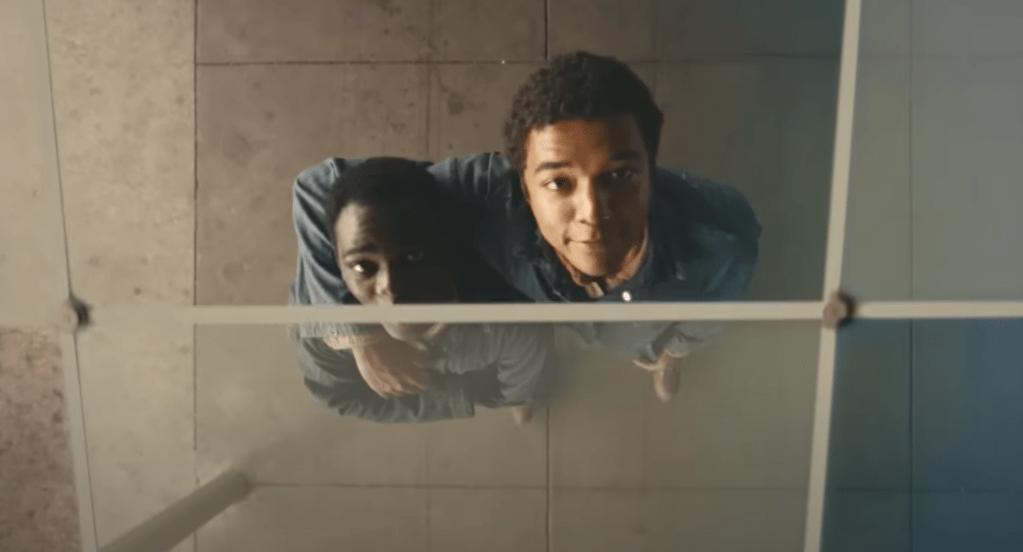
How is the film then? Well, on the one hand I am over the moon excited about the stylistic, formal exercise that this film is built around (a first person point-of-view that even, sometimes, switches from character to character). It makes for such a special viewing experience and I am all about such experimentation, especially when it is used to tell an important story such as this one. However, on the other hand, I also think it has a few elements that hold it back from the ‘undeniable masterpiece’ status that the word-of-mouth had indicated.
While I got a lot out of the film and found it to be a rich, fascinating experience, it is, at 140 minutes, a tad overlong. Sometimes the stylistic exercise, though rewarding, gets in the way of the pacing and the forward momentum, as it, strangely, becomes harder to be fully immersed in the narrative, the performances, and the characterizations. This is despite the fact that what the film is doing — effectively putting you in the shoes of young African-American men — still works to turn this into a transformative and transportive viewing experience. I was constantly thinking about the Ebert quote about cinema’s power as an empathy generator, as it places you in the lives of others. This is arguably one of the most powerful examples of that, despite the stylistic exercise sometimes keeping you at a distance.
The cinematography is astoundingly good (somehow this didn’t get an Oscar nomination in that category, which is a travesty). It is both in the often effective carrying out of its stylistic exercise, which is both clever and feels, at times, Malick-esque, but it is also in the rich and gorgeous shooting of genuinely affecting moments of memory that become larger than life and powerfully evocative. There’s the extended train car time lapse, the Christmas lights covering trees in the dark, the young girl on the floor of the bus, the grandmother dropping golden tinsel on our lead character’s head as they’re decorating the Christmas tree. I could go on. It is all done in this indescribably beautiful way that touches you deeply. There are also moments with really effective sound design, like in the scene where Aunjanue Ellis-Taylor, who gives the film’s most memorable performance, is scraping cake off a knife. And, ultimately, despite the fact that it has its issues with regards to its twist (which I’m not sure is executed as well as it could’ve), pacing, and the difficulties with immersion, the final hour really does bring it all together in a great way, even though I do think the ending is a little bit too abrupt.
This is an astoundingly good and confident narrative feature directorial debut from RaMell Ross, a professor and Oscar-nominated documentary filmmaker, even though I have slight issues with it. I’ll also add that its use of archival footage is eye-opening and fascinating, as, for example, it both helps to establish the period and to contrast the historical progress being made with the barbaric injustices being committed at the same time (given the choice of certain archival footage, I was reminded of “Whitey On the Moon”). On the whole, this is an occasionally powerful historical drama that works as something of a meditation on the memories that make up identity and the experiences and injustices that must not be forgotten.
8 out of 10
– Review Written by Jeffrey Rex Bertelsen.

 I'm Jeffrey Rex
Excellent reviews as always. I absolutely adored this movie. As someone who has once attended an abusive school many years ago, it truly resonated with me on a personal level. I thought it was such an emotional, powerful and important film about a subject that isn’t discussed often enough today. So happy that it got a best picture nomination.
Here’s my thoughts on the movie: