
Directed by Matthieu Delaporte and Alexandre de La Patellière — Screenplay by Matthieu Delaporte and Alexandre de La Patellière.
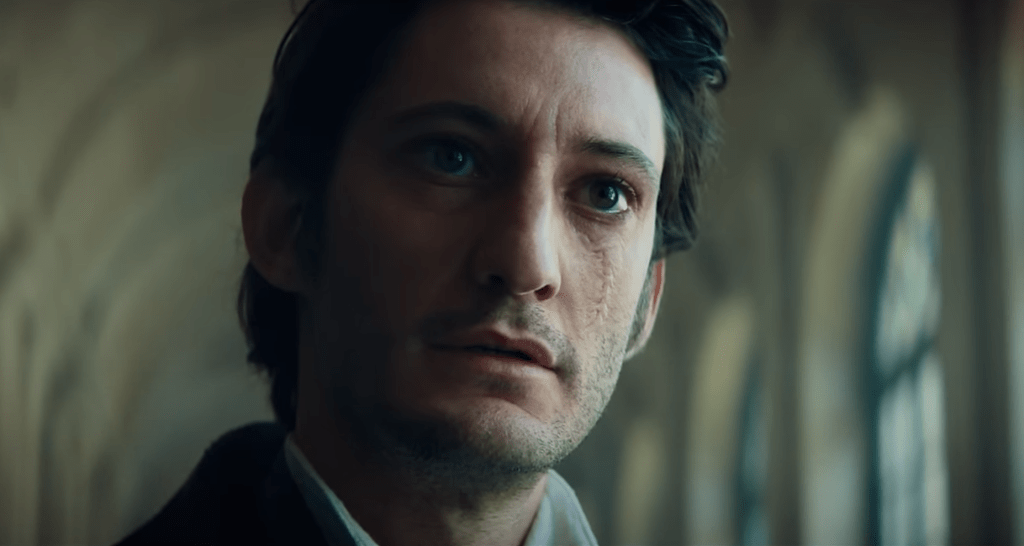
Based on Alexandre Dumas’ novel of the same name, The Count of Monte Cristo is set in the 1800s, where we follow Edmond Dantès (played by Pierre Niney), a recently promoted sailor, who, during his wedding with his fiancee Mercédès (played by Anaïs Demoustier), is arrested and accused of being a Bonapartist. Though innocent, Edmond is betrayed by people he thought that he could trust and is, eventually, imprisoned indefinitely on a harsh prison island. When he starts talking to his neighboring inmate Abbé Faria (played by Pierfrancesco Favino), Edmond starts to plan for both an escape and sweet revenge on the people who wronged him.
This is obviously one of the most famous stories ever told, and, yes, it has been adapted into more than a dozen films over the years. That said, I can’t claim to be a walking, talking encyclopedia of this story or its adaptations, and, as I was watching this, I didn’t really compare it to any other version of the story, I just let the telling of the narrative take me away, and, boy, did it.
For films that are longer than two and a half hours, the number one issue they can run into is them overstaying their welcome or running out of steam along the way. Thankfully, this latest adaptation never runs into that problem. Time flew by and I was fully engrossed in the narrative. Despite, of course, featuring plenty of castles and costumes and whatnot, I don’t think it ever feels stuffy or stiff. Somehow the filmmakers manage to keep the epic story of vengeance and justice dynamic without feeling overly flashy. Instead, it holds you in the palm of its hand, carrying you the distance, without ever loosening its grip.
Throughout the film, you’re met with a top-notch production that looks expensive and full of passion. In addition to the surprisingly strong pacing, the score is solid, the scale-emphasizing cinematography hooks you, the colors pop appropriately, and the set design is lavish and impeccable. From the first scenes with the burning ship and the massive waves to the iconic last line, the film just nails that action-adventure swashbuckling look but with an appropriate emphasis on the search for revenge. I remember when Disney sought out Joachim Rønning and Espen Sandberg after their strong raft-based adventure drama Kon-Tiki, and, similarly, I think Disney is now looking in Matthieu Delaporte and Alexandre de La Patellière’s direction for the next Pirates of the Caribbean chapter.
Performance-wise, I was particularly vested in the work done by Pierre Niney, as the central and vengeful protagonist, but also Anamaria Vartolomei as Haydée, despite her character sometimes lacking in characterization depth. The ‘Andrea’ character could also maybe have used some more work. But, really, my main nitpicks are that the disguise in the film is somewhat unbelievable — they didn’t exactly have Mission: Impossible masks in the 1800s — and, then, that the final sword fight wasn’t as elegant and entertaining as it could’ve been.
But, as a total package, Matthieu Delaporte and Alexandre de La Patellière’s adaptation of the iconic narrative always held my attention and is probably the best non-English language attempt at epic adventure storytelling that I’ve seen done in quite some time. This is definitely one of the best surprises in the last twelve months, and, frankly, it’s also probably one of the very best films of 2024. Despite my nitpicks, I found it to be such a fulfilling epic film that I was, honestly, a little bit surprised Emilia Pérez got the official French submission for the Oscars ahead of it. I’d happily watch this again.
8.5 out of 10
– Review Written by Jeffrey Rex Bertelsen.

 I'm Jeffrey Rex
One thought on “The Count of Monte Cristo (2024) | REVIEW”