
Directed by Steve McQueen — Screenplay by Steve McQueen.
Despite sharing a name with the celebrated American Bullitt-actor known as the so-called ‘King of Cool,’ this film’s director, the British Steve McQueen, has done a lot to cement himself as one of British filmmaking’s most clear artistic voices, while at the same time becoming not only a critical darling but also someone who has been celebrated at award shows and, in general, for his contribution to culture. After he burst onto the scene as a feature filmmaker with the capital-g great films Hunger, Shame, 12 Years a Slave, and the underseen Widows, McQueen went on to make Small Axe, a phenomenal anthology series about racism, activism, and the joy and spirit of specific communities in mid-to-late 20th century Britain. Since then he has been knighted, and then gone on to make a couple of attempts at documentary filmmaking with his Uprising and Occupied City. Now, with Blitz, he has made his return to narrative feature filmmaking, and while it is not quite as good as his best output, it is absolutely consistent with the artistic interests for which we have come to know him.
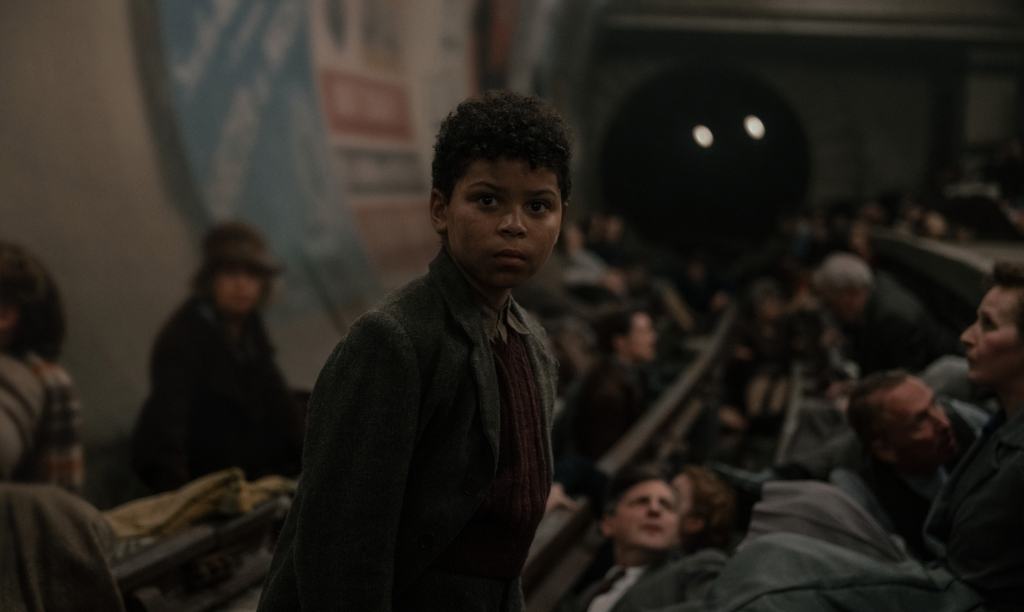
Set in London in the early 1940s, Steve McQueen’s Blitz is a film that depicts the violent bombing campaign against the United Kingdom during the start of the Second World War. At this point in time, the German Luftwaffe systematically bombed the English capital for eight long months, during which time more than 40,000 civilians were killed. In McQueen’s picture, we follow a mother, Rita (played by Saoirse Ronan), and her son, George (played by Elliott Heffernan), as the former works as a munitions worker, while the latter is sent away for evacuation on a train. However, when George defiantly decides to jump off the train to return to his mother, he goes on a dangerous adventure that could cost him his life, but which will also teach him a thing or two about the complexities of his identity and the communities he was born into.
I was initially quite intrigued and excited by this project because of how this film appeared to be some sort of blend of Sam Mendes’ 1917 and Steven Spielberg’s Empire of the Sun though seen through the artistic interests and sensibilities of McQueen. And while that description does apply somewhat to this film, I did not expect for it to be as Dickensian as it ultimately is. I think the sometimes slightly exaggerated Dickensian elements — e.g. Stephen Graham’s character and subplot and George’s involvement in it — take you out of the experience of being wrapped up in the film, but I also think that McQueen designed these sometimes almost cartoonish elements in the George-storyline deliberately for the purpose of having this be accessible to younger audiences. Whether or not that is appropriate or wise will be up for debate, as it is a war film that wants to have its cake and eat it too, in a way. It both wants to be a Dickensian adventure with war and injustice seen through the eyes of a child, as well as have very dark and horrific elements. As such, I think there is a tonal unevenness to the narrative that, although it may be intended to highlight George’s obvious gradual loss of innocence, sometimes makes it difficult to fully get on the film’s wavelengths. I also think that there are several times when the film cuts away from the action or has certain pivotal moments happen off-screen that, frankly, hinder the effectiveness of its most harrowing scenes.
Furthermore, Blitz also seems a tad too cursory in its depiction of various groups at the time. I especially wanted more from the environment that Saoirse Ronan’s character was thrown into as a munitions worker, or, frankly, the world that the soldier that Harris Dickinson played was a part of (strangely, Dickinson is barely in the film). Because McQueen only briefly touches on these elements, you get the sense that the picture may have been stronger if it had opted for a single focus. Every so often you get glimpses of elements that are super interesting or extremely well done, but it doesn’t go deep enough in the important storylines. If you want to be cynical about this, or overly critical, you might say that it almost feels like he’s too much in documentary-mode still and not enough in narrative-mode, but I think that’s a harsh stretch. I do think the film deserves credit for how effective these glimpses are. I just think the film ought to have either dived deeper into the different narrative elements, opted for that single focus, or maybe McQueen should’ve even made this as a series instead. This, however, isn’t to say that this is a bad film — it really isn’t.
As you would expect given McQueen’s thematic interests in his oeuvre, he pays particular attention to his main character — George — and his complex racial identity. Instead of opting for this film to be just the aforementioned predictable ‘loss of innocence’ narrative, McQueen wisely and effectively crafted narrative elements and scenes meant to emphasize how George learns to embrace all aspects of his racial identity with the way he learns more about his country and his countrymen over the course of his arduous journey back home (including in the wonderful scenes shared between Elliott Heffernan and Benjamin Clementine). Admittedly, none of these scenes are particularly subtle about McQueen’s core messages about racial identities, multiculturalism, or racism’s impact on British history, but they are effective and, by opting to tell this aspect of wartime (of racial self-discovery, as well as the complexities of belonging to a nation with so much xenophobia), he manages to put a spin on a WWII film that not only makes it unique but which also can help to enlighten others.
Furthermore, McQueen has certain scenes that recapture the kind of period spirit and joy that he did such a good job of highlighting and evoking in his Small Axe films. I am thinking specifically of two dance and nightclub scenes that stick with you. There is an early sequence with a lot of excited dancing, which features Saoirse Ronan and George’s father, that clearly had so much love and energy poured into it. It is perfectly edited and shot, and you can almost feel the temperature of the club they’re dancing in. It’s very Lovers Rock. Later, there’s another, perhaps more formal, night club sequence that’ll also stick with you, but for different, but still quite effective, reasons. So while, yes, there is an uneven quality to the film, as well as some issues with focus or depth (or a lack thereof in certain subplots), Steve McQueen’s Blitz still contains many extremely effective moments. The costuming and production designs are also strong, while Hans Zimmer’s eerie and ominous score is terrific, as it may manage to send a chill down your spine due to how it sometimes sounds like it was meant for a horror film. It likely won’t be as celebrated as the narrative films that precede it in McQueen’s oeuvre, but it is nonetheless a competently made film with glimpses of greatness scattered over the course of its two-hour runtime.
7 out of 10
– Review Written by Jeffrey Rex Bertelsen.

 I'm Jeffrey Rex