
Directed by Alex Garland — Screenplay by Alex Garland.
I would definitely describe myself as a fairly big fan of writer-director Alex Garland. Although he, as a writer, had already influenced a couple of personal favorite genre films in the early 2000s — specifically Danny Boyle’s 28 Days Later and Sunshine — I must admit that I didn’t really know who he was until I saw his feature directorial debut titled EX_MACHINA, which is this breathtakingly fascinating and stunning science-fiction masterpiece. After blowing me away with his debut as a director, he cemented himself as a true master of the science-fiction genre with his equally thought-provoking and spellbinding sophomore effort titled ANNIHILATION. Following his sophomore directorial effort, his career trajectory changed slightly as he created, wrote, and directed the underseen but very good FX sci-fi series titled Devs. He then made his third feature as a director, but it, a folk horror film titled Men, didn’t quite receive the warm critical reception that his previous efforts did. Some might think that after the lukewarm reception to his third outing, he would be tempted to make something less button-pushing or with fewer potential pitfalls. Not so. Civil War, his fourth film as a director, is his biggest film yet, and it dares to imagine a world where tensions as a result of dangerous, hateful polarization — perhaps not unlike today — have devolved in such a way that the United States of America has entered into a modern — you guessed it — civil war. Along with the release of his biggest and potentially most controversial film yet, Garland has also suggested that he has fallen out of love with filmmaking and may be stepping down from directing. But if Civil War is evidence of anything for Garland, it is that he is a filmmaker who knows how to craft a fascinating film that can ratchet up the tension and ask interesting questions.
Set in near-future dystopian America, Alex Garland’s Civil War follows Lee Smith (played by Kirsten Dunst), a dejected but renowned war photographer, who intends to travel to Washington, D.C. to photograph and interview the President of the United States (played by Nick Offerman) at this late stage of a civil war that has fractionalized the country and led to violence and several crimes against humanity. Tagging along is Joel (played by Wagner Moura), a journalist; Sammy (played by Stephen McKinley Henderson), an older journalist who is Lee’s mentor; and, finally, Jessie (played by Cailee Spaeny), a young aspiring photojournalist who idolizes Lee. Along the way, the group witnesses the deteriorating state of the country, encounters dangerous militants, and witnesses how some people are willing and able to live blissfully in ignorance despite the gravity of the situation. On their journey, Lee and Jessie grow closer, as the latter becomes more assertive and bold about her vocation.
I can’t possibly talk about this film without talking about the discourse surrounding the film, which has focused on whether or not Alex Garland’s film is right or wrong in being vague about the details of his film’s politics and the reasoning for the disturbing fractionalization of the United States of America in his movie. Some think it’s a cop-out, while others are more understanding. Here’s my take. Civil War insists on not being politically didactic, as it, yes, deliberately makes details vague so as to not further polarize audiences. The marketing and the current-day politics of America have perhaps twisted audience expectations in such a way that they may expect more of a moral lesson from this. Frankly, it is probably difficult to get away with divorcing your film from the political landscape that it is released into given that it is a film explicitly set around a political polarization and a downfall of the United States. This is especially true since the film has been released into a Post-January 6th America and in an election year, no less. Perhaps Garland felt that it was not right to wag his finger with a moral lesson as he, as a Brit, has a foreign perspective, but, on the other hand, foreign perspectives should be welcomed since those with foreign perspectives can, in some instances, perhaps take a step back and view things more clearly. However, I do think Garland’s foreign perspective is felt somewhat given that I’m not sure a prestige filmmaker from America would feel as comfortable doing what he does to American iconography in the film, but I digress.
One might insist that it would be wrong for the film to argue for or against a political party ideology in an election year during actual extreme polarization in America, but, on the other hand, isn’t it also a little bit like treating the chosen subject with kiddie gloves and borderline irresponsible to not engage with the political unrest of the country which you as a filmmaker are exploiting to tell your story? After all, you can’t just disentangle your film from the environment it is released in or the unrest that the film is very clearly born out of. This is the crux of my complicated feelings on the film; on the one hand, I do feel like it is fair not to want to engage with a certain element of modern-day politics in your film, but, conversely and given everything, I also think it’s perhaps wrong not to. After all, despite what Garland may suggest about this film’s centrism or deliberate apolitical aims, I also think it is very clear in the text exactly who Nick Offerman is built on through his character’s dialogue and what we learn about the president in the film, so it isn’t like the film is completely apolitical — it just acts like it is (and only sometimes gets away with it).
I do think it is fair to say that the film pulls some of its punches, at moments when it’s clear it ought to be pushing buttons. And, frankly, when it does feel intended to be politically provocative in our current landscape, it feels too hollow to really mean much (and, frankly, its hollowness and vagueness are arguably the most provocative elements in the film). But how much of this is about what you bring with you into the theater and how much of this is what the film gives — or fails to give — you? I can’t say for sure, as I’ve only seen it once. But, as stated above, I don’t think it is completely apolitical. Also, when, eventually, enough time is separated from the current political moment (assuming everything will eventually turn out fine), I do think this film will work and sit better with a lot of people. Separated from the heated current political moment in America, this film’s vagueness probably won’t feel as inherently provocative politically. More than anything else, though, I think what Alex Garland wanted to do with this film was — like the journalistic code of some of his characters — ‘shoot the film and let others ask the questions’ as a result of it (shoot first, ask questions later essentially). He wanted to provoke the conversations that this review is dancing around and struggling with, but more so I think he wanted to, like Dunst expresses in the film, have it be seen as the warning that war photography is sometimes meant to be — a warning about the state of political division in America — but also a discussion about the tenets of journalistic necessity, integrity thereof, complexities therein, and the fourth estate as a whole.
Garland’s reported goal of celebrating journalists who can “remove their biases” is admirable, but I’m also not entirely sure photojournalism is then the profession to go with given the age-old adage about how every single image — whether filmed or photographed — is selective. It cannot be purely objective, as every single frame is designed deliberately with aspects kept in the frame and other aspects excluded from the frame. I do wonder if Garland’s film is deliberately staying centrist so as to protect the commerciality of the film but also, frankly, ensure its existence in the first place. Could this film be given the budget and the wide release that it has if Garland had opted to fully infuse the film with political content? In any case, his film is designed in such a way that it is not perceived as didactic, emotional, or propagandist. And it is in the absence of that where I think Garland wants to sit, so as to ensure a kind of journalistic trustworthiness (the idea of reporting and not opinion-ating), which, however, I’m not sure can be described as objective or completely devoid of biases due to the inherent selectiveness of filmmaking and photography.
I think a lot of the discourse surrounding the film has been about what the film isn’t rather than what it actually presents you with when you watch it. But, as I have tried to do above, to engage with this film critically, I do think you have to assess and discuss its interests, its deliberate omissions, and its role in ongoing discussions that are above it. However, if you separate the expectations, the discourse, and the marketing from the film, then you have a pretty damn gripping flick. It is essentially a road film with journalists (some aspiring others jaded) who are all enveloped or surrounded by utter chaos. The film excels in these extended sequences that showcase the state of the country in different ways, but also in the way war journalists put their bodies on the line to report. From a filmmaking craft standpoint, it is a pretty terrific effort with strong cinematography, sound design, and memorable imagery. There are notable performances that elevate the film significantly. Kirsten Dunst delivers a quietly powerful performance, and I also think that Cailee Spaeny is quite good in a, sort of, coming-of-age type role.
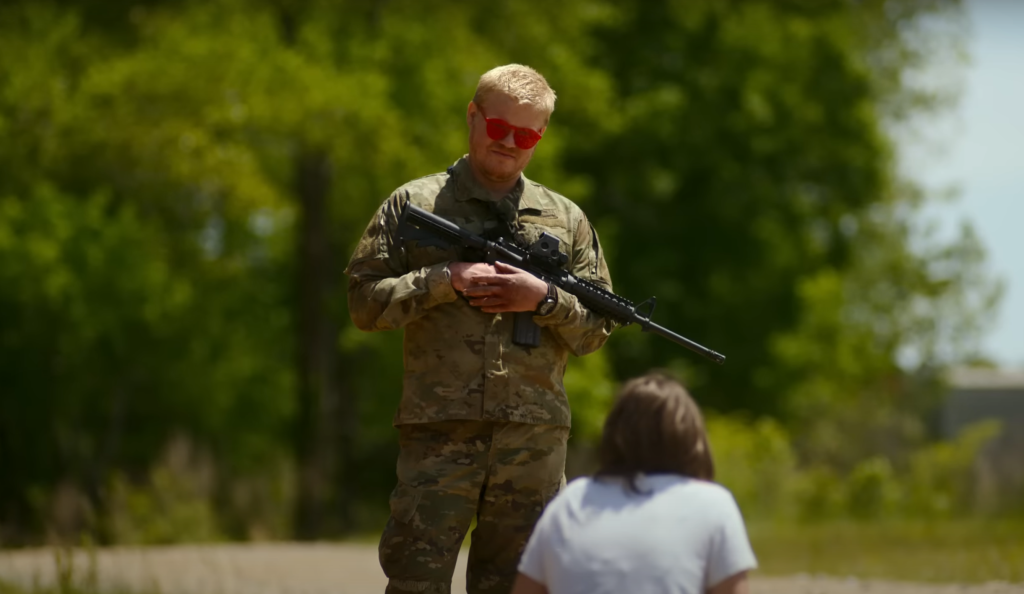
There are some sensational sequences, set-pieces, or chapters that are among some of the best scenes in any film that has been released this year. There is a thought-provoking sniper battle that says a lot about the futility of war between individuals and how ideology loses meaning on the battlefield, and then there is the much-discussed sequence in which Jesse Plemons appears as a deeply racist militant who threatens the lives of our main characters. The Plemons sequence is one of the tensest scenes of the year, and, frankly, Jesse Plemons almost steals the entire film away from the core cast with his chilling and somehow seemingly effortless intensity. Plemons is phenomenal. I will say that I am frustrated by a certain prior scene’s contrivance, as well as its eye-rolling and jarring goofiness precisely because the aforementioned Plemons sequence only happens because of this other scene’s unbelievable moment of journalistic foolishness. Furthermore, most of the characters that aren’t played by Spaeny and Dunst lack complexity and heft. Put bluntly, the male main characters in the film are extremely one-note with Wagner Moura especially deserving of more to work with given the significance of his role in the narrative.
Alex Garland’s Civil War is one that already divides opinion, and I do think there is a chance that people’s unease about its political vagueness may lead to the film being destined to only flirt with greatness and never quite reaching it, instead living somewhere between inadequate and good, for most people. It is a film where I have complex feelings about its intentions and its deliberate vagueness, but, at the same time, it is also undeniable, at least to me, that it features great filmmaking and performances that, along with its thought-provoking aspects, help to make it one of the most memorable films of the year thus far. While the political commentary may be half-baked to some, what absolutely is baked in and quite clear is the personality, actions, and classification of the President, most of which resemble many people’s perception of a certain recent former POTUS (even if they’ll never admit that it was intentional). Garland is just not layering it on too thick, and I wonder if that is mainly to protect his film.
7.9 out of 10
– Review Written by Jeffrey Rex Bertelsen.

 I'm Jeffrey Rex
Another great review. I have heard mixed reviews for this movie so I’m not entirely sure whether I will watch it. Truthfully, films about American politics have never interested me. That being said, this film does have an amazing cast of actors that I appreciate. For instance, Jesse Plemons is a fantastic actor proving he can excel in any role. He is really good at playing suspicious characters with despicable intentions. Recently, I admired his performance as a slimy FBI agent in Martin Scorsese’s “Killers of the Flower Moon”. Here’s why I admired that film:
Plemons is excellent and has a tendency to recently steal films from their leads (e.g., ‘Game Night’).
Thank you for the nice comment.