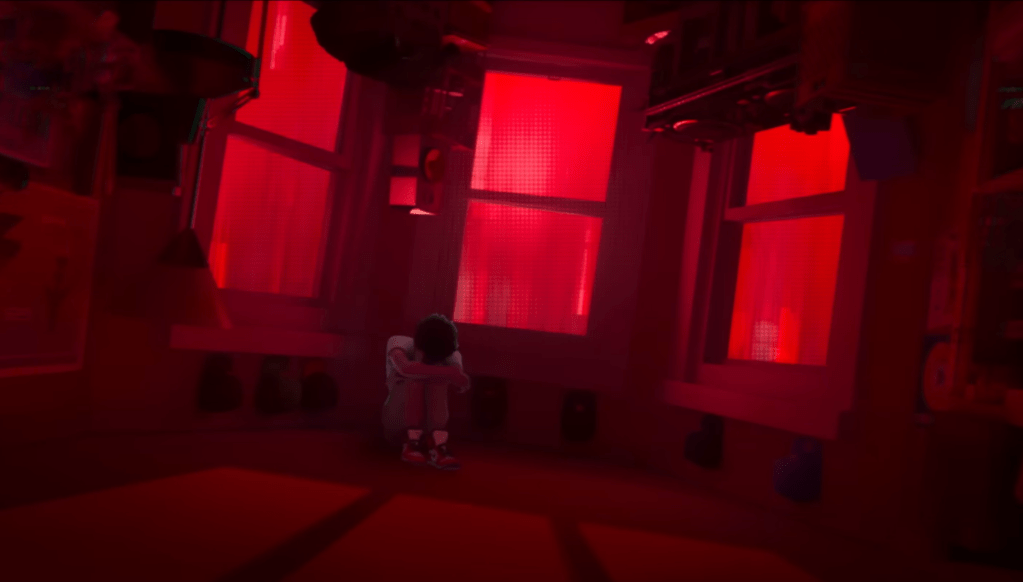
Still image from Sony Pictures’ THE SPIDER WITHIN: A SPIDER-VERSE STORY, directed by Jarelle Dampier — PHOTO: Sony Pictures Entertainment.
Directed by Jarelle Dampier — Screenplay by Khaila Amazan.
Sony Pictures Entertainment has today released Jarelle Dampier’s animated short film The Spider Within: A Spider-Verse Story on YouTube (click here to watch it). The animated short film, which originally premiered at the Annecy International Animation Film Festival in June of 2023, is a part of Sony’s animated Spider-Verse trilogy, and it is set between the events of Spider-Man: Into the Spider-Verse from 2018 and last year’s sequel Spider-Man: Across the Spider-Verse. In the animated short, we follow Miles Morales (voiced by Shameik Moore) as he returns home after a stressful day of crime-fighting and being a teenager and is approached by his father Jefferson Davis (voiced by Brian Tyree Henry), who wants to have a father-son night where they watch horror films on the TV and snack on popcorn. Miles, however, is unprepared for this, and he hides away in his room where all his fears manifest in the form of first a shadow and, later, spiders.
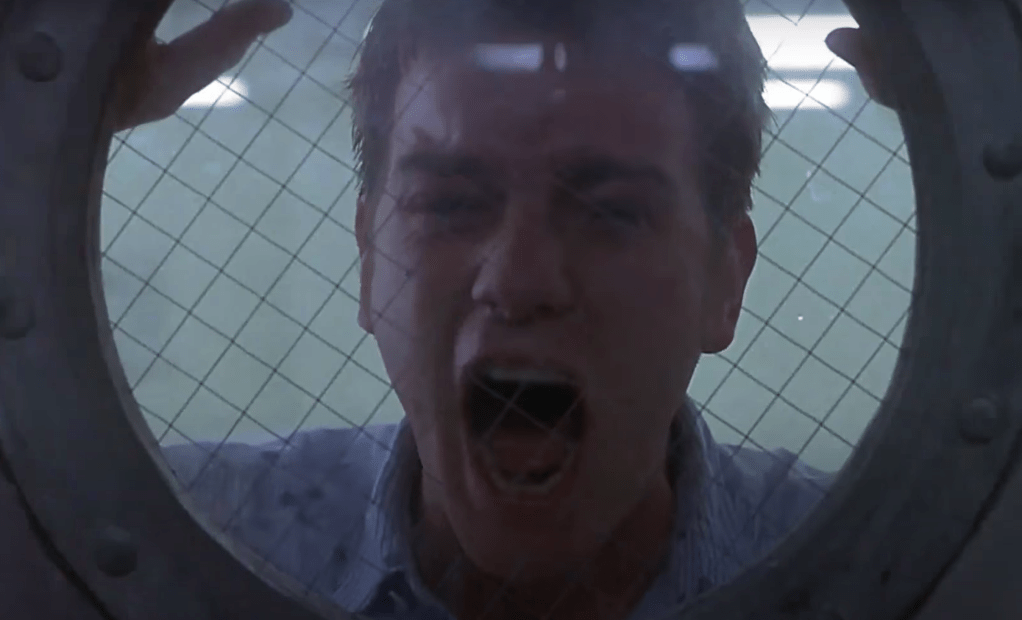
Ewan McGregor as ‘Martin’ in NIGHTWATCH — PHOTO: Dimension Films.
Directed by Ole Bornedal — Screenplay by Ole Bornedal and Steven Soderbergh.
A couple of months back, I decided to finally watch something that had been on my watchlist for such a long time, but which I was kind of dreading watching. I am referring to the English-language remake of Ole Bornedal’s Nattevagten, one of the most beloved and iconic Danish horror films. Although there are instances in which an English-language remake or reimagining of a Danish film can result in something akin to an improvement (see Michael Bay’s Ambulance), more often than not, though, English-language remakes of Danish films go one of two ways, either they result in A) a bland copy (though often with a more internationally recognizable cast) or b) an unnecessary remake that is so bad that it ruins the chances of the original reaching a larger audience by mere association. Make no mistake, Dimension Film’s English-language remake of Nattevagten, Nightwatch (also directed by Danish director Ole Bornedal), is not an improvement whatsoever. And, frankly, of the previous A and B options, Nightwatch is decidedly more in the A category. Nightwatch does have a more recognizable cast, but the American product is inferior, less interesting, and, yes, quite bland. This also means that it isn’t the Americanized abomination that I feared, but that, however, doesn’t mean that it is good.
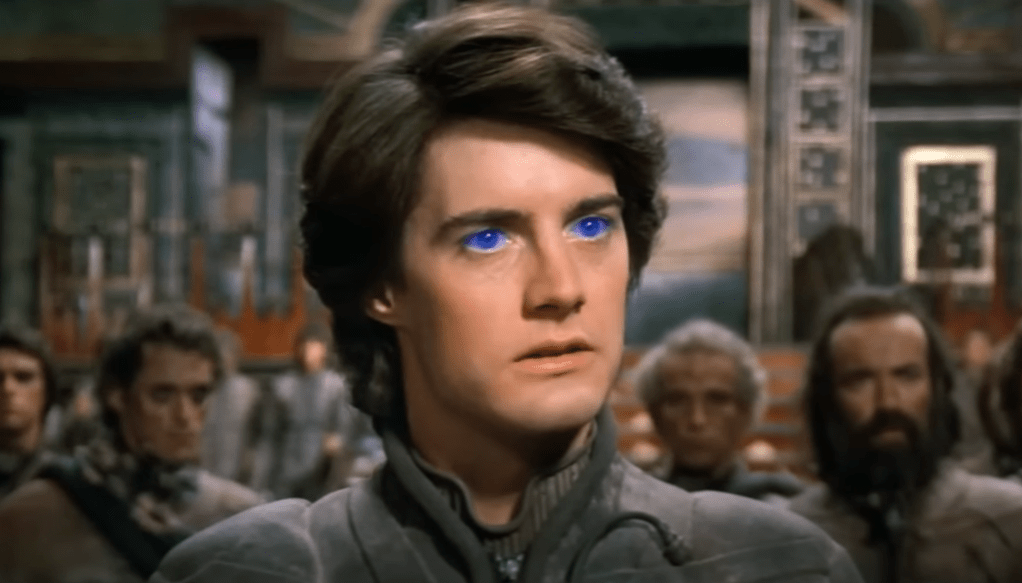
Kyle MacLachlan as Paul Atreides in David Lynch’s Dune — PHOTO: Universal Pictures.
Directed by David Lynch — Screenplay by David Lynch.
With the recent release of Denis Villeneuve’s hotly anticipated Dune: Part Two, it felt right to finally have another look at the first major adaptation of Frank Herbert’s 1965 sci-fi novel Dune — i.e. David Lynch’s Dune from 1984. Even after having ‘rewatched it,’ I’m, honestly, still not entirely sure if I had seen this before. I’m pretty sure I watched this when I was a kid and was obsessed with sci-fi (I watched everything), and, as I was watching it, it felt like I had seen a lot of this before. I asked my dad — who showed me Star Wars, Stargate, and whatnot — and he’s pretty sure he showed me Lynch’s Dune as well. But, hey, 7-to-10-year-old-me probably struggled with this as much as moviegoers in the 1980s reportedly did (Gene Siskel and Roger Ebert apparently both hated the adaptation). Now, it’s so interesting to view this after having seen Denis Villeneuve’s two-part adaptation and having read about 300 pages (or so) of the original novel. Now, I don’t want to take anything away from David Lynch because I think he is a very good filmmaker, and he, himself, has essentially admitted that he failed with his adaptation of Frank Herbert’s iconic novel, but, man, let’s just start by saying that Villeneuve’s adaptations are an improvement on Lynch’s film in every conceivable way.
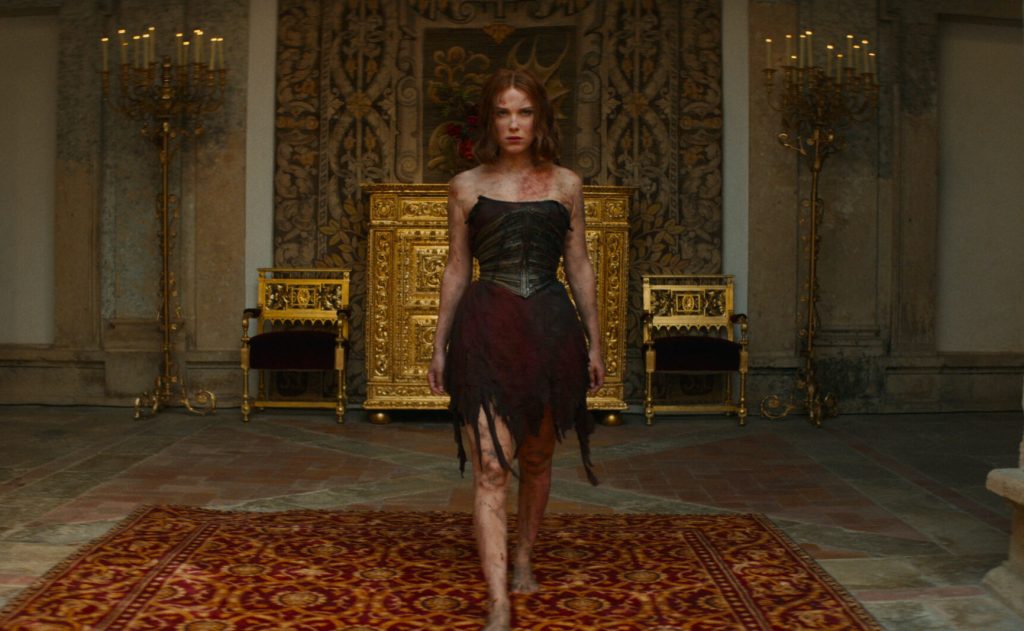
Millie Bobby Brown as Elodie in Damsel — PHOTO: Netflix.
Directed by Juan Carlos Fresnadillo — Screenplay by Dan Mazeau.
28 Weeks Later-director Juan Carlos Fresnadillo’s Damsel is a fantasy film that follows a teenage girl named Elodie (played by Millie Bobby Brown) as she is urged by her father Lord Bayford (played by Ray Winstone) to accept a royal proposal to marry Prince Henry (played by Nick Robinson), the son of Queen Isabelle of Aurea (played by Robin Wright). Although there is initially no spark between the prince and our heroine, whose people need the wealth her marriage would afford them, they warm to each other once they get to know each other. But as the tagline on the poster would have you know, this is no fairytale. After the wedding, Elodie and her new husband Prince Henry are taken out to the mountains where they must take part in an ancient ritual, which reveals the true intentions of the royal family.
Directed by Andrew Haigh — Screenplay by Andrew Haigh.
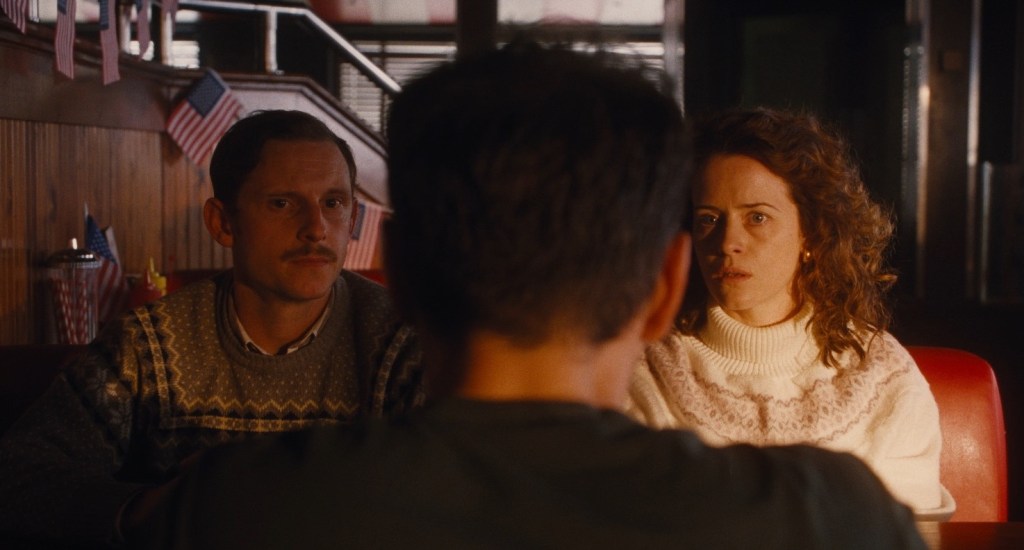
Loosely based on Taichi Yamada’s 1987 novel titled Strangers, Andrew Haigh’s All of Us Strangers follows Adam (played by Andrew Scott), a lonely screenwriter living in a high-rise London apartment building. One night, a drunk neighbor, Harry (played by Paul Mescal), knocks on his door hoping to have a good time with Adam that night. Though Adam refuses, Adam starts getting closer to Harry in the days to come. This is in part because he’s starting to work through some of his issues. Why now all of a sudden? Well, when, one day, Adam takes the train back to his hometown to look at the town he grew up in and around, he is approached by a man (played by Jamie Bell) who turns out to be his father. Adam’s parents died in an accident when he was just a young boy, and yet here is his father — at the exact same age that he was when he passed away. His father invites Adam back to his childhood home where he finds his mother (played by Claire Foy), who is also the same age that she was when she died. Overjoyed to reconnect, Adam and his parents gradually start to open up about things once left unsaid.
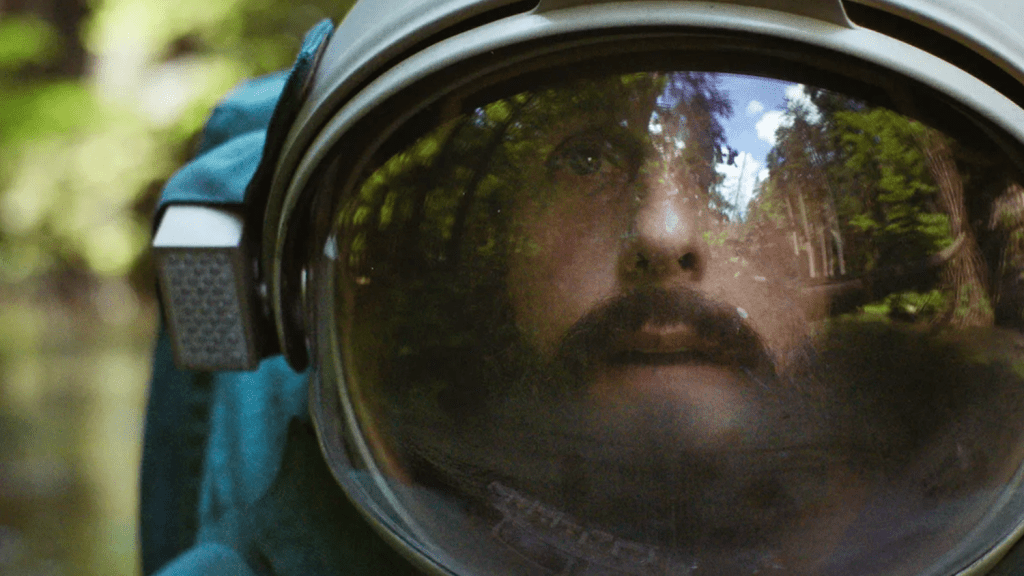
Adam Sandler as a lonely astronaut in Netflix’s SPACEMAN — PHOTO: Netflix.
Directed by Johan Renck — Screenplay by Colby Day.
Based on Jaroslav Kalfař’s 2017 science-fiction novel Spaceman of Bohemia, Johan Renck’s Spaceman follows Jakub Procházka (played by Adam Sandler), a Czech astronaut, while on a solo mission in space to investigate a mysterious particle cloud nearby Jupiter. His mission is in direct competition with that of a South Korean ship, which is also part of a relatively untraditional space race compared to the real world. By his lonesome on the spaceship, Jakub is feeling the effects of solitude and long-term space travel, and he desires contact with his pregnant partner Lenka (played by Carey Mulligan). Lenka has indeed prepared a video for Jakub to see, but, fearing that Jakub’s depression may worsen if it reaches him, the commander of the Czech space agency, Tuma (played by Isabella Rossellini), prevents it from reaching the most lonely human in space. That is because, in the video, Lenka expresses very clearly that she wants to leave Jakub for good. While Jakub gets lonelier and lonelier as he gradually gets closer to the mysterious particle cloud, he is approached by a massive spider-like alien creature, which has made its way into the spacecraft somehow. The alien arachnid, which is often referred to as Hanuš (voiced by Paul Dano), insists that it doesn’t want to harm this ‘skinny human.’ Rather, it wants to investigate our species and help Jakub with his troubled headspace.
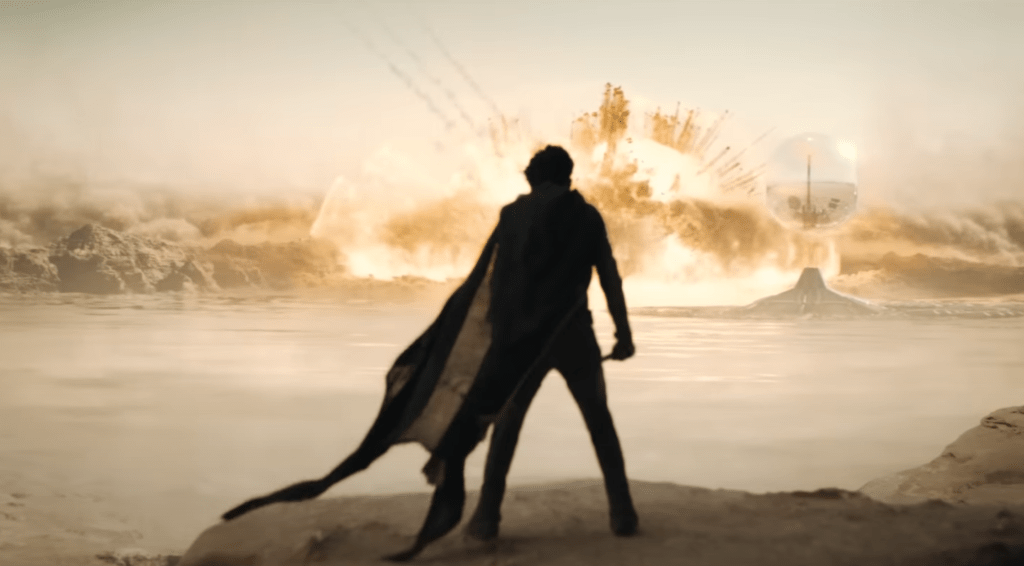
Timothée Chalamet as Paul Atreides in DUNE: PART TWO — PHOTO: Warner Bros. Pictures.
Directed by Denis Villeneuve — Screenplay by Denis Villeneuve and Jon Spaihts.
I don’t know if I’ve ever told this story before, but I have this vivid memory where — when I was probably around the age of ten — I looked up at my mother and asked her a question. I had either just seen The Lord of the Rings: The Return of the King, or else it was about to come out and I knew it was going to be the last film in the trilogy. With a note of sadness in my voice, I looked up at my mother and asked her something along the lines of “What happens after the Lord of the Rings? Will we ever get anything as good as that ever again?” You have to understand that in those early 2000s, we were being treated to fantasy filmmaking of the highest order with Peter Jackson’s Tolkien adaptations, while Sam Raimi was hard at work on Spider-Man 2 following the success of the first one, and after George Lucas’ Star Wars: Episode II — Attack of the Clones, we all knew that there was only a single film left in the so-called prequel trilogy. At the age of ten, I was blown away by what I was seeing, but I could also see an end to what we were getting. I wasn’t quite sure if this was a once-in-a-lifetime kind of perfect storm for fantasy and blockbuster filmmaking or not. Of course, in the years to come, Hollywood would go on to shovel dozens upon dozens of films with similar aims down our collective pop culture gullet, in an attempt to recapture what was so addicting and marvelous about Jackson, Raimi, and Lucas’ films. Hollywood, we must admit, often failed to recapture that. Now, it’s not like the Lord of the Rings, Star Wars, or Spider-Man is dead and buried — not by a long shot — but there is an argument to be made that none of those franchises have ever been afforded the same level of creative freedom for its principal filmmakers as was the case back then. So, what did my mother say? Well, with generosity and kindness in her voice, she assured me that, of course, major motion pictures with that sense of scale, scope, and artistry were not going away for good. She assured me that I had so much more to look forward to. My mother was right. Every so often something comes along that both feels like a throwback to the days when creative freedom was to be expected for filmmakers but which also feels like the perfect utilization of modern sensibilities and technical mastery. Denis Villeneuve’s two-part adaptation of Frank Herbert’s iconic science-fiction novel Dune is the perfect modern example of that. I feel so lucky. Now more than twenty years after my mother reassured me about the future of filmmaking — though perhaps not in as many words as I put it above — I have had the wonderful opportunity to watch Denis Villeneuve’s Dune: Parts One and Two in theaters with my mother, and both times the French-Canadian filmmaker has managed to both transport us to another world full of fantasy and science-fiction wonders, but also remind us — both mother and son in love with film’s transportive power — of the kind of storytelling that we love with all of our hearts.
Pool party at Rudolf Höss’ compound right next to Auschwitz in THE ZONE OF INTEREST — PHOTO: A24
Directed by Jonathan Glazer (Under the Skin) — Screenplay by Jonathan Glazer.
The other day, I overheard someone claim that she didn’t need to watch or read the news and that she shouldn’t be expected to. The memory of that remark came back to me after I saw The Zone of Interest, Jonathan Glazer’s BAFTA-winning German-language World War Two historical drama about evil, complicity, wilful ignorance, what is happening just outside our borders, and the walls that we create and construct for ourselves as a means to hide from the meanness, ugliness, and cruelty of the world. Now, I definitely don’t mean to compare an ignorant remark from someone that I just overheard with a Nazi commandant and his family, who are the principal characters of The Zone of Interest, but that person’s insistence on not keeping themselves informed reminded me of just how many people make a choice not to engage with politics and world events even at a time of great injustice in the world (e.g. the Russian invasion of Ukraine or the Israel-Hamas war). The Zone of Interest is a film about Nazis going about their day with ease, talking about mass genocide as if it is statistics, and turning a blind eye to what is happening in the concentration camp next door. But it also holds a mirror up to the modern day to remind us to stay informed, as well as to stay vigilant and look out for the kind of evil that may be happening around us. It also is a disturbing and clear-eyed fly-on-the-wall-esque example of the complexities of historical perspectives that we are afraid to try to understand. The film highlights how evil seeps into the games children play when their world is surrounded by cruelty, and how easy it is for some people to commit monstrous acts thoughtlessly. It is an extraordinary film, but also one that will be testing for a lot of people — not because of its visuals but because of the images its soundscape conjures up in your head and for how untraditional Glazer’s approach is.
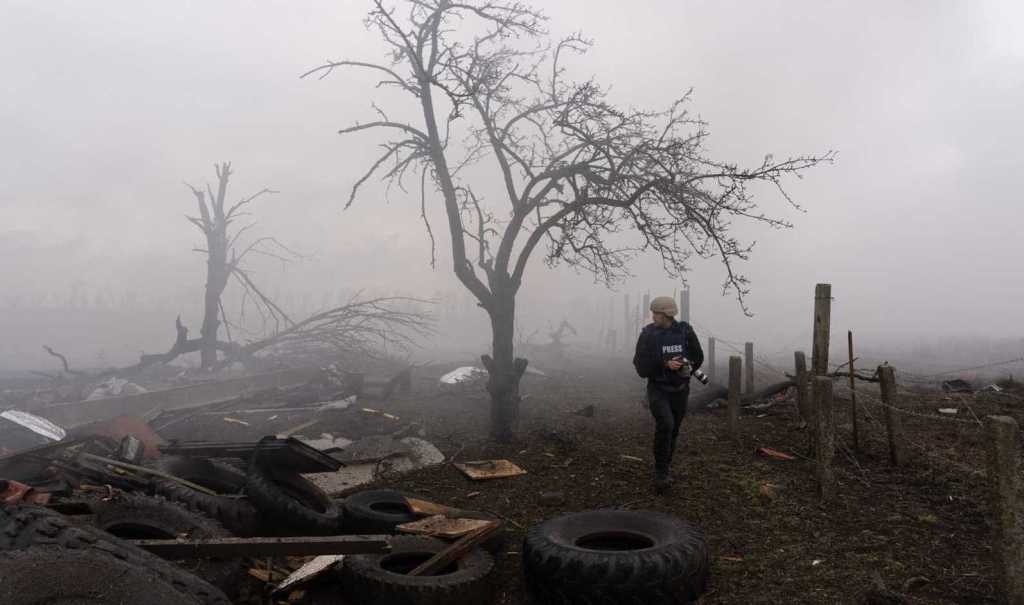
Photographer Evgeniy Maloletka picks his way through the aftermath of a Russian attack in Mariupol, Ukraine, Feb. 24, 2022. From 20 DAYS IN MARIUPOL. (AP Photo/Mstyslav Chernov)
Directed by Mstyslav Chernov.
Ever since I first saw Mstyslav Chernov’s on-the-ground documentary 20 Days in Mariupol in early January, I have been unable to shake it. Sure, one might argue that the reason for that is that the Russian invasion of Ukraine is still very much ongoing and is all over the news every single day. While it is true that I am already constantly thinking about the Russo-Ukrainian conflict, and I would be even if I hadn’t seen this documentary, the haunting images of Chernov’s film echo inside of my head whenever I think about the cost of life in Ukraine. Mstyslav Chernov’s documentary, which chronicles the twenty days that Chernov and his colleagues were on the ground covering the Russian invasion in the city of Mariupol, is the kind of film you don’t forget, but it is also the kind of film that you absolutely mustn’t look away from — it is vital that you watch this.
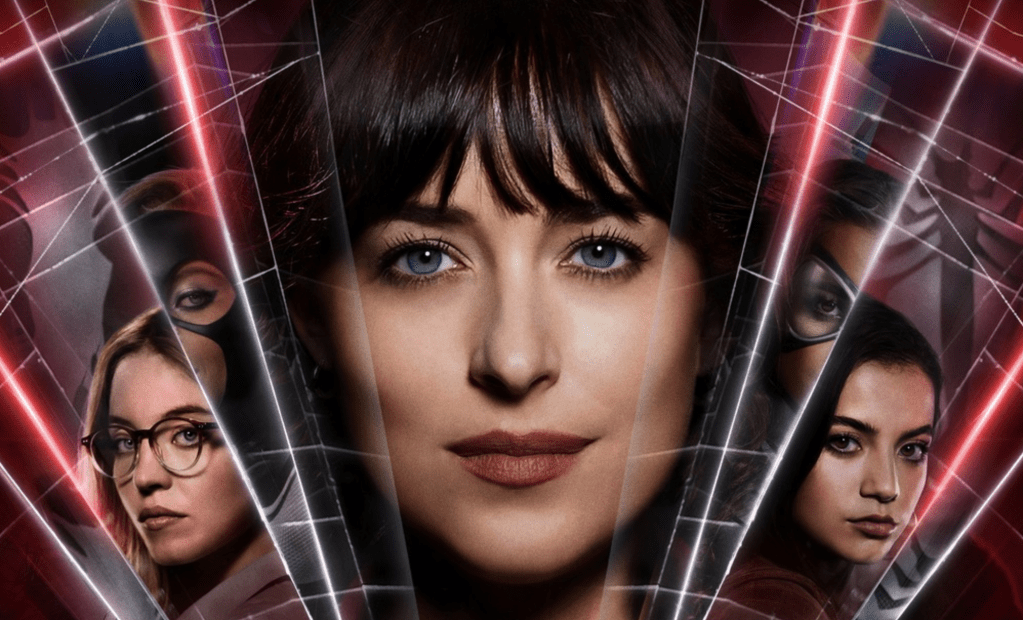
(L-R) Sydney Sweeney, Dakota Johnson, and Isabela Merced on the poster for MADAME WEB — PHOTO: Sony Pictures.
Directed by S.J. Clarkson — Screenplay by Matt Sazama, Burk Sharpless, Claire Parker, and S. J. Clarkson — Story by Kerem Sanga, Matt Sazama, and Burk Sharpless.
If Avengers: Endgame represented the absolute zenith of the 21st-century golden age of the Hollywood superhero movie craze — which was, in a sense, kickstarted in 2008 by Jon Favreau and Christopher Nolan — then I think it would be fair to say that this current moment could be the trend’s nadir. At the very least, this is undoubtedly one of its lowest points. Warner Bros.’s DC Extended Universe (DCEU) is sleeping with the fishes after the release of Aquaman and the Lost Kingdom, as Warner is preparing a clean reboot. The once always consistently good Marvel Studios — and their Marvel Cinematic Universe (MCU) — is struggling in the post-Endgame era, as the existence of Disney+ has led them to wrongly focus on quantity over quality (though some hope exists that they may have learned the error of their ways in time to properly course correct). Meanwhile, Sony and their half-in/half-out relationship with Marvel Studios and their MCU have led to a series of Spider-Man-related spin-offs that are, at best, superfluous curiosities and, at worst, ill-conceived cash-grabs. Credit where credit is due, Sony did create some of the most beloved superhero films of the early 2000s under the direction of Sam Raimi, their animated Spider-Man films are universally beloved, and whenever they’ve teamed up with Marvel Studios on a Spider-Man film, it has led to a final product that fans and the vast majority of critics agree is quite good. But, for some reason, Sony has struggled to cross the finish line without having to limp across it each and every time it has come to their live-action Spider-Man spin-off films. This was already apparent with both of their Venom films (Fleischer’s Venom and Serkis’ Venom: Let There Be Carnage) and it was impossible to deny with Morbius. Unfortunately, S.J. Clarkson’s Madame Web doesn’t change that downward trajectory for live-action Spider-Man spin-offs. Madame Web feels disconnected and desperate.


 I'm Jeffrey Rex