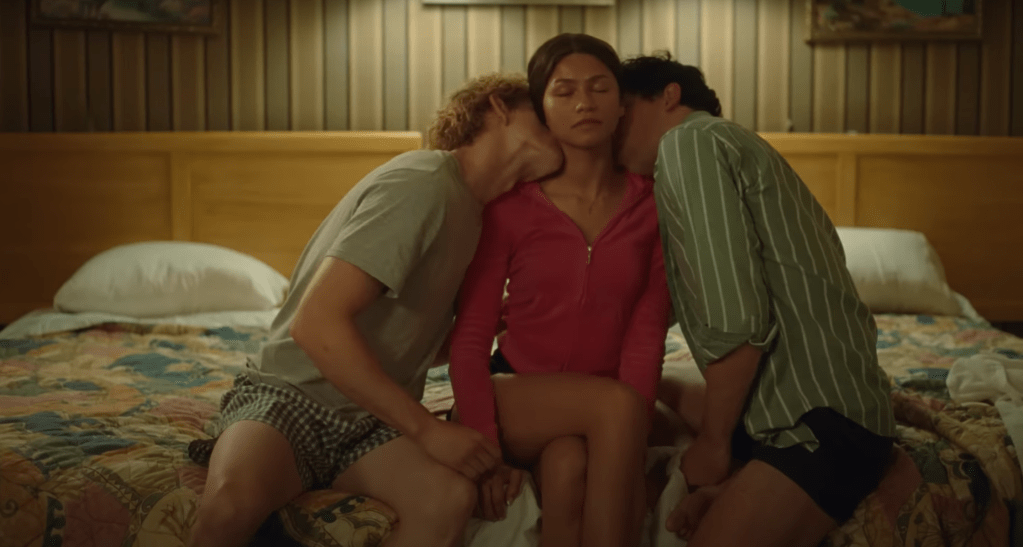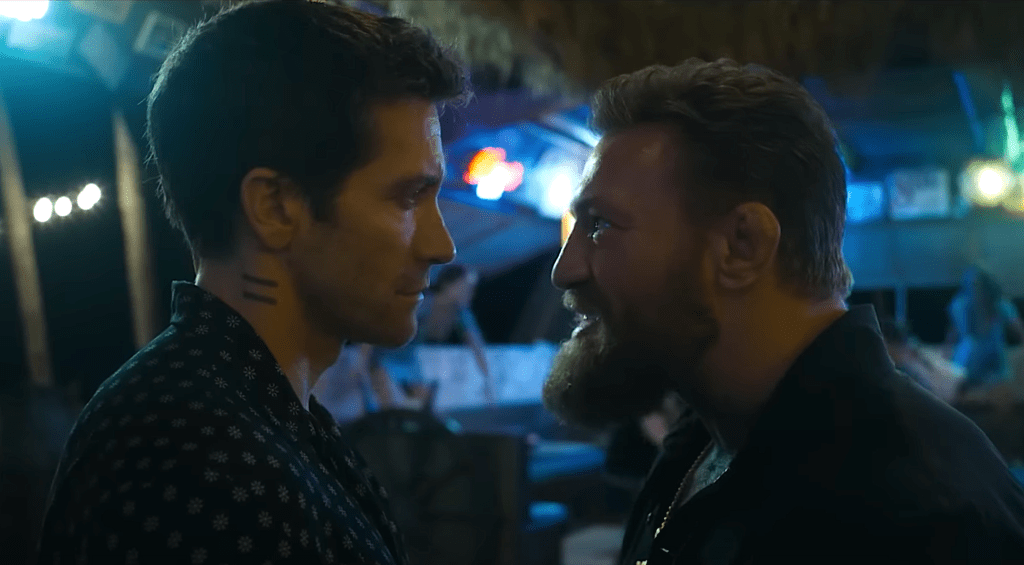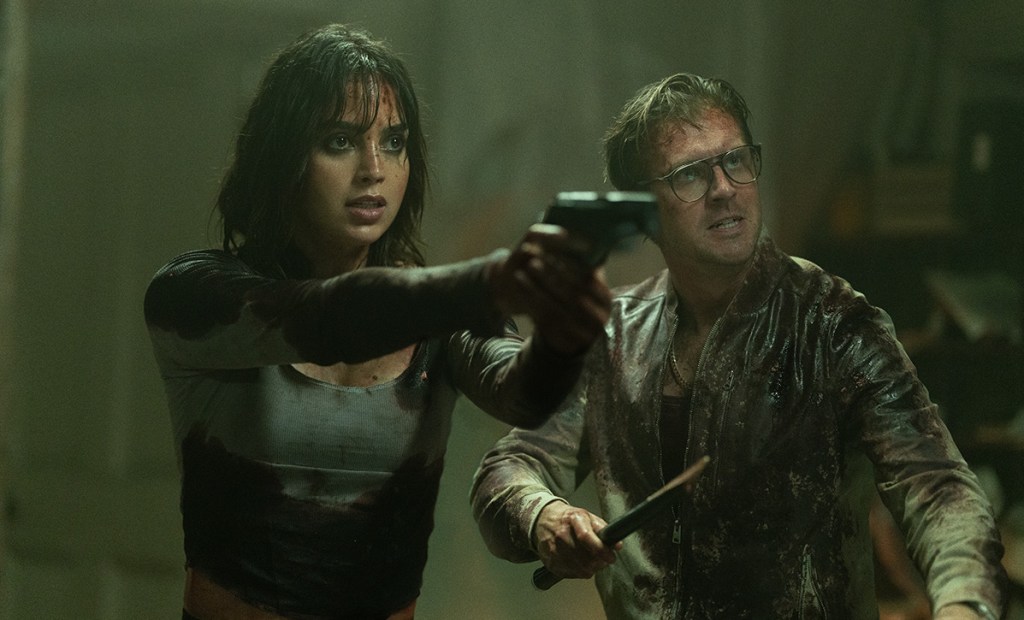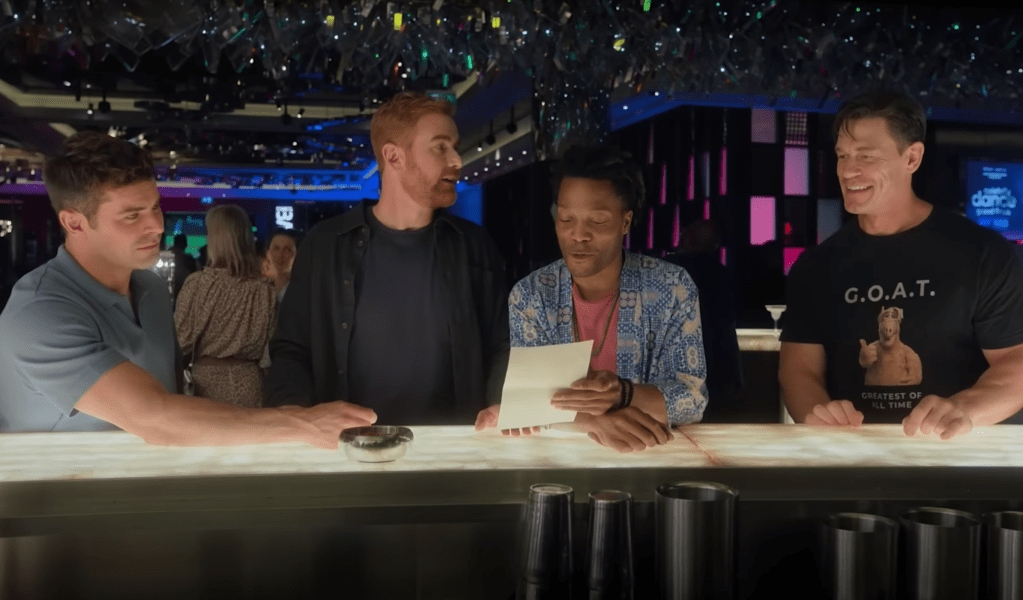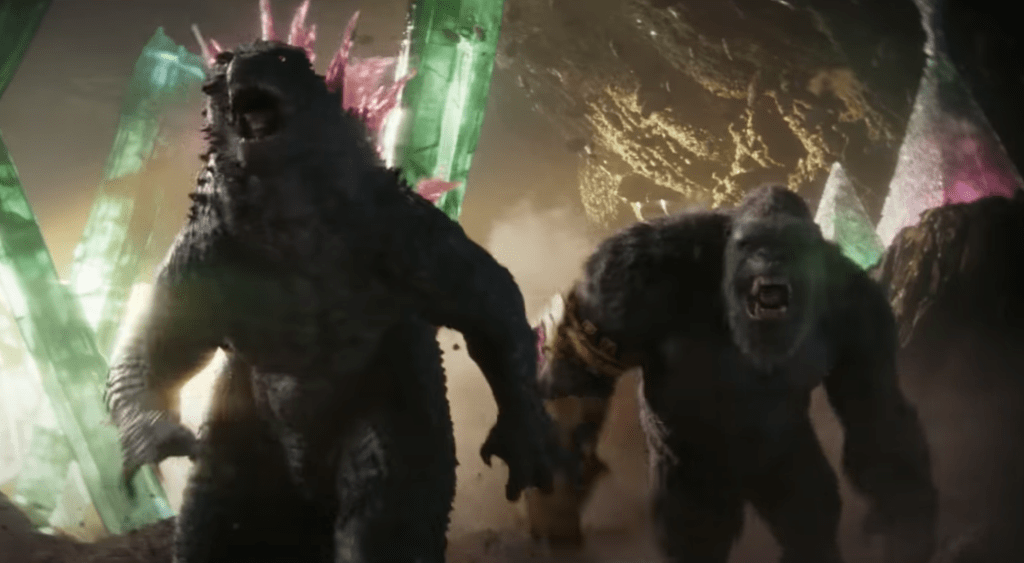
Godzilla and Kong teaming up in Adam Wingard’s GODZILLA X KONG: THE NEW EMPIRE — PHOTO: Warner Bros. Pictures (Still image from trailers).
Directed by Adam Wingard — Screenplay by Terry Rossio, Simon Barrett, and Jeremy Slater.
Whether you call them kaiju, titans, or just plain old movie monsters, everyone knows King Kong and Godzilla. They’ve been projected onto the big screen for decades upon decades and yet it was only at the most recent Oscars ceremony that a Godzilla film was awarded with its first prestigious little golden statue. Now that franchise is only three Oscar statues behind Kong, who gained AMPAS recognition long before they finally gave Godzilla its own golden statuette. It was, however, a Japanese Toho production and not an American one, which this film is, that earned an Oscar. Nevertheless, the Oscar indicates that audiences, critics, and industry representatives alike all have an appetite for engrossing monster movies with something to say. At least, that’s what I’m told Godzilla: Minus One, which I have yet to see, is. Godzilla x Kong: The New Empire — Minus One’s American cousin — is, however, pretty much just a silly monster movie (though I’m not sure it aspired to be anything else, so I don’t fully mean it is a pejorative). It has plenty of things going for it, but it also made me question what exactly we, or I, want from these kinds of films.
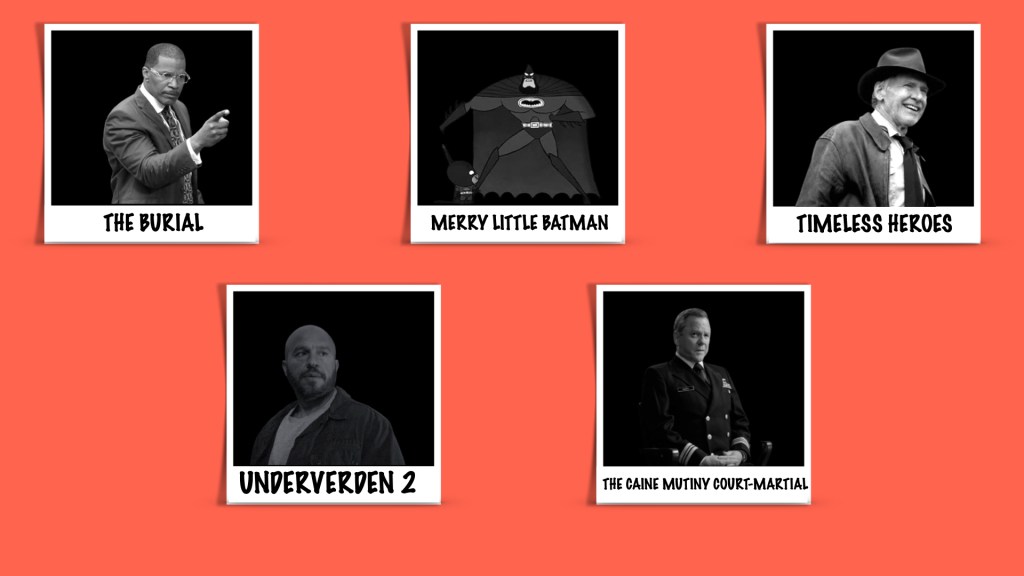
(Clockwise from top left): The Burial (Amazon Prime Video); Merry Little Batman (Amazon Prime Video); Timeless Heroes: Indiana Jones and Harrison Ford (Disney+); Underverden II (Nordisk Film); The Caine Mutiny Court-Martial (Republic Pictures).
For this edition of Additional Bite-Sized Reviews, I have highlighted five films that I saw in the past few months, these include a Danish action-crime sequel, a remake from a filmmaking master, a tribute to a big screen legend, a great animated comic book movie surprise, and, finally, an underseen courtroom drama with some really strong performances from Jamie Foxx and Tommy Lee Jones.
(Clockwise from top left): The Pope’s Exorcist (Sony Pictures Releasing); Talk To Me (A24); The Crow (Miramax); Sympathy for the Devil (RLJE Films); Totally Killer (Amazon Prime Video).
In the next couple of editions of Additional Bite-Sized Reviews (including this one), these review compilations will consist of my thoughts on certain films or shows that I saw in the last year that I, for some reason, never published full reviews for. Often, I see a bunch of stuff that I write notes for or about on Letterboxd, and I don’t want to miss the opportunity to post those review thoughts here, as I want to share them with you. For this post, I have specifically highlighted five horror-thrillers, including a modern comic book adaptation classic that I finally saw in the past few months.
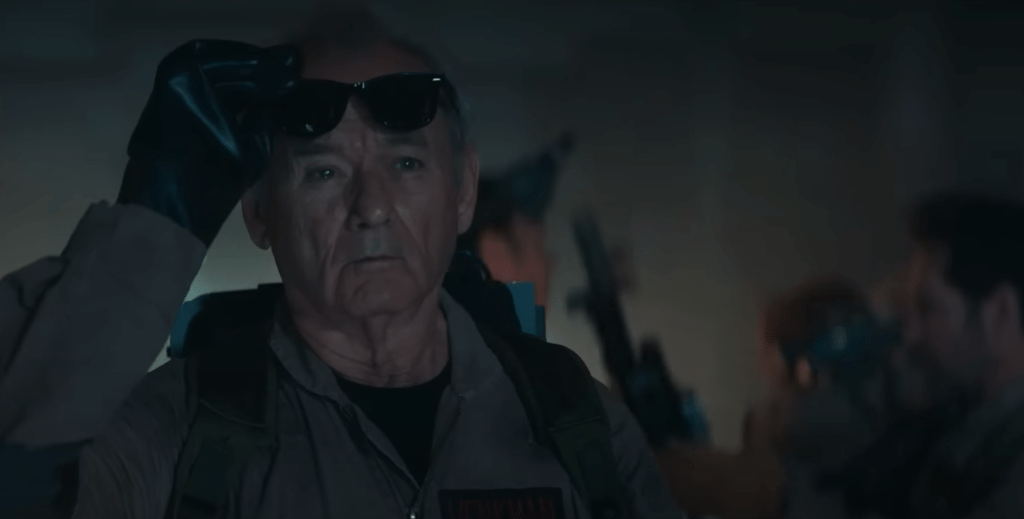
A large number of characters — both new and old — team up, including Bill Murray’s Peter Venkman, to stop a paranormal creature from ending the world in GHOSTBUSTERS: FROZEN EMPIRE — PHOTO: Sony Pictures Releasing (Still image from trailers).
Directed by Gil Kenan — Screenplay by Gil Kenan and Jason Reitman.
Though not for want of trying, no one has been able to recapture the lightning in a bottle that was Ivan Reitman’s original 1984 Ghostbusters. Since that Saturday Night Live breakout ghostly adult comedy topped box office charts and won over the hearts and minds of many generations, many have tried and failed to make it work once more. This includes Ivan Reitman himself whose 1989 sequel did not reach the same success in part due to a lackluster story, reliance on the same structure of the original, being targeted more towards children, and a botched villain. Decades later, Paul Feig gave it a go with his female reboot also titled Ghostbusters in 2016 and caused uproar from both puritanical fans and misogynistic moviegoers. The film itself was neither particularly good or particularly awful, even though the mass hysteria may get you to imagine otherwise (it’s a hit-or-miss improv session with more misses than hits and a talented cast thrown into the fire of a fandom whose most vocal members were unprepared for even slight changes). It all became so toxic that Sony opted to go down the safe route of having Jason Reitman (yes, Ivan’s son) make a direct sequel to his father’s films with Ghostbusters: Afterlife, which relies on the safe and nostalgic formula of modern legacy sequels. The most original aspect of Afterlife, which I mostly really enjoy, was a new setting in the middle of nowhere as opposed to New York City, but it couldn’t resist teasing a sequel of its own that would abandon Afterlife‘s single-most fresh element. Because in Ghostbusters: Frozen Empire, in which Jason Reitman has returned as a co-writer (while Afterlife co-writer Gil Kenan has taken over the director’s chair), the titular paranormal investigators are back in New York City for a sequel that is just as safe as Afterlife. What holds Frozen Empire back, though, is a supersized cast and its structure.
Carolina Gaitan and Allan Hawco in QUICKSAND — PHOTO: Shudder / Altitude (Still image from trailers).
Directed by Andres Beltran — Screenplay by Matt Pitts.
I know there is a belief among some that all critics enjoy endlessly spewing hatred toward films that they dislike. I think the truth isn’t that simple. I can say that disliking a film frustrates and/or disappoints me quite a bit. The reason why negative reviews from critics may often sound more hyperbolic, ‘colorful,’ or invested than reviews of, say, mediocre films is because actively disliking something is a powerful emotion, while most films don’t inspire the kind of passion that actively liking or disliking something does. When you dislike something, then you know immediately what bothers you about it, and it’s much easier to get it onto the page than with a frustrating but merely underwhelming flick. So, rest assured that I take no please in saying this, but… I think Andres Beltran’s Quicksand is one of the worst films of 2023.
Ewan McGregor as ‘Martin’ in NIGHTWATCH — PHOTO: Dimension Films.
Directed by Ole Bornedal — Screenplay by Ole Bornedal and Steven Soderbergh.
A couple of months back, I decided to finally watch something that had been on my watchlist for such a long time, but which I was kind of dreading watching. I am referring to the English-language remake of Ole Bornedal’s Nattevagten, one of the most beloved and iconic Danish horror films. Although there are instances in which an English-language remake or reimagining of a Danish film can result in something akin to an improvement (see Michael Bay’s Ambulance), more often than not, though, English-language remakes of Danish films go one of two ways, either they result in A) a bland copy (though often with a more internationally recognizable cast) or b) an unnecessary remake that is so bad that it ruins the chances of the original reaching a larger audience by mere association. Make no mistake, Dimension Film’s English-language remake of Nattevagten, Nightwatch (also directed by Danish director Ole Bornedal), is not an improvement whatsoever. And, frankly, of the previous A and B options, Nightwatch is decidedly more in the A category. Nightwatch does have a more recognizable cast, but the American product is inferior, less interesting, and, yes, quite bland. This also means that it isn’t the Americanized abomination that I feared, but that, however, doesn’t mean that it is good.
Millie Bobby Brown as Elodie in Damsel — PHOTO: Netflix.
Directed by Juan Carlos Fresnadillo — Screenplay by Dan Mazeau.
28 Weeks Later-director Juan Carlos Fresnadillo’s Damsel is a fantasy film that follows a teenage girl named Elodie (played by Millie Bobby Brown) as she is urged by her father Lord Bayford (played by Ray Winstone) to accept a royal proposal to marry Prince Henry (played by Nick Robinson), the son of Queen Isabelle of Aurea (played by Robin Wright). Although there is initially no spark between the prince and our heroine, whose people need the wealth her marriage would afford them, they warm to each other once they get to know each other. But as the tagline on the poster would have you know, this is no fairytale. After the wedding, Elodie and her new husband Prince Henry are taken out to the mountains where they must take part in an ancient ritual, which reveals the true intentions of the royal family.
Directed by Andrew Haigh — Screenplay by Andrew Haigh.
Loosely based on Taichi Yamada’s 1987 novel titled Strangers, Andrew Haigh’s All of Us Strangers follows Adam (played by Andrew Scott), a lonely screenwriter living in a high-rise London apartment building. One night, a drunk neighbor, Harry (played by Paul Mescal), knocks on his door hoping to have a good time with Adam that night. Though Adam refuses, Adam starts getting closer to Harry in the days to come. This is in part because he’s starting to work through some of his issues. Why now all of a sudden? Well, when, one day, Adam takes the train back to his hometown to look at the town he grew up in and around, he is approached by a man (played by Jamie Bell) who turns out to be his father. Adam’s parents died in an accident when he was just a young boy, and yet here is his father — at the exact same age that he was when he passed away. His father invites Adam back to his childhood home where he finds his mother (played by Claire Foy), who is also the same age that she was when she died. Overjoyed to reconnect, Adam and his parents gradually start to open up about things once left unsaid.
Adam Sandler as a lonely astronaut in Netflix’s SPACEMAN — PHOTO: Netflix.
Directed by Johan Renck — Screenplay by Colby Day.
Based on Jaroslav Kalfař’s 2017 science-fiction novel Spaceman of Bohemia, Johan Renck’s Spaceman follows Jakub Procházka (played by Adam Sandler), a Czech astronaut, while on a solo mission in space to investigate a mysterious particle cloud nearby Jupiter. His mission is in direct competition with that of a South Korean ship, which is also part of a relatively untraditional space race compared to the real world. By his lonesome on the spaceship, Jakub is feeling the effects of solitude and long-term space travel, and he desires contact with his pregnant partner Lenka (played by Carey Mulligan). Lenka has indeed prepared a video for Jakub to see, but, fearing that Jakub’s depression may worsen if it reaches him, the commander of the Czech space agency, Tuma (played by Isabella Rossellini), prevents it from reaching the most lonely human in space. That is because, in the video, Lenka expresses very clearly that she wants to leave Jakub for good. While Jakub gets lonelier and lonelier as he gradually gets closer to the mysterious particle cloud, he is approached by a massive spider-like alien creature, which has made its way into the spacecraft somehow. The alien arachnid, which is often referred to as Hanuš (voiced by Paul Dano), insists that it doesn’t want to harm this ‘skinny human.’ Rather, it wants to investigate our species and help Jakub with his troubled headspace.
Timothée Chalamet as Paul Atreides in DUNE: PART TWO — PHOTO: Warner Bros. Pictures.
Directed by Denis Villeneuve — Screenplay by Denis Villeneuve and Jon Spaihts.
I don’t know if I’ve ever told this story before, but I have this vivid memory where — when I was probably around the age of ten — I looked up at my mother and asked her a question. I had either just seen The Lord of the Rings: The Return of the King, or else it was about to come out and I knew it was going to be the last film in the trilogy. With a note of sadness in my voice, I looked up at my mother and asked her something along the lines of “What happens after the Lord of the Rings? Will we ever get anything as good as that ever again?” You have to understand that in those early 2000s, we were being treated to fantasy filmmaking of the highest order with Peter Jackson’s Tolkien adaptations, while Sam Raimi was hard at work on Spider-Man 2 following the success of the first one, and after George Lucas’ Star Wars: Episode II — Attack of the Clones, we all knew that there was only a single film left in the so-called prequel trilogy. At the age of ten, I was blown away by what I was seeing, but I could also see an end to what we were getting. I wasn’t quite sure if this was a once-in-a-lifetime kind of perfect storm for fantasy and blockbuster filmmaking or not. Of course, in the years to come, Hollywood would go on to shovel dozens upon dozens of films with similar aims down our collective pop culture gullet, in an attempt to recapture what was so addicting and marvelous about Jackson, Raimi, and Lucas’ films. Hollywood, we must admit, often failed to recapture that. Now, it’s not like the Lord of the Rings, Star Wars, or Spider-Man is dead and buried — not by a long shot — but there is an argument to be made that none of those franchises have ever been afforded the same level of creative freedom for its principal filmmakers as was the case back then. So, what did my mother say? Well, with generosity and kindness in her voice, she assured me that, of course, major motion pictures with that sense of scale, scope, and artistry were not going away for good. She assured me that I had so much more to look forward to. My mother was right. Every so often something comes along that both feels like a throwback to the days when creative freedom was to be expected for filmmakers but which also feels like the perfect utilization of modern sensibilities and technical mastery. Denis Villeneuve’s two-part adaptation of Frank Herbert’s iconic science-fiction novel Dune is the perfect modern example of that. I feel so lucky. Now more than twenty years after my mother reassured me about the future of filmmaking — though perhaps not in as many words as I put it above — I have had the wonderful opportunity to watch Denis Villeneuve’s Dune: Parts One and Two in theaters with my mother, and both times the French-Canadian filmmaker has managed to both transport us to another world full of fantasy and science-fiction wonders, but also remind us — both mother and son in love with film’s transportive power — of the kind of storytelling that we love with all of our hearts.