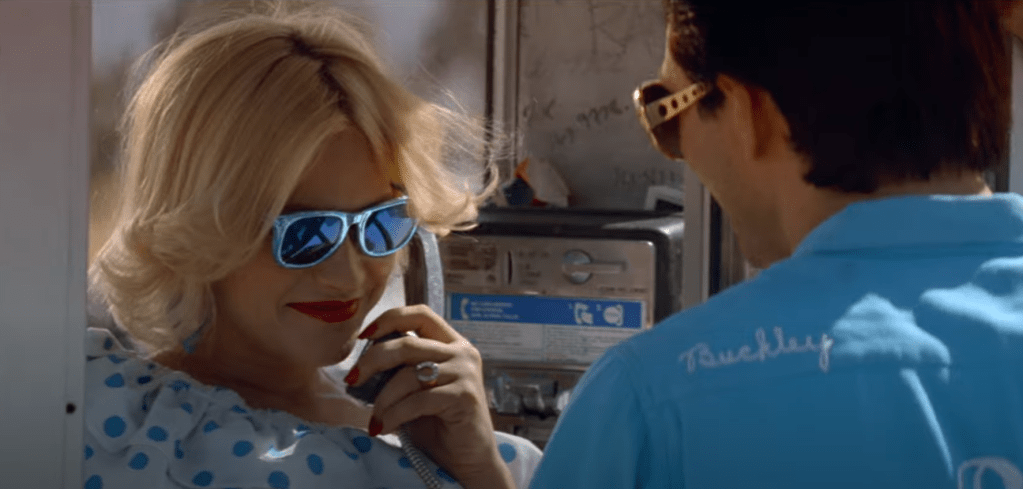
Patricia Arquette and Christian Slater in TRUE ROMANCE — PHOTO: Warner Bros. (Still image from trailer).
Directed by Tony Scott — Screenplay by Quentin Tarantino.
Tony Scott’s True Romance follows Clarence (played by Christian Slater) and Alabama (played by Patricia Arquette), two newlyweds who are headed for Hollywood to start their new life together. However, before they got going, Clarence stole a suitcase of drugs, the loss of which has now put the couple at the top of the Mafia’s hit list.
This is one of those movies that’s been on my watchlist for quite some time. A little over a month ago, I finally got the Arrow Video 4K Blu-ray, and today I finally thought it was a good time to check out what this early ’90s flick was all about. I’m glad I did. True Romance is an exhilarating and irresistible crime charmer.
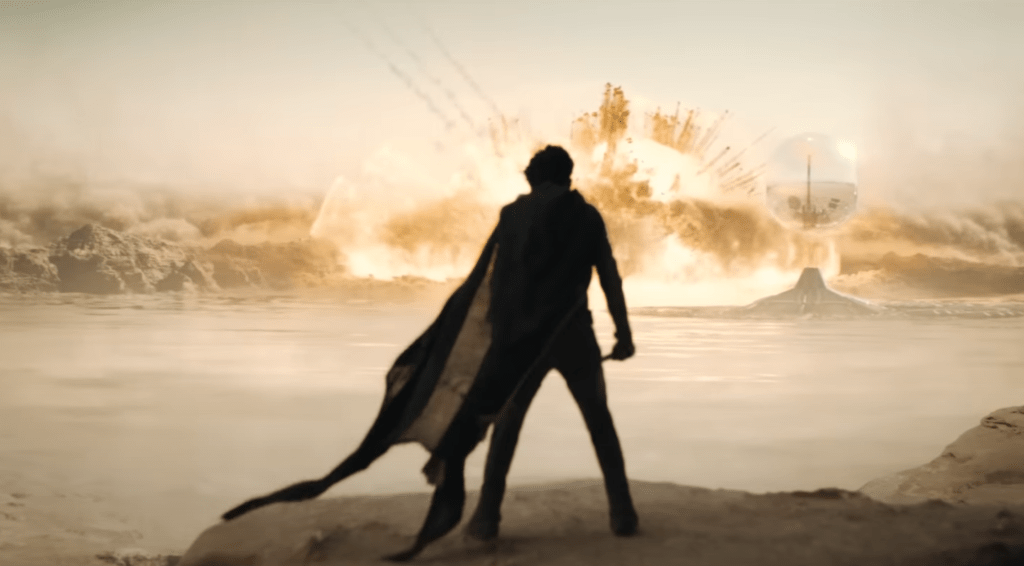
Timothée Chalamet as Paul Atreides in DUNE: PART TWO — PHOTO: Warner Bros. Pictures.
Directed by Denis Villeneuve — Screenplay by Denis Villeneuve and Jon Spaihts.
I don’t know if I’ve ever told this story before, but I have this vivid memory where — when I was probably around the age of ten — I looked up at my mother and asked her a question. I had either just seen The Lord of the Rings: The Return of the King, or else it was about to come out and I knew it was going to be the last film in the trilogy. With a note of sadness in my voice, I looked up at my mother and asked her something along the lines of “What happens after the Lord of the Rings? Will we ever get anything as good as that ever again?” You have to understand that in those early 2000s, we were being treated to fantasy filmmaking of the highest order with Peter Jackson’s Tolkien adaptations, while Sam Raimi was hard at work on Spider-Man 2 following the success of the first one, and after George Lucas’ Star Wars: Episode II — Attack of the Clones, we all knew that there was only a single film left in the so-called prequel trilogy. At the age of ten, I was blown away by what I was seeing, but I could also see an end to what we were getting. I wasn’t quite sure if this was a once-in-a-lifetime kind of perfect storm for fantasy and blockbuster filmmaking or not. Of course, in the years to come, Hollywood would go on to shovel dozens upon dozens of films with similar aims down our collective pop culture gullet, in an attempt to recapture what was so addicting and marvelous about Jackson, Raimi, and Lucas’ films. Hollywood, we must admit, often failed to recapture that. Now, it’s not like the Lord of the Rings, Star Wars, or Spider-Man is dead and buried — not by a long shot — but there is an argument to be made that none of those franchises have ever been afforded the same level of creative freedom for its principal filmmakers as was the case back then. So, what did my mother say? Well, with generosity and kindness in her voice, she assured me that, of course, major motion pictures with that sense of scale, scope, and artistry were not going away for good. She assured me that I had so much more to look forward to. My mother was right. Every so often something comes along that both feels like a throwback to the days when creative freedom was to be expected for filmmakers but which also feels like the perfect utilization of modern sensibilities and technical mastery. Denis Villeneuve’s two-part adaptation of Frank Herbert’s iconic science-fiction novel Dune is the perfect modern example of that. I feel so lucky. Now more than twenty years after my mother reassured me about the future of filmmaking — though perhaps not in as many words as I put it above — I have had the wonderful opportunity to watch Denis Villeneuve’s Dune: Parts One and Two in theaters with my mother, and both times the French-Canadian filmmaker has managed to both transport us to another world full of fantasy and science-fiction wonders, but also remind us — both mother and son in love with film’s transportive power — of the kind of storytelling that we love with all of our hearts.
Quentin Tarantino’s Once Upon a Time In Hollywood opened in North American theaters a couple of weeks ago, but it was just released in my corner of the world yesterday. To commemorate the release of what Tarantino claims is his penultimate feature film as a director, I decided to rewatch and review every full feature film directed by Quentin Tarantino thus far (not including his partially lost amateur film). Below you’ll find reviews of all of the films listed in the image above. So, without further ado, let’s get to it. Continue reading “REVIEWS: Feature Films Directed by Quentin Tarantino (1992-2015)”→
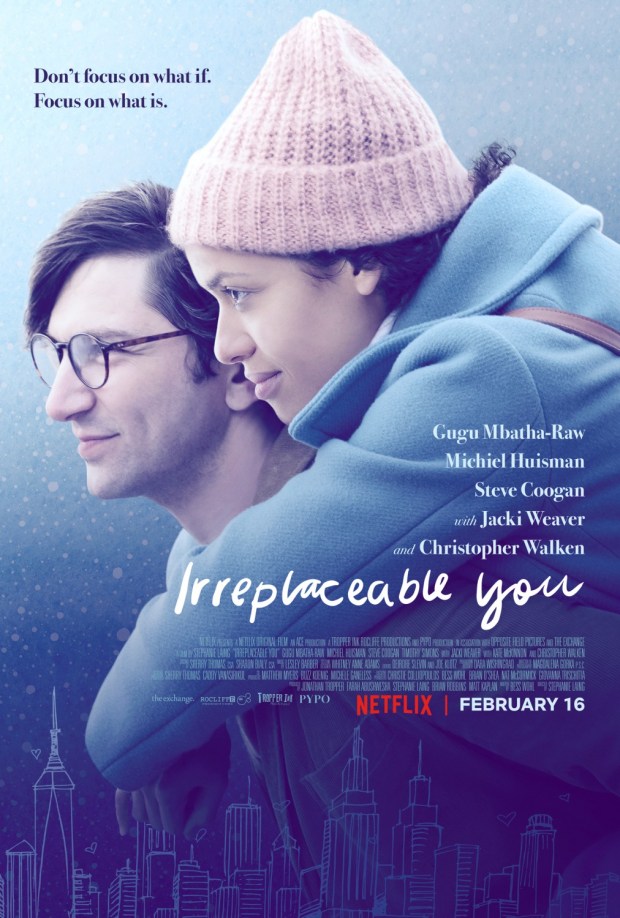
The following is a review of Irreplaceable You — Directed by Stephanie Laing.
Cancer movies are a dime a dozen, which isn’t to say that I dislike these films. I’m a sucker for films like A Walk to Remember and 50/50, the latter of which I believe is actually a masterpiece — but I digress. What I am saying is that there are a lot of these films, so when you encounter a new one, it has to really stand out to be worthwhile. Netflix just released the feature film directorial debut for Stephanie Laing, who has previously worked on shows like Veep and Vice Principals. Laing’s first film, unfortunately, does not manage to stand out at all. Continue reading “REVIEW: Irreplaceable You (2018)”→
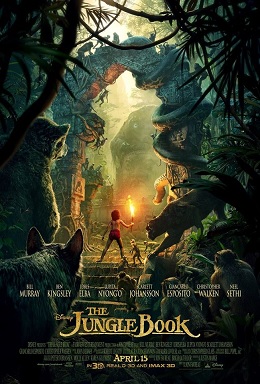
Theatrical Release Poster – Walt Disney Studio Motion Pictures
The following is a review of Disney’s The Jungle Book, a Jon Favreau Film. The reviewed film was seen in IMAX 3D.
Jon Favreau is a great director that has shown his talents both with blockbusters, like Iron Man, and with smaller, personal films, like Chef, so when he was announced for the ‘live-action’ Disney remake of the famous Rudyard Kipling stories the film community was very excited. I am so happy to write here that The Jungle Book might be the very best film Favreau has ever made, as well as Disney’s best attempt at improving and updating an animated classic. Continue reading “REVIEW: The Jungle Book (2016)”→


 I'm Jeffrey Rex