Jeffrey Rex Bertelsen is an aspiring film and television critic from Denmark. Jeffrey graduated from the University of Copenhagen in 2018, and he holds a Master of Arts degree in English Studies with a minor in Film and Media Studies. Harry Potter fans will want to know that he is a Ravenclaw. Star Wars fans will be interested in knowing that he loves Star Wars: The Last Jedi. Cineastes will want to know that his favorite film of the first decade of the 21st Century is Guillermo Del Toro's El Laberinto del Fauno.
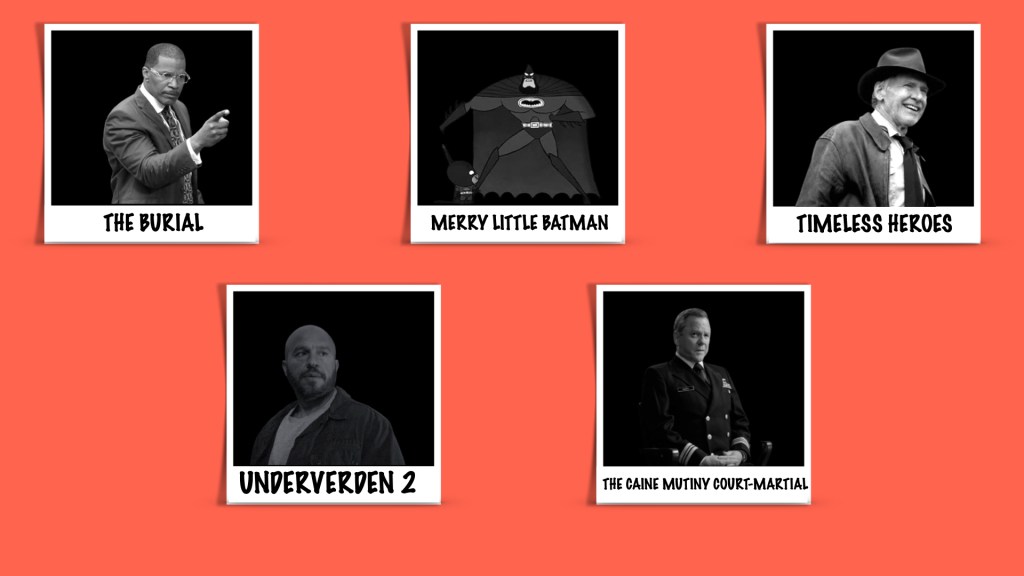
(Clockwise from top left): The Burial (Amazon Prime Video); Merry Little Batman (Amazon Prime Video); Timeless Heroes: Indiana Jones and Harrison Ford (Disney+); Underverden II (Nordisk Film); The Caine Mutiny Court-Martial (Republic Pictures).
For this edition of Additional Bite-Sized Reviews, I have highlighted five films that I saw in the past few months, these include a Danish action-crime sequel, a remake from a filmmaking master, a tribute to a big screen legend, a great animated comic book movie surprise, and, finally, an underseen courtroom drama with some really strong performances from Jamie Foxx and Tommy Lee Jones.
(Clockwise from top left): The Pope’s Exorcist (Sony Pictures Releasing); Talk To Me (A24); The Crow (Miramax); Sympathy for the Devil (RLJE Films); Totally Killer (Amazon Prime Video).
In the next couple of editions of Additional Bite-Sized Reviews (including this one), these review compilations will consist of my thoughts on certain films or shows that I saw in the last year that I, for some reason, never published full reviews for. Often, I see a bunch of stuff that I write notes for or about on Letterboxd, and I don’t want to miss the opportunity to post those review thoughts here, as I want to share them with you. For this post, I have specifically highlighted five horror-thrillers, including a modern comic book adaptation classic that I finally saw in the past few months.
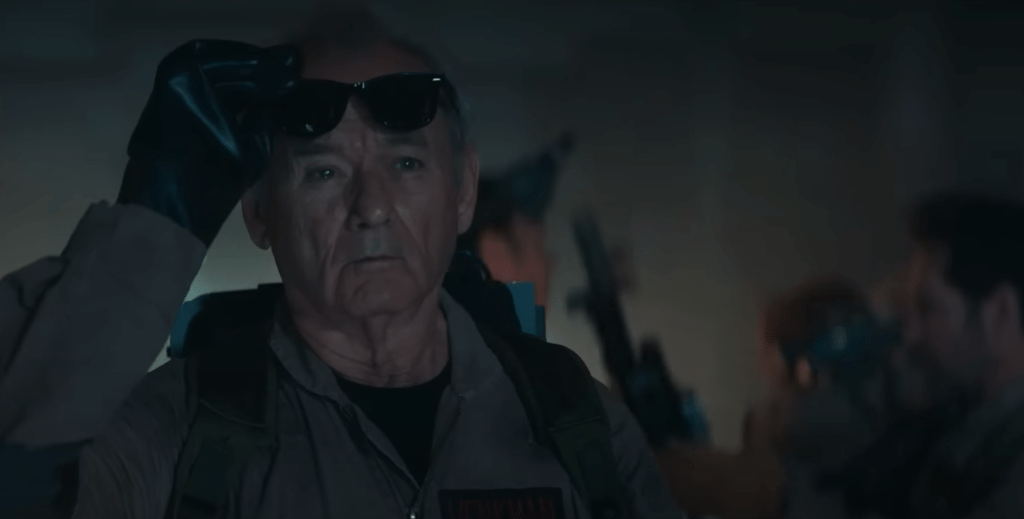
A large number of characters — both new and old — team up, including Bill Murray’s Peter Venkman, to stop a paranormal creature from ending the world in GHOSTBUSTERS: FROZEN EMPIRE — PHOTO: Sony Pictures Releasing (Still image from trailers).
Directed by Gil Kenan — Screenplay by Gil Kenan and Jason Reitman.
Though not for want of trying, no one has been able to recapture the lightning in a bottle that was Ivan Reitman’s original 1984 Ghostbusters. Since that Saturday Night Live breakout ghostly adult comedy topped box office charts and won over the hearts and minds of many generations, many have tried and failed to make it work once more. This includes Ivan Reitman himself whose 1989 sequel did not reach the same success in part due to a lackluster story, reliance on the same structure of the original, being targeted more towards children, and a botched villain. Decades later, Paul Feig gave it a go with his female reboot also titled Ghostbusters in 2016 and caused uproar from both puritanical fans and misogynistic moviegoers. The film itself was neither particularly good or particularly awful, even though the mass hysteria may get you to imagine otherwise (it’s a hit-or-miss improv session with more misses than hits and a talented cast thrown into the fire of a fandom whose most vocal members were unprepared for even slight changes). It all became so toxic that Sony opted to go down the safe route of having Jason Reitman (yes, Ivan’s son) make a direct sequel to his father’s films with Ghostbusters: Afterlife, which relies on the safe and nostalgic formula of modern legacy sequels. The most original aspect of Afterlife, which I mostly really enjoy, was a new setting in the middle of nowhere as opposed to New York City, but it couldn’t resist teasing a sequel of its own that would abandon Afterlife‘s single-most fresh element. Because in Ghostbusters: Frozen Empire, in which Jason Reitman has returned as a co-writer (while Afterlife co-writer Gil Kenan has taken over the director’s chair), the titular paranormal investigators are back in New York City for a sequel that is just as safe as Afterlife. What holds Frozen Empire back, though, is a supersized cast and its structure.
Carolina Gaitan and Allan Hawco in QUICKSAND — PHOTO: Shudder / Altitude (Still image from trailers).
Directed by Andres Beltran — Screenplay by Matt Pitts.
I know there is a belief among some that all critics enjoy endlessly spewing hatred toward films that they dislike. I think the truth isn’t that simple. I can say that disliking a film frustrates and/or disappoints me quite a bit. The reason why negative reviews from critics may often sound more hyperbolic, ‘colorful,’ or invested than reviews of, say, mediocre films is because actively disliking something is a powerful emotion, while most films don’t inspire the kind of passion that actively liking or disliking something does. When you dislike something, then you know immediately what bothers you about it, and it’s much easier to get it onto the page than with a frustrating but merely underwhelming flick. So, rest assured that I take no please in saying this, but… I think Andres Beltran’s Quicksand is one of the worst films of 2023.
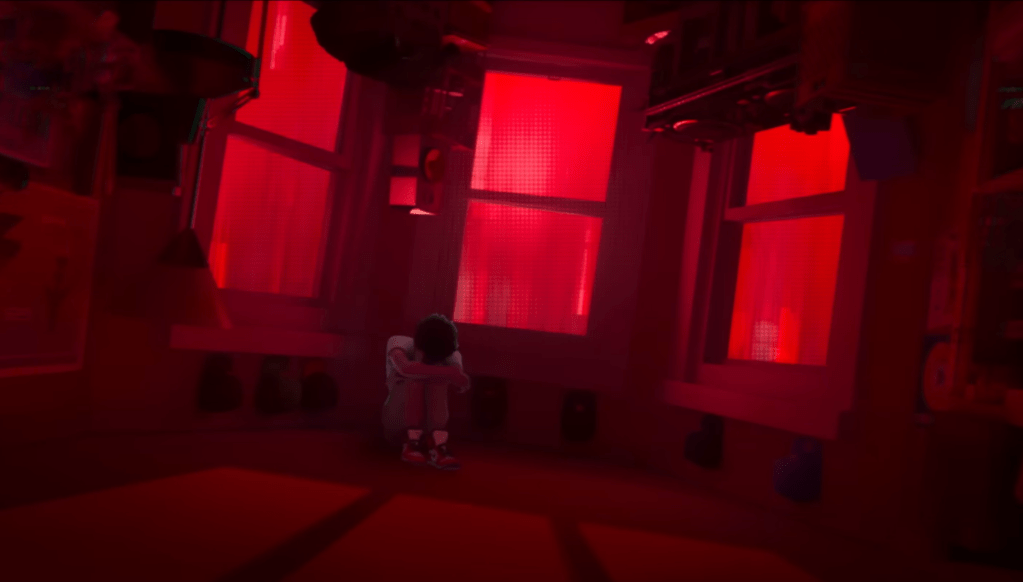
Still image from Sony Pictures’ THE SPIDER WITHIN: A SPIDER-VERSE STORY, directed by Jarelle Dampier — PHOTO: Sony Pictures Entertainment.
Directed by Jarelle Dampier — Screenplay by Khaila Amazan.
Sony Pictures Entertainment has today released Jarelle Dampier’s animated short film The Spider Within: A Spider-Verse Story on YouTube (click here to watch it). The animated short film, which originally premiered at the Annecy International Animation Film Festival in June of 2023, is a part of Sony’s animated Spider-Verse trilogy, and it is set between the events of Spider-Man: Into the Spider-Verse from 2018 and last year’s sequel Spider-Man: Across the Spider-Verse. In the animated short, we follow Miles Morales (voiced by Shameik Moore) as he returns home after a stressful day of crime-fighting and being a teenager and is approached by his father Jefferson Davis (voiced by Brian Tyree Henry), who wants to have a father-son night where they watch horror films on the TV and snack on popcorn. Miles, however, is unprepared for this, and he hides away in his room where all his fears manifest in the form of first a shadow and, later, spiders.
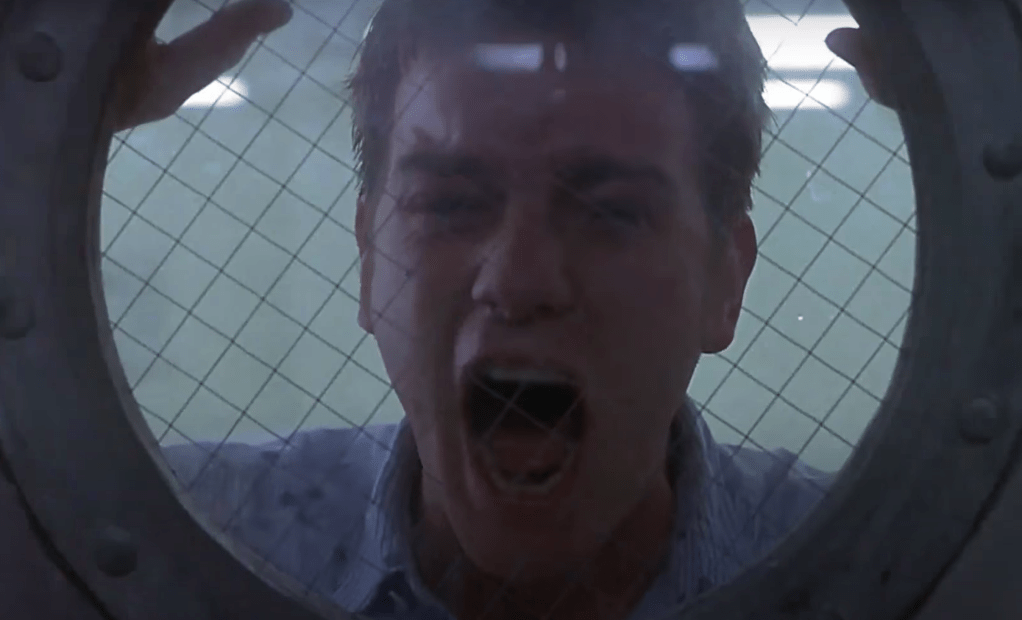
Ewan McGregor as ‘Martin’ in NIGHTWATCH — PHOTO: Dimension Films.
Directed by Ole Bornedal — Screenplay by Ole Bornedal and Steven Soderbergh.
A couple of months back, I decided to finally watch something that had been on my watchlist for such a long time, but which I was kind of dreading watching. I am referring to the English-language remake of Ole Bornedal’s Nattevagten, one of the most beloved and iconic Danish horror films. Although there are instances in which an English-language remake or reimagining of a Danish film can result in something akin to an improvement (see Michael Bay’s Ambulance), more often than not, though, English-language remakes of Danish films go one of two ways, either they result in A) a bland copy (though often with a more internationally recognizable cast) or b) an unnecessary remake that is so bad that it ruins the chances of the original reaching a larger audience by mere association. Make no mistake, Dimension Film’s English-language remake of Nattevagten, Nightwatch (also directed by Danish director Ole Bornedal), is not an improvement whatsoever. And, frankly, of the previous A and B options, Nightwatch is decidedly more in the A category. Nightwatch does have a more recognizable cast, but the American product is inferior, less interesting, and, yes, quite bland. This also means that it isn’t the Americanized abomination that I feared, but that, however, doesn’t mean that it is good.
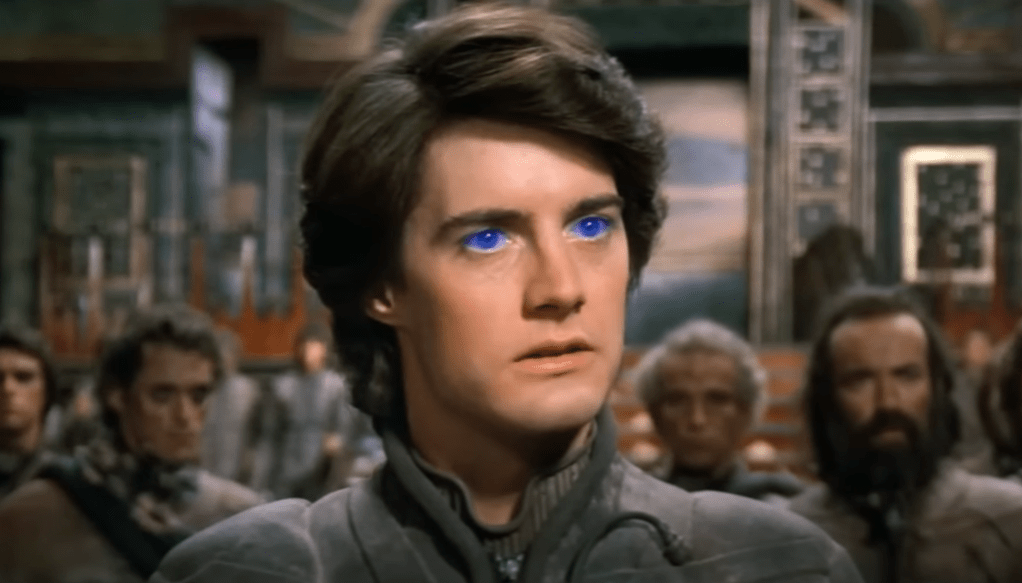
Kyle MacLachlan as Paul Atreides in David Lynch’s Dune — PHOTO: Universal Pictures.
Directed by David Lynch — Screenplay by David Lynch.
With the recent release of Denis Villeneuve’s hotly anticipated Dune: Part Two, it felt right to finally have another look at the first major adaptation of Frank Herbert’s 1965 sci-fi novel Dune — i.e. David Lynch’s Dune from 1984. Even after having ‘rewatched it,’ I’m, honestly, still not entirely sure if I had seen this before. I’m pretty sure I watched this when I was a kid and was obsessed with sci-fi (I watched everything), and, as I was watching it, it felt like I had seen a lot of this before. I asked my dad — who showed me Star Wars, Stargate, and whatnot — and he’s pretty sure he showed me Lynch’s Dune as well. But, hey, 7-to-10-year-old-me probably struggled with this as much as moviegoers in the 1980s reportedly did (Gene Siskel and Roger Ebert apparently both hated the adaptation). Now, it’s so interesting to view this after having seen Denis Villeneuve’s two-part adaptation and having read about 300 pages (or so) of the original novel. Now, I don’t want to take anything away from David Lynch because I think he is a very good filmmaker, and he, himself, has essentially admitted that he failed with his adaptation of Frank Herbert’s iconic novel, but, man, let’s just start by saying that Villeneuve’s adaptations are an improvement on Lynch’s film in every conceivable way.
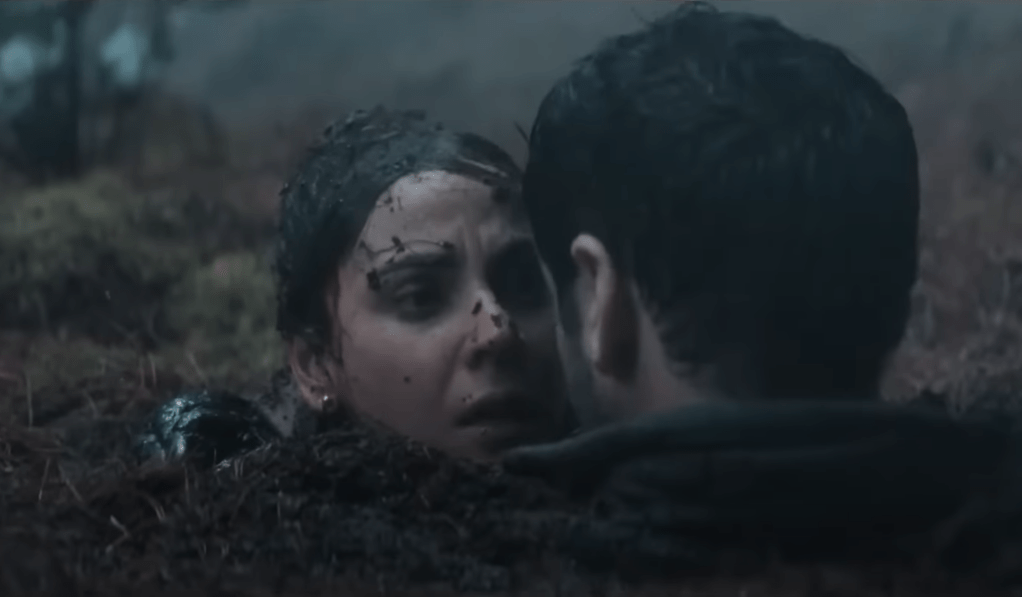
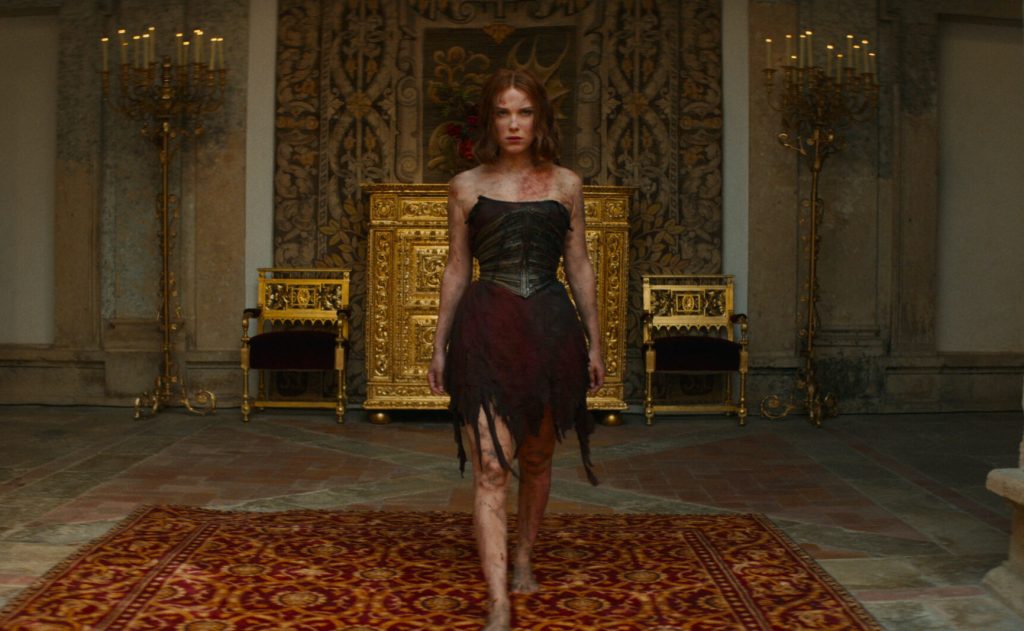
Millie Bobby Brown as Elodie in Damsel — PHOTO: Netflix.
Directed by Juan Carlos Fresnadillo — Screenplay by Dan Mazeau.
28 Weeks Later-director Juan Carlos Fresnadillo’s Damsel is a fantasy film that follows a teenage girl named Elodie (played by Millie Bobby Brown) as she is urged by her father Lord Bayford (played by Ray Winstone) to accept a royal proposal to marry Prince Henry (played by Nick Robinson), the son of Queen Isabelle of Aurea (played by Robin Wright). Although there is initially no spark between the prince and our heroine, whose people need the wealth her marriage would afford them, they warm to each other once they get to know each other. But as the tagline on the poster would have you know, this is no fairytale. After the wedding, Elodie and her new husband Prince Henry are taken out to the mountains where they must take part in an ancient ritual, which reveals the true intentions of the royal family.
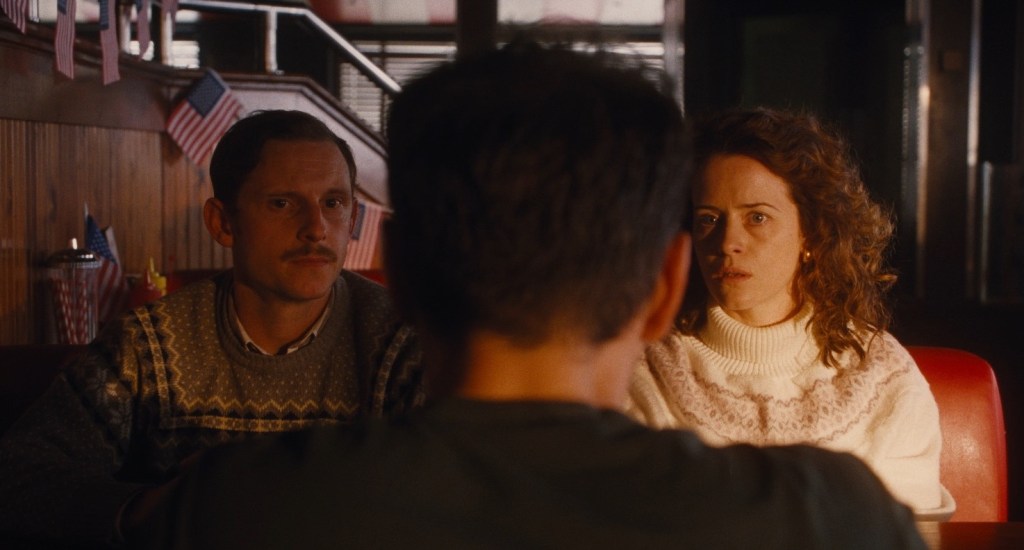
Directed by Andrew Haigh — Screenplay by Andrew Haigh.
Loosely based on Taichi Yamada’s 1987 novel titled Strangers, Andrew Haigh’s All of Us Strangers follows Adam (played by Andrew Scott), a lonely screenwriter living in a high-rise London apartment building. One night, a drunk neighbor, Harry (played by Paul Mescal), knocks on his door hoping to have a good time with Adam that night. Though Adam refuses, Adam starts getting closer to Harry in the days to come. This is in part because he’s starting to work through some of his issues. Why now all of a sudden? Well, when, one day, Adam takes the train back to his hometown to look at the town he grew up in and around, he is approached by a man (played by Jamie Bell) who turns out to be his father. Adam’s parents died in an accident when he was just a young boy, and yet here is his father — at the exact same age that he was when he passed away. His father invites Adam back to his childhood home where he finds his mother (played by Claire Foy), who is also the same age that she was when she died. Overjoyed to reconnect, Adam and his parents gradually start to open up about things once left unsaid.
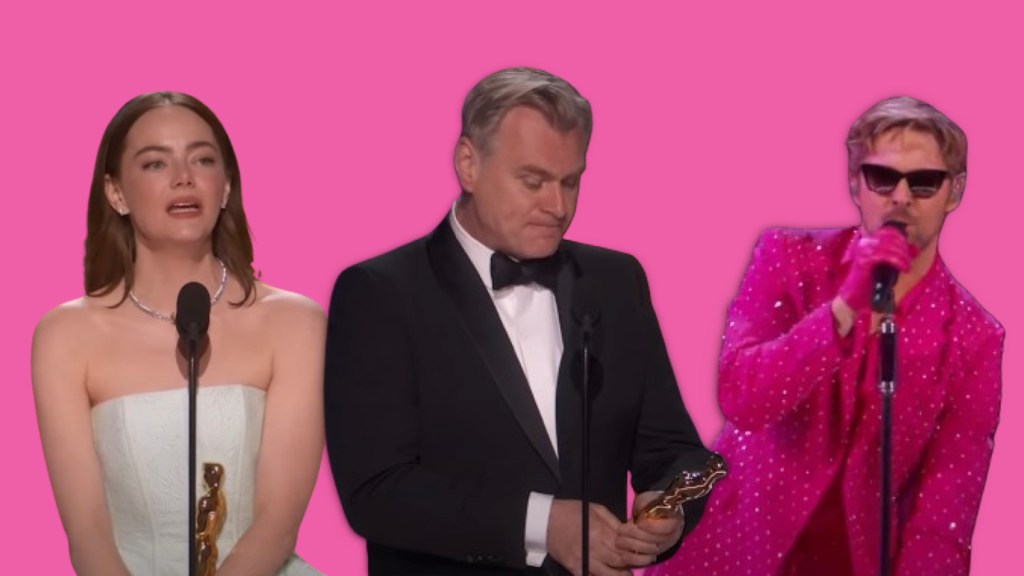
(L-R) Emma Stone, Christopher Nolan, and Ryan Gosling at the 96th Academy Awards — IMAGE STILLS: A.M.P.A.S. 2024.
Last night, Jimmy Kimmel hosted the 96th edition of the Academy Awards on a night where awards prognosticators felt most of the big awards were already spoken for beforehand. However, conventional prognosticating wisdom did not always win out, as the presenters read out the winners of the Academy’s 23 categories. The early frontrunner and expected Best Picture winner Oppenheimer did, indeed, become the biggest winner of the night with seven total Oscars including wins that saw shatteringly good work from Robert Downey, Jr. and Cillian Murphy earn them their first ‘Little Golden Men.’ Hollywood’s safest bet and — as I liked to call him last night on social media — the ‘Crown Prince of Cinema,’ Christopher Nolan, had his grand coronation as Steven Spielberg passed the baton, awarded him with the Best Director award, and gave him a big hug. For many, that is what the night will be remembered for — i.e. the triumph of the immensely popular biopic and Christopher Nolan who, as some will undoubtedly perceive it, went toe-to-toe with Barbie and came out of the explosion that was ‘Barbenheimer’ with 7 golden statuettes in tow. Indeed, Christopher Nolan’s Oppenheimer is a hugely deserving winner of all of the awards that the cast and crew went home with (including Best Picture, which was announced in a relatively confusing way by film-legend Al Pacino), but that’s not all the 96th edition of the Academy Awards should be remembered for.


 I'm Jeffrey Rex