
Directed by Joachim Trier — Screenplay by Joachim Trier and Eskil Vogt.
Like Thomas Vinterberg and Ruben Östlund, the Danish-born Norwegian auteur Joachim Trier is part of a select group of Scandinavian filmmakers who, in recent years, have broken through across the pond, exemplified by their prestigious Academy Award nominations. Trier, best known for his critically acclaimed Oslo trilogy (including the films (1) Reprise, (2) Oslo 31. August, and (3) The Worst Person in the World), has made several modern films that work as ruminations and meditations on the modern human experience, as his films cover themes, to name just a few, such as growing up, turning a corner in life, feeling unfulfilled, and feeling socially excluded. In recent years, some of my favorite reviews to write have been of the films in his excellent Oslo trilogy, two-thirds of which I consider genuine masterpieces (and, to add to that, Reprise is a fantastic debut film, despite arguably being the lesser of the three). Naturally, every new film of his is a major event to me. His latest film, Sentimental Value (original title: Affeksjonsverdi), continues Trier’s hot streak.
In Joachim Trier’s Sentimental Value, we follow members of the Borg family, who have owned and passed down the same house in Norway through several generations. When sisters Nora (played by Renate Reinsve) and Agnes Borg (played by Inga Ibsdottir Lilleaas) grew up in their family home, they witnessed the deterioration of their parents’ marriage. When they divorced, their mother raised them in the house, while their father was away, mostly focusing on his thriving film career as a celebrated director. Years later, in modern-day, where the film takes place, Nora and Agnes’ estranged father, Gustav (played by Stellan Skarsgård), shows up unannounced at the wake following their mother’s funeral. Agnes, now a historian, is married and the mother of a young son, while Nora, a fairly successful stage actress, has a non-committal affair with a married co-worker (played by Anders Danielsen Lie).
Gustav isn’t there solely to honor the memory of the mother of his children. He wants to get his things from the basement of the house, organize the sale of the family home (even though his youngest daughter lives there, it is still in his name), and make an offer to his eldest daughter, Nora. Gustav has plans to direct a new film (notably in the family home), whose lead role is expressly written for Nora, despite appearing to be partly inspired by his own mother’s passing. Despite Nora, clearly agitated by his behavior over the years, declining the offer to appear in his film, Gustav eventually gets ready to film his new script, as he has offered Nora’s role to a popular American actress, Rachel Kemp (played by Elle Fanning), who charmed him during a film festival. As Gustav’s project takes away their family home, the sisters’ daily lives are upended.
One part Scandinavian family drama and one part movie about making movies, Joachim Trier’s latest film might as well be titled ‘Scenes From a Family Home,’ both due to his frequent inspirations and the focus on our attachment to the place in which we grew up. The film opens with an extended sequence, guided by voice-over, that emphasizes the history of the family home, the perspectives of the Borg siblings as their parents’ marriage crumbled, and a school paper, for which one of the sisters had to write a personification narrative, to illustrate how the child’s thoughts on the feelings of the family home managed to say a great deal about her own headspace. The crack in the house’s foundation worked as a strong metaphor for familial trauma and individuals’ interiority. The film manages to say a great deal, though without ever being heavy-handed, about emotional attachment, art as therapy, and conflict avoidance. It is a layered and well-written narrative that offers up great heart-to-heart scenes, revealing lines about characters’ understanding of what family means, and a powerful balancing of flickers of modernity and the wounds of history (the film both researches history and retains modern details, including using Netflix as a distributor that both allows for Borg’s vision and risks limiting his original vision or the way he intends it to be viewed). The connection between the ancestral powers of the family home, which almost feels like its own character, and the styles and desires of modernity culminates in a — in one of the final sequences of the film — final montage of the house that shows a version of the home where all the soul has been peeled away in favor of a more pristine minimalist look. That right there will really hurt to see for anyone who has ever had to see their family home be sold, left behind, and molded in someone else’s vision.
The balancing of a family portrait film and a movie about moviemaking is done so well here. Trier and Vogt’s narrative focuses on the way core memories are designed to be retold (early in the film, we’re told that Borg plans to have one long take build up to an off-screen suicide attempt that viewers will know happens through the sound effect of a falling chair), and, when we finally see the way that scene plays out on set, it is in a deeply touching scene that, rather than letting us hear the falling of the chair, emphasizes the connection and now deepened understanding between the director, his film’s pivotal character, and possibly his leading lady. It is a powerful final scene as the two characters’ eyes meet. It is also a stroke of genius to have a central element of the film be the way Borg views his cast like family, as, when Nora declines her father’s offer to appear in the film, another person gets to feel the attention she has perhaps always had missing in her life because of his time away from his family (and his daughter’s upbringing), his stubbornness with regards to not really paying attention to her theater career, and his difficulty with showing affection in a normal way (at one point, he gifts his very young grandson with DVD copies of Michael Haneke’s The Piano Teacher and Gaspar Noé’s Irreversible).
It is a gorgeously shot film — from Danish director of photography Kasper Tuxen (The Worst Person in the World; Riders of Justice) — and there are plenty of deeply affecting and evocative shots and techniques used here, but if you’re looking for something similar to Trier’s previous film’s romance stopping time sequence or the drug trip scene, the closest thing we get here are (1) a scene where we see the faces of the Borg family members morph into each other over and over again to emphasize their similarities, dissimilarities, and connection, and (2) an extremely effective scene from a film designed to be one of the masterpieces of Borg’s fictional oeuvre.
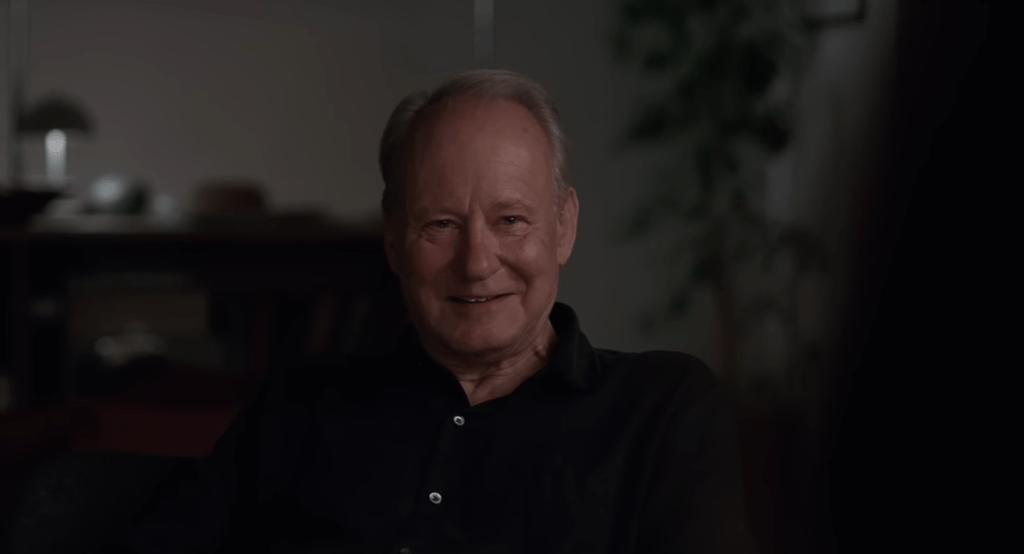
Trier has, predictably, assembled a strong cast to portray his characters (that also includes Danish veteran Jesper Christensen in a smaller role). Renate Reinsve commands the screen as the talented but agitated and lonely actress with severe stage fright. She is terrific here, even though the narrative doesn’t rest as much on her shoulders as it did in her previous Trier film. She shares a complicated relationship in the film with another Trier mainstay, Anders Danielsen Lie, who is relegated to a bit-part role here. However, he’s always so effective when asked to land on the wavelengths of Trier’s narratives, and the same is the case here. Elle Fanning, as the main Hollywood inclusion in Trier’s Scandi-universe, turns in a really effective performance, wherein she skillfully navigates being asked to be a good actress who is wrong for the part her character has been cast in. It is a tricky ask, but she does it so well. Lilleaas is the film’s secret ingredient. For so long, her character is more functional than integral, but then, late in the film, her heart-to-heart scenes with the film’s two primary characters work as the glue that holds the character arcs together. The way she communicates her sibling relationship should stick with you. The centerpiece performance, however, is the one delivered by Stellan Skarsgård. The legendary Scandinavian star at home and abroad communicates his character’s interior blend of awkward stubbornness, stunted emotional growth, and pained center with a nuanced performance that makes his character feel like someone you’ve met or known.
On the whole, Joachim Trier’s Sentimental Value is another deeply affecting Scandi-drama powered by a knowing script that holds a strong understanding of the influence of parenting on a child’s adulthood. The narrative’s blend of filmmaking within a film and a focus on a fractured family makes for fertile ground for his capable cast to explore the film’s themes. Although on first viewing, I am not prepared to proclaim it as good as Oslo 31. August or The Worst Person in the World, it is, nonetheless, one of the best efforts in Trier’s oeuvre, as well as one of the strongest films of 2025.
9 out of 10
– Review written by Jeffrey Rex Bertelsen.

 I'm Jeffrey Rex
2 thoughts on “Sentimental Value (2025) | REVIEW”