
Directed by Kevin Williamson — Screenplay by Kevin Williamson and Guy Busick.
When Matt Bettinelli-Olpin and Tyler Gillett (often referred to as Radio Silence) took over the reins to this long-beloved slasher franchise from the late, great master of horror Wes Craven — starting with 2022’s Scream legacy sequel — they did a good job of steering the film series in the right direction by creating two films (also including Scream VI) that successfully introduced a new core group of characters, inserted the effective meta-genre commenary that Craven’s films were known for, and earned strong box office returns and critical reception. That goodwill was dealt a significant blow when, after Radio Silence had already exited the seventh film in the series due to scheduling conflicts, the rebooted series’ lead, Melissa Barrera, was, shockingly, fired for pro-Palestinian posts on social media. Following this, co-lead Jenna Ortega announced that she would not return for the seventh film, and director Christopher Landon left the project (and was replaced by original Scream screenwriter Kevin Williamson). Recently, boycotts have been announced, and protests have been organized. The very public behind-the-scenes drama has led to a troubled production, and, among the fanbase, there were concerns that this seventh entry would suffer for it. After having seen the film, I can say that, well, ultimately, it’s not just drama behind the camera that’s holding Scream 7 back.
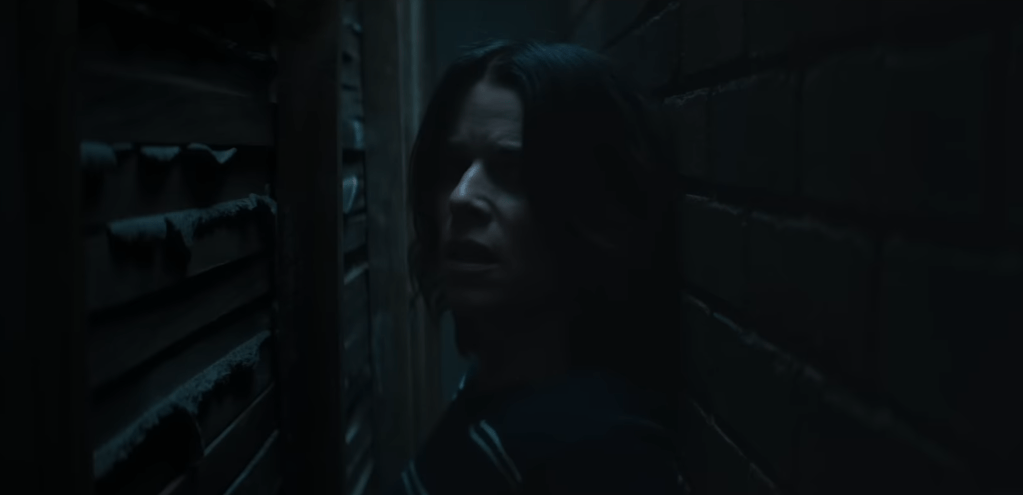
Set sometime after the events of Scream VI, Kevin Williamson’s Scream 7 follows the series’ original final girl, Sidney Prescott (Now Sidney Evans, still played by Neve Campbell), in Pine Grove, Indiana, where she has built a new life for herself with her husband Mark Evans (played by Joel McHale), a local police officer, and her three children, the oldest of which, Tatum (played by Isabel May), is struggling to connect with her mother due to her not being interested in opening up about her past (and being cautious when it comes to letting anyone get close to Tatum, including her boyfriend). But even though Sidney has tried to leave Woodsboro behind, her past isn’t done with her. While Tatum is at rehearsal for a High School play, a Ghostface killer calls and threatens Sidney. The Ghostface killer continues the call through FaceTime, and the face that Sidney sees is that of a scarred and noticeably older Stu Macher (played by Matthew Lillard), one of the two original killers from the first film, whom Sidney has always thought that she had killed way back when. As this Ghostface killer targets Sidney, her family, and her daughter’s friends, Sidney has to find out if this is a deepfake or if Stu somehow survived the events of the first film.
Given that Paramount turned to Williamson to direct the seventh film, the hope was that one of the original people behind the franchise could deliver something befitting of the film series, something that could recapture what made the franchise great in the first place (the meta-references and the playful slasher horror genre blend being the key elements). But because Williamson (it’s only his second feature as a director) is involved, it only makes it more disappointing how far off the mark Scream 7 is from working the way these films should.
Now, it’s not all bad, and I do want to highlight what works. The primary element that is successful is Neve Campbell’s performance. Campbell’s return to the franchise is seamless based on the performance, even though the dialogue bafflingly emphasizes her absence from the sixth film over and over again. Campbell helps to make the mother-daughter relationship work well, and she thus paired well with Isabel May. In general, I actually liked most of the Pine Grove set-up. I think McHale is solid in this, even though his character is thinly drawn, and I think it was an interesting choice to frontload a lot of the slasher carnage. There’s also a relatively effective early home invasion sequence, even though it requires some suspension of disbelief concerning how amateurishly law enforcement searched the premises in the build-up to it. Also, although I have some issues with the Woodsboro prologue, I think the film was, sort of, dancing around an interesting topic (i.e., dark tourism).
Now, while I will say that having the Ghostface killer potentially use AI to deepfake legacy characters isn’t an inherently bad idea, the way that element is executed is extremely unsatisfying. Throughout the film, it looks too seamless, and the film doesn’t ask legitimate questions about how the Ghostface killer would even get a hold of enough footage of said characters to pull off such seamlessness. It is wholly unconvincing. Even if you can overlook what some may say are merely nitpicks (including, but not limited to, how empty and underpopulated Pine Grove seems), the problems keep piling up. The film has rushed pacing, supporting characters are all extremely thinly drawn, the AI subplot becomes increasingly half-hearted as the plot develops, characters often restate both plot elements and character name backgrounds (in a way that makes it feel like the film doesn’t trust its audience), and, in several moments, the film has characters appear, or reappear, in places and at times that only make sense if they could teleport, thus defying narrative logic and basic continuity.
For me, those problems really started to hit hard the moment Gale Weathers (still played by Courteney Cox) showed up. It is a very cartoonish moment. I also think the writing fails both Gale and the younger returning cast members from Scream VI (i.e., Jasmin Savoy Brown and Mason Gooding), as they act in ways that betray the tenets of their characters or, in Gale’s case, don’t respect Gale and Sidney’s three-decade-long friendship. Their performances leave a lot to be desired, and I primarily blame that on the way they are written. But, for a slasher film in this franchise, what really has to work is, first, the murder mystery aspect, and, secondly, the meta-commentary. While, at one point, Brown’s character blurts out something along the lines of: “This one is about nostalgia,” it never really feels like this film has anything on its mind, and the film mostly opts out of a long monologue explaining the rules that govern these types of films, which feels like a slap in the face given rule-listing is such a beloved tradition in these films.
Where the film almost falls apart is in the pivotal murder mystery aspect. The film doesn’t do a good job of building up to the reveal, as one pivotal scene has almost all the main suspects at a bar together, and the way the scene plays out makes it easy to rule out several characters in one fell swoop. Also, the film essentially reveals one of the killers relatively early on through a line of dialogue from this individual delivered directly to Sidney in broad daylight, but the film doesn’t have Sidney pick up on how suspicious this line is. Because of all of this, you get the sense that the identity and the reveal of the killers were an afterthought, or the product of heavy rewriting or reshoots. I found the reveal to be so underwhelming that I almost lost all interest in the climactic scenes, and, I remind you, this is coming from someone who thinks of Scream as his favorite horror film series.
It’s more of a Stab movie (i.e., the in-universe films adapting the events of the series, the sequels to which have long been used by these very films to satirize the nature of tired, uninspired horror movie cashgrabs) than a good Scream movie. It feels like an obvious and almost lazy critique, but it is also right on the money. Even though Neve Campbell delivers a strong horror movie performance in this, Scream 7 is, without a doubt, the nadir of the film series. The essential Scream traditions feel like afterthoughts here, characters are thinly drawn, and the way it uses AI to modernize the Ghostface killer (albeit through nostalgia) feels half-hearted and poorly thought-out.
4 out of 10
– Review written by Jeffrey Rex Bertelsen.

 I'm Jeffrey Rex