
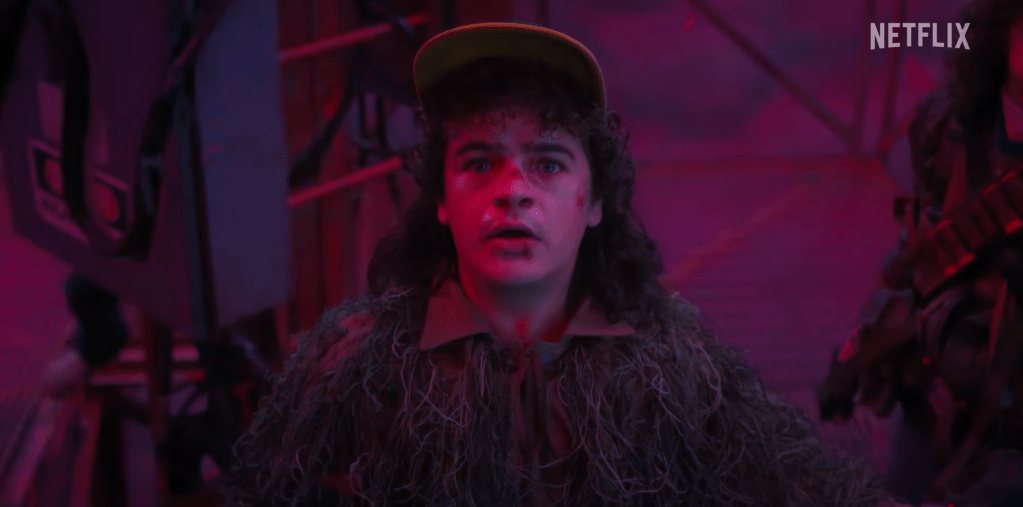
Regardless of what you think about the show or this season, I think you have to admire the gusto of the release strategy for the final season of Stranger Things, of which the first volume (episodes one to four) was released early in December, the second volume on Christmas, and the series finale on New Year’s Eve or New Year’s Day (depending on your region). Stranger Things really took over a huge chunk of the online entertainment focus in December, despite the fact that massive trailers for huge films were released alongside a new Avatar film in theaters around the world. They really made the three-part release of the show into events. But did the series finale of the most popular US-based Netflix original series, or the season as a whole, live up to the hype it created for itself? Well, let’s talk about it, because it’s not a straightforward answer.
After the events of Season Four, Stranger Things, now set in the late 1980s, picks up the action in the small town of Hawkins, Indiana, at a time when the military, led by Dr. Kay (played by Linda Hamilton), has overtaken the surroundings to put certain areas into quarantine and appear to be desperately searching for Eleven (played by Millie Bobby Brown), who is training and hiding with Jim Hopper (played by David Harbour). As the core group of heroes, both young and old, get ready to take down Vecna (played by Jamie Campbell Bower) for good, despite Max (played by Sadie Sink) still being comatose, they are further kneecapped by the sudden attack on the Wheeler household and the kidnapping of young Holly Wheeler (played by Nell Fisher).
I thought the final season got off to a relatively strong start with Volume One, which did a good job of further elevating the stakes, reintroducing characters, leveling up a certain individual’s abilities, and pulling off excellent action-horror sequences that still focused on our investment in the characters in the show. It wasn’t perfect, though, as certain dynamics felt inorganically sidetracked (e.g., although the Steve-Dustin heart-to-heart in Volume Two was quite good, I thought their disagreements for most of the season felt forced) or previous disagreements were pulled back to the forefront despite being old hat (e.g., the Steve-Jonathan duel for Nancy was unnecessary, despite how much I enjoy those characters), and the latter example of these two wasn’t properly resolved until very late in the season, at which point it became obvious that they weren’t actually doing anything new here with these two.
Now, with the release of Volume Two, it certainly felt like the internet was not in a gift-giving mood, as a lot of criticism rained over the second portion of episodes. Some of the criticism felt overly harsh, though I agreed with several points. Frankly, it felt to me like certain corners of the internet were ready to jump on every negative feeling from the core fanbase and blow them up beyond recognition, and, I’ll add, that it felt to me like some people online wanted this to be some Game of Thrones-esque final season fiasco. Now, is this the weakest season of the show? Possibly, but it is nowhere near the utter failure that Game of Thrones‘ final few episodes were. On several technical levels, the show remained immensely watchable and entertaining, and there was never a show or character betrayal here that was as odious as what was seen in the aforementioned series.
But, as I intimated, the season is quite weak compared to other seasons. This did become clear with the second volume, wherein the constant use of descriptive or expository dialogue was noteworthy, and the overwhelming amount of characters (due to the previous seasons’ apparent allergy to killing off main characters, all the while continuously adding new regular cast members) became a problem, as it led to narrative inconsistencies or key characters and dynamics falling into the background (Caleb McLaughlin deserves better than to have barely anything to do this season). Though occasionally effective, the second volume felt stuck in a rut. This is a bit of a spoiler for the second volume, but I have to say that I think it is crazy that arguably the biggest action sequence in the second volume is built around the idea that Vecna needed a ‘spy’ on the outside to figure out where a comatose Max would be. You’d think he could guess that.
So, when the super-sized two-hour series finale came around, it did feel like people were nervous the show wouldn’t stick the landing. Thankfully, I think it ultimately did despite some glaring weaknesses present in the finale. Despite packaging, if I’m not mistaken, most of the action in the first hour of the finale, I didn’t think that first hour felt rushed, even though its Kaiju-esque battle was maybe a little bit too short. About the Kaiju-esque battle, I loved how the show presented and executed that sequence. Sure, it’s got empty and obvious visual effects backgrounds, but I was really impressed by the fleshy creature design showcased there and how, I guess, anime-inspired it all looked. I really dug it (and the teamwork showed therein). I found it to be immensely satisfying, and the same goes for the weepy epilogue, which emphasized a celebration of their characters. There is a choose-your-own-adventure ambiguity to the ending that I really dig, and, in general, I think the many character beats found in the second half of the episode are both loving and lovely.
That said, it was also a very safe and oversized series finale that, even while steering the ship safely into shore, retained some of the longstanding elements that people have had issues with, including 1) way too many fake-outs, 2) way too many characters, 3) actors having aged out of their roles, and 4) sometimes iffy dialogue. I mentioned that it was a celebration of its characters in a nice way, but it also falls victim to the classic ‘too many endings’ criticism. That said, I really enjoyed the series finale, even with its flaws and its few dangling story threads (so much of the military fallout is just handwaved away at the end there). I particularly liked how Finn Wolfhard finally got a chance to show his talent in the finale, despite, for some time, having had very few ambitious scenes to pull off. Over the course of the entire season, I thought the standouts were Sadie Sink, Natalia Dyer, Joe Keery, Jamie Campbell Bower, Maya Hawke, Gaten Matarazzo, and newcomers Nell Fisher and Jake Connelly, though for different reasons.
To conclude, despite the season as a whole having quite a few issues, The Duffer Brothers’ Stranger Things bowed out with a somewhat oversized and safe but immensely satisfying series finale that did a good job of celebrating its characters through incredibly moving scenes (with the Dungeons and Dragons-basement scene being the standout scene of the entire season) and strong character work.
– Review written by Jeffrey Rex Bertelsen.

 I'm Jeffrey Rex