
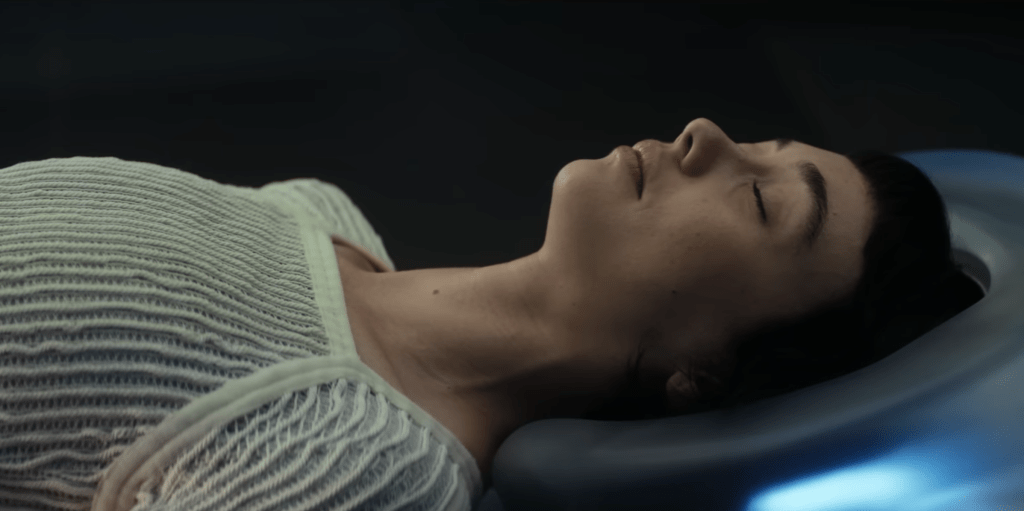
Although I grew to be really excited about it, I’ll admit that when I first heard about Alien: Earth, I was somewhat displeased. I admire the work of series creator Noah Hawley a great deal, but, as a defender of Ridley Scott’s prequel films, it upset me that it had been reported that the new show would distance itself from those films and potentially split the canon into two. When I finally watched the show, I was taken on something akin to an emotional rollercoaster ride, as I, from episode to episode, would switch between being skeptical about the show to being head over heels in love with it. So, where did I ultimately land on the show once the season was over and done? Well, I found it to be both a promising and frustrating experience that teased something cerebral that it couldn’t quite live up to, while I thought the show did the titular Xenomorph creature a massive disservice.
Set in 2120 (notably two years before the events of Alien and twenty-seven years after Prometheus), Alien: Earth is all about humanity’s search for immortality as seen through major corporations’ efforts to control alien life forms and create new inventions regarding both human consciousness and artificiality. As the series opens, they emphasize three types of human artificiality, the final of which represents the secret new path that the previously unknown Prodigy Corporation is dedicated to exploring. These are: 1) cyborgs (i.e., humans with robotic or mechanical body parts), 2) synthetics (i.e., fully robotic beings created with artificial intelligence), and 3) hybrids (i.e., synthetic bodies that have had human consciousness transferred into them).
As the show kicks off, a Weyland-Yutani ship piloted by a cyborg (played by Babou Ceesay) and carrying various alien life forms, including a vicious Xenomorph, crash lands on a part of Earth that the rival Prodigy Corporation controls, Prodigy’s Peter Pan-obsessed leader Boy Kavalier (played by Samuel Blenkin) sends his hybrid prototypes (all of which can be defined as having had the consciousnesses of terminally ill children transferred into their adult synthetic bodies) to retrieve Weyland-Yutani’s intellectual property and the alien life forms that, once they come into contact with the hybrids, will lead to the hybrids questioning everything about who they are and what they can be.
What initially caught me off guard about the show was how slavishly it sought to recreate what had come before it. Now, don’t get me wrong, I, too, enjoy seeing modern recreations of the kind of retrofuturistic production design featured in Scott’s original film, which I love, but given how the series supposedly had set out to carve a distinctly different prequel path than the one Ridley Scott had put us on, it felt counterintuitive for the show to continuously redo what had come before it. Though the hybrids are different than Scott’s synthetics, their stories still dig into similar narrative paths or themes related to a confused identity or outright creator defiance. Though this takes place on Earth, it is still as corporate-focused as so many other entries in the franchise, and very little new is brought to the table. We still get the same retrofuturistic designs, similar references, and similarly questionable decision-making from specific characters. This can be either a feature or a bug, but I think, to me, it is somehow both at one and the same time, given its position as a canon-splitter, as one might call it. The show overtly or subtly references or repeats steps taken in pretty much every film. For a while, the most novel thing about it was the Earth setting (even though we’re mostly at one facility), the repeated references to Peter Pan, and the rock music used in the closing credits for each episode.
Despite clunky exposition, issues with the structuring of episodes, and my complicated feelings about how safe and unoriginal it felt in early stages, the show did gradually pull me in and start to win me over. This was partially due to entertaining performances turned in by Sydney Chandler, Timothy Olyphant, Alex Lawther, and, especially, Babou Ceesay, but I also just felt that the show started to toy with thought-provoking ideas that got to a ‘Ship of Theseus’ like discussion about the hybrids, which I thought was both absorbing and chilling, at one and the same time. I also greatly enjoyed how, even though it was marketed as a show about Xenomorphs on Earth, they sometimes took a backseat while Hawley’s show invented new monsters from outer space. Frankly, the eyeball alien is the single most exciting thing about this show, and what it could get up to was what I started caring about the most.
Frustratingly, it ended on a sour and disappointing note that knocked the wind out of its sails right when the show was starting to work. I felt that the final episodes, and, especially, the season finale, made decisions that needlessly (and in a way that ruined the stakes of the goings on) overpowered a key individual; so much so that the Xenomorph itself was relegated to being a tool that one could tame, which just takes away from the horror of cinema’s most iconic otherworldly sci-fi horror monster. It felt to me like a lesser episode of Westworld, which is a show that I once adored but whose power gradually faded, rather than something befitting the world that Ridley Scott has crafted. Furthermore, events felt rushed or were left unresolved, with characters making poor decisions seemingly primarily so as to speed up the plot to move the chess pieces of the show, so to speak, around hastily, even though it didn’t always make logical sense. As such, the show ended up like something akin to a mixed bag for me. On the one hand, it does the titular alien a disservice and is overly safe in the early goings, but, on the other hand, it does flirt with intriguing ideas and creates something new to fear. Time will tell, if a second season can undo the frustrating elements in the late stages of the season and actually do something exciting and new in this universe, but, as of right now, though it has its moments and strengths, Alien: Earth is not the triumph that I think many had hoped it would be once the very talented Noah Hawley was brought on board. Hopefully, he’ll have a plan that can steer things in the right direction, because there is room to grow and a decent foundation to build off, despite my complicated feelings about the show’s potentially canon-splitting role.
– Review written by Jeffrey Rex Bertelsen.

 I'm Jeffrey Rex