
Directed by Joachim Rønning (Young Woman and the Sea) — Screenplay by Jesse Wigutow.
One good thing that Tron: Ares immediately accomplished was getting me to give Tron: Legacy a rewatch. Back in the day, I greatly enjoyed Legacy, which was essentially Disney’s attempt to get their own Matrix clone, but I hadn’t rewatched it in so long. Though Legacy has its issues with performance, runtime, and slightly dated visual effects, it is such a good time. Its visual style was effective, Daft Punk’s music was sensational, and Olivia Wilde and Jeff Bridges were joys to watch. It may have been style over substance, but it was genuinely entertaining and has rightfully earned a cult following in recent years despite underwhelming at the box office. Now, with Tron: Ares, Disney has switched out Joseph Kosinski for Joachim Rønning, Daft Punk for Nine Inch Nails, the digital world for the real world, and the cold blue look for a reddish one. Unfortunately, while there are things to like about Tron: Ares, the writing and casting let it down.
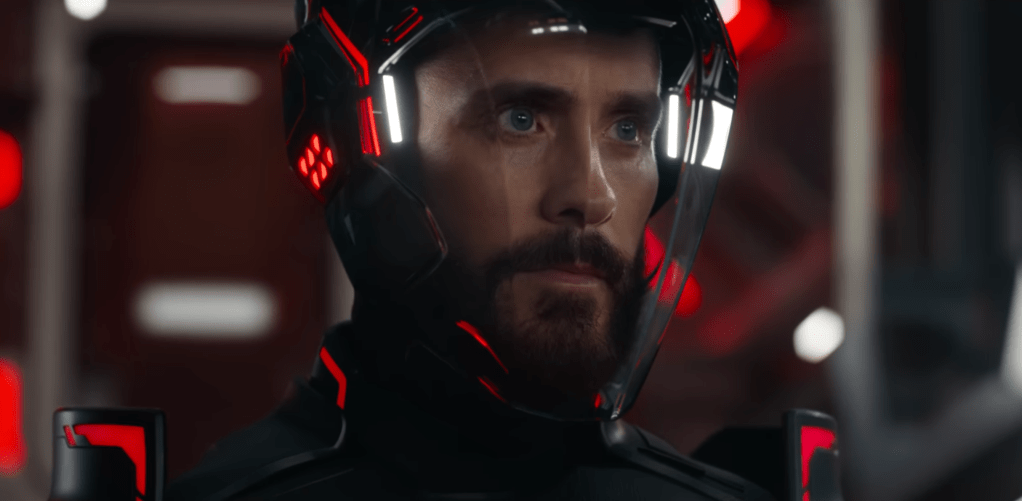
Set fifteen years after the events of Tron: Legacy, Joachim Rønning’s Tron: Ares takes place during a corporate battle for influence between ENCOM and Dillinger Systems. Both hope to be able to create or transfer digital elements, but are struggling to figure out how a digital creation can last in our reality for more than 29 minutes. They need the so-called permanence code. Dillinger Systems, led by Julian Dillinger (played by Evan Peters), is hoping to use it to create and offer military equipment and perfect soldiers, while ENCOM CEO Eve Kim (played by Greta Lee) hopes to be able to heal the world. When Kim discovers the permanence code, Dillinger assigns Ares (played by Jared Leto), a so-called Master Control program, to be the perfect expandable soldier and bring them the permanence code by any means necessary. But when Ares starts to notice that Kim’s thoughts and ideas are kinder than Dillinger’s, he starts to think for himself and has second thoughts about his purpose. As Ares experiences the world, he starts to develop a desire to stay.
When the original Tron and its sequel Tron: Legacy were released, they represented films that were years ahead of their time with forward-reaching state-of-the-art visuals, but I don’t think Tron: Ares quite manages to accomplish that. Don’t get me wrong, it does exemplify a step forward technologically and with its visuals, but I don’t think it feels like it is doing anything particularly new or groundbreaking. Rather, it feels like it is following in the footsteps of obvious sources of inspiration. The whole idea of having this be mostly set in our world was technically set up in Legacy, but given the popularity of the Tron bike in Grand Theft Auto Online, you have to admit that it is very likely that Disney opted for that look to pull in a younger video game-focused audience. Then some scenes and visuals directly copy Blade Runner 2049 and Blade Runner (e.g., the rain) or The Terminator. And, of course, it still has the feeling of being designed to be another version of The Matrix. But it’s nowhere near as interesting as the films it is copying.
Frankly, I found it to be tonally uneven. For so long, it feels like it is supposed to be this uber-serious sci-fi flick, which I, honestly, dug. In the early going, Arturo Castro is the only source of humor. But then it feels like the filmmakers or the studio panicked and feared the reception it would get if it took itself too seriously, because all of a sudden Jared Leto’s character starts to smirk and make jokes that turn him into a different kind of character and a much less believable one. It felt like they were jamming a square peg into a round hole. Furthermore, it felt as though the filmmakers didn’t trust the audience. Characters will repeat themselves over and over again or restate character motivations. It felt like they were worried audiences couldn’t keep up. On top of this, it is overcrowded, overstays its welcome, has a hokey ending, no chemistry between its stars, unengaging performances, and, on the whole, it lacks proper connective tissue to Legacy.
So, there are a lot of things that just don’t work. But, at the same time, I also had a pretty good time for most of the film. How come? Well, I think this is a much better feature-length music video or visual companion to an album than it is a good movie. Trent Reznor and Atticus Ross’ music, like Daft Punk before them, steals the movie. Even when scenes didn’t work for me, I found myself moving my head up and down and enjoying myself from the music, the beats, the rhythm. It also just looks nice. Although narratively most of the action is just visual noise, the red look and techy ambitions fit well with the music accompanying it.
Ultimately, Joachim Rønning’s Tron: Ares felt like a step in the wrong direction for the franchise due to it lacking enough of connective tissue, its dreadful writing, forgettable characters, and uneven tone. But it is still a decent time at the movies, if you’re just going in for an audiovisual experience rather than a ‘good film.’ Because, yes, the music is so good.
5.5 out of 10
– Review written by Jeffrey Rex Bertelsen.

 I'm Jeffrey Rex