
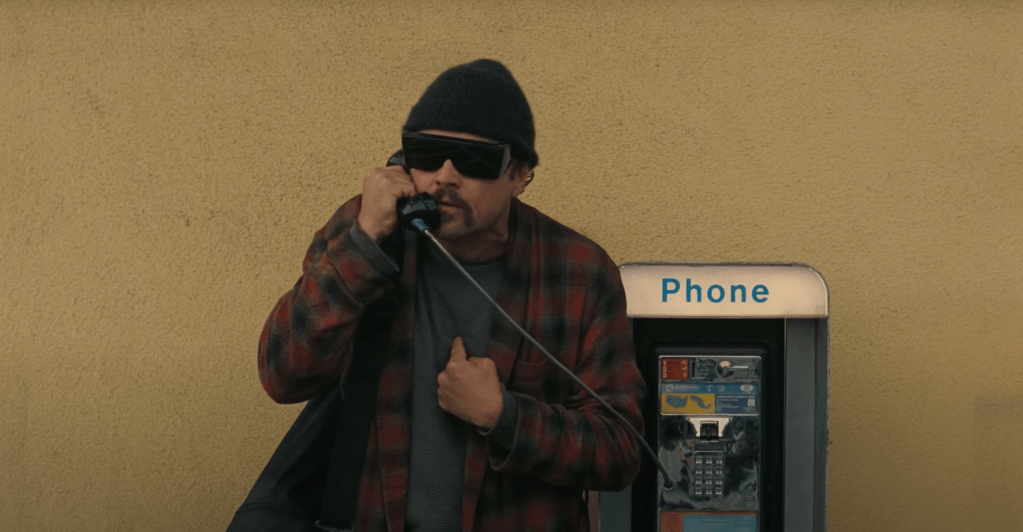
Directed by Paul Thomas Anderson (Phantom Thread) — Screenplay by Paul Thomas Anderson.
One of the most anticipated major auteur works of 2025 has been released. Inspired by Thomas Pynchon’s postmodern 1990 novel Vineland, One Battle After Another marks the 10th narrative feature from writer-director Paul Thomas Anderson (often abbreviated as PTA) and the first team-up with the renowned and immensely popular thespian Leonardo DiCaprio. The film follows Bob Ferguson (played by Leonardo DiCaprio), a paranoid ex-revolutionary, who has gone into hiding from the government to protect his now-teenaged daughter, Willa (played by Chase Infiniti), who has yet to fully understand what he and her mother went through when they quarreled with the government during their time as prominent members of the far-left revolutionary group the French 75, who, among other things, broke out detained immigrants from militarized detention centers. However, on the day of a school dance, it becomes clear that the government — personified by Colonel Steven Lockjaw (played by Sean Penn), who has personal reasons for seeking out Bob and Willa — has finally found them. When Lockjaw and the military’s presence becomes known, Bob goes in pursuit of his daughter, with the hope of getting to her before Lockjaw can, but he needs the assistance of the cool-headed local community leader, Sergio St. Carlos (played by Benicio Del Toro), if he is to have any chance of navigating both the chaos around him and the paranoia inside of him, as well as getting to his daughter before it’s too late.
Despite having an oeuvre that includes an epic neowestern about turn of the century American foundations (the battle between profiting and praying in America) and a film that many have interpreted to be partly about the birth of Scientology, his 2025 flick is arguably PTA‘s most overtly political picture. Sometimes through political satire, the film examines pathetic white supremacists, hopeful revolutionary aspirations, immigration, false flag operations, working together as a community, and what teachings and lessons we can pass on to future generations. It is a rich and complex narrative that is genre-bending, ambitious, and sensationally entertaining. There are bits and pieces of The Big Lebowski, Burn After Reading, Sicario, and so many other films scattered throughout, but it is very much its own thing, with elements of, again, political satire, a stoner buddy comedy, a political thriller, and an action film.
Perfectly paced, it is an electrifying total package with relatively distinct acts, and a fast pace that almost never lets up but complements Bob’s sense of paranoia. I never really got to my movie theater snacks despite the 162-minute runtime because there was never a suitable moment to look away or catch your breath. The film flies by without feeling overly rushed, and it has a straightforward narrative that should help to make it appeal to a wide audience despite the fact that it also has an auteurist sense of importance to it. Although, on first viewing, I did have some issues with a shaky camera look at times (though it does, again, complement the emotional journey of the main character), the film looks fantastic, features standout costuming and hair and make-up that help to craft distinct and memorable characters, and then, of course, there’s the perfectly designed musical score from Jonny Greenwood, which is intense, jittery, and often piano-note heavy. It is remarkable.
One of the great delights of watching a skilled popular actor’s career trajectory is watching them find new facets to play and master. In the case of Leonardo DiCaprio, he has become especially proficient at playing characters losing their minds or finding themselves over their heads (often while under the influence or in need of a confidence boost). We saw delightfully unhinged glimpses of this in both Martin Scorsese’s The Wolf of Wall Street and Quentin Tarantino’s Once Upon a Time in Hollywood, and, for One Battle After Another, DiCaprio is following down that same comedic track. Watching Leo play both unhinged, overwhelmed, and panicky is one of the many joys of Paul Thomas Anderson’s latest film. Though DiCaprio is undoubtedly the biggest name-brand actor associated with the film, the most memorable performance in the film is the one delivered by Sean Penn in the role of the film’s antagonist. Penn disappears into the role of this pathetic power-desperate walking-contradiction of a soldier who is not only an incredible character design (kudos to the hair and make-up department) but is also brought to life through an astounding physical performance from Penn. It’s in the notable voice choice but also in the stick-up-your-butt way he walks. Sure, it’s almost definitely meant to look like he’s a soldier who had a serious injury once, but it also gives off this idea that he is trying to permanently hide a side stitch to keep up this fake and stiff toy soldier exterior. Penn nails every facet of the character, from the frightening actions and intentions to the inadequacy and the confused desires that run his life.
Then there’s Chase Infiniti, in her first film role, who is a revelation. She is capable of holding and evoking a mix of confusion, anger, and fear at one and the same time, while, in the very same film, doing quite an impressive physical performance. She is capable of keeping up with both a fantastic DiCaprio and Penn in, arguably, career-best performance mode. Though featured prominently in trailers, Benicio Del Toro still feels a little bit like the film’s secret weapon. He lends a calmness and a professionalism to the chaotic revolutionary hijinks. He is always a step ahead, and it is such a treat to see Del Toro play the steady man to Leo’s unraveling nitroglycerin energy. In addition to these, there are notable supporting performances turned in by actors like Regina Hall and Teyana Taylor, who give off warmth (and a clear-eyedness) and a dynamite firepower, respectively, to the film scenes.
Paul Thomas Anderson’s One Battle After Another is an electrifying jolt to the senses; it is a complex thrill ride that gets the most out of its stellar cast, and it is a political call to arms that seeks to bridge the gap between generations and pass the torch to future generations so as to ensure they can carry on the fight, while learning from mistakes. I see it partly as a film that carries a hope that future generations, raised on promises (note the closing needle drop), can right wrongs through solidarity. And with Anderson’s political examination and satire, the film somehow feels both timeless and timely. But, for as much as this is a film with a lot on its mind, it is also a perfectly paced crowdpleaser that I couldn’t take my eyes off. It hits the comedic highs of The Nice Guys, possesses the kind of call to arms political aspirations of V for Vendetta, and has breathtaking car chase filmmaking (even sometimes rollercoaster-like filmmaking that can be both dizzying and hyper-engaging at one and the same time) that, in a few scenes, reaches the heights of exceptional car-centric films like Mad Max: Fury Road and Baby Driver, but, notably in One Battle After Another, it is executed in such a markedly realistic way that you can almost taste the asphalt of certain getaway scenes and feel the wind in your hair as you hold onto your theater seat, while vehicles speed through hills and valleys. It’s an outstanding total package that will have a life of its own beyond the big screen and which deserves to be seen with a crowd.
10 out of 10
– Review written by Jeffrey Rex Bertelsen.

 I'm Jeffrey Rex
3 thoughts on “One Battle After Another (2025) | REVIEW”