
Directed by Zach Cregger — Screenplay by Zach Cregger.
Whenever an up-and-coming new filmmaker, whose previous film had the makings of a bona fide genre classic, is about to turn in his latest film, you pay attention. You especially pay attention when the filmmaker’s script for his new picture was so highly regarded in the American film industry that it not only launched a bidding war but also, reportedly, got a modern horror master to fire his manager over their failed attempt at securing the distribution rights to it. Such is the case with Barbarian writer-director Zach Cregger and his latest film, Weapons, a multi-perspective horror-thriller with drama and comedy elements that had a memorable and fantastic marketing campaign built around it, and which also, thankfully, turns out to be exactly the kind of must-see thriller epic that I’ve been craving.
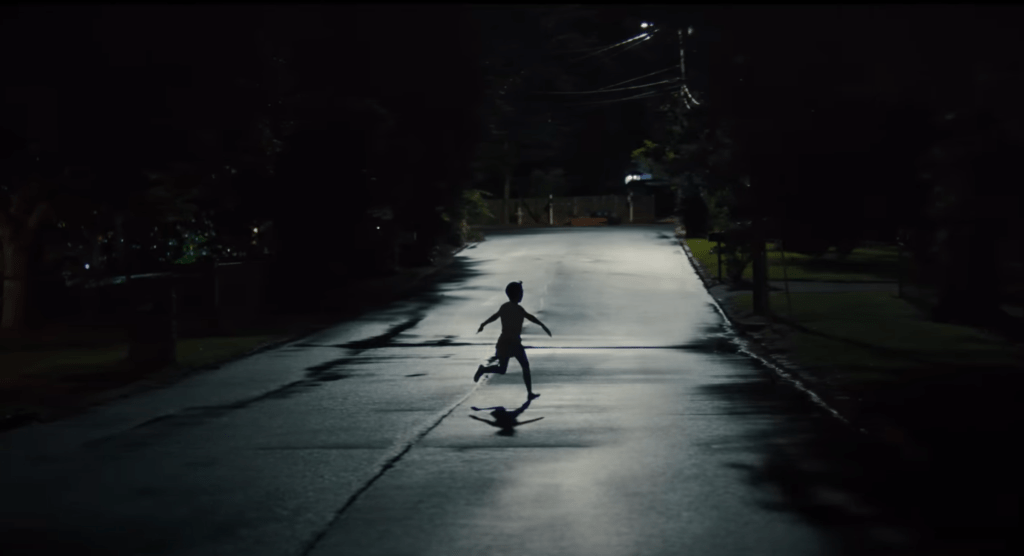
Zach Cregger’s Weapons takes place in a small American town known as Maybrook, where something mysterious and tragic has occurred. One night, at 2:17 A.M., seventeen out of eighteen children from the same elementary school class all woke up, got out of their beds, and ran out of their houses and into the dark with their arms spread out wide and vanished. This mysterious event was only captured on home security cameras, and authorities are at a loss as to what caused it, as the investigation and subsequent questioning of both the class teacher and the single student who didn’t disappear gave them no new leads. Scared, worried, and angry, the missing children’s parents (led by an outwardly angry and inquisitive Archer Graff, played by Josh Brolin) need someone to blame, and they target their anger at the class’ young teacher, Justine Gandy (played by Julia Garner), who, despite having no idea how this came to pass, becomes a social pariah and turns to alcohol to soften her distress. Unsatisfied with the police investigation, Justine and Archer, both of whom are plagued by vivid nightmares, start investigations of their own, independent of one another. Archer starts scrutinizing the security footage, while Justine investigates a mysterious home, and, eventually, their paths intersect as they realize something dark and violent is taking place in the suburbs.
One of the first things that audiences will notice about Zach Cregger’s Weapons is that it has a curious nonlinear narrative structure. It features different puzzle piece chapters with inter-title chapter headings named after characters from the film, and so, depending on the name on screen, the following chapter will be seen from the perspective of said character. This means that the film can have a sort of mechanical step-by-step formula to it with 1) a start, 2) a gradual buildup, 3) a chapter-ending reveal, scare, or the like, before the film then 4) goes in reverse to give us another character perspective chapter. This may sound laborious or repetitive to some, and, admittedly, eventually there is perhaps one too many chapters (the chapters dedicated to Alden Ehrenreich and Austin Abrams’ characters probably could’ve worked as only a single chapter), but in the hands of the capable writer-director, the sense of momentum and mystery is contained and kept alive. He has crafted a tightly written narrative with strong filmmaking and both effective scares and surprising climaxes that make you excited to put the entire puzzle together. For a more exciting horror movie comparison than a puzzle piece or a start-stop-reverse formula, I think it’s also fair to compare it to a roller coaster ride or a Jack-in-the-box. Like a Jack-in-the-box, you can feel how each chapter has its crank slowly turned as the music builds up, and eventually you get the doll to pop up and give you a scare. Like a roller coaster ride, the film often has effective and tense buildup that gets you to lean forward and take notice (or grab ahold of your seat), and, like when a roller coaster ride takes the scary plunge, the film builds up to both scares, laughs, and exciting reveals that keep your mouth agape.
It’s also a film that wears its inspirations on its sleeves. There are traits of, or references to, the filmographies of David Fincher, Paul Thomas Anderson, Denis Villeneuve, Stanley Kubrick, Quentin Tarantino, and more. In the buildup to release, it’s often been compared, especially, to Paul Thomas Anderson’s Magnolia and Ari Aster’s Hereditary. Though, from my perspective, it feels like Weapons is best described as having the tonal agility of Barbarian, has taken structural inspiration from Quentin Tarantino’s Pulp Fiction and the aforementioned Magnolia, has a premise and a hook that is obviously inspired by Denis Villeneuve’s Prisoners, but is executed in a way that makes it feel like its own thing and with very specific horror movie traits that I cannot get into without spoiling the film. It is, at one and the same time, both a suspense thriller, a prestige drama, and a mysterious and disturbing horror film. Cregger’s narrative manages to contain that perfectly, and, as I mentioned above, the tonal agility of the piece is quite fascinating.
Like Barbarian, there are moments of levity that liven up the film, but that also manage to dial up the humor found in absurd or uncanny scares. Certain characters are deliberately designed so as to elicit humor, e.g., Austin Abrams’ character, but there are also bold moments in the film’s climax where the visual language is unmistakably comedic (it’s got a certain Ferris Bueller’s Day Off element to it). Although I’m sure others may find the comedy and horror to be clashing in moments, I found it to be extremely satisfying in the way the humor paired with the release of the tension that had been built up over the course of the rest of the film. It felt to me like the moments of comedy were natural parts of the fabric of the text. Frankly, I think there are enough moments of subtle humor in the earlier stages of the film, so that when it goes wild with the relatively comedic visual language of its climactic act, despite its obvious horror elements, it didn’t feel particularly unnatural to me. There’s also just a lot of humorous moments sprinkled in with the horror, e.g., the occasional jump-scare, intense violence, or gore in the film. But, don’t get me wrong, this is, first and foremost, a suspense thriller with horror elements. For me, the most memorable scene in the entire film was a scene in which a character was approached by a menacing individual while they were sleeping in their car. Here, Cregger plays with expectations, the pacing of the scene (in slightly funny ways), and how what’s outside the frame can be even scarier than what you could possibly put inside of it if paired with the right sound effect. It’s a great scene that’s been on my mind for several days since I saw the film last Friday.
In addition to being an effective suspense thriller with horror elements that manages to even add in a sprinkling of comedy every once in a while, the film also represents a significant budgetary jump up for the director since working on Barbarian. Weapons gives him a higher budget, but also a higher level of expectation to live up to. From my point of view, this is at least as good a film as Barbarian was, but what makes it also a filmmaking evolution for Zach Cregger is that you can definitely tell it is a much more slick, good looking, and confidently made film that not only nails the look of a Prisoners or Gone Girl-esque prestige thriller, but which also sees Cregger toy with his filmmaking style. He definitely plays around with the movement of the camera in this film, whether that be slow zooms in, peeks around the corner, or dynamic action in certain scenes. Every single jump scare here also manages to be quite effective without ever being annoying, which is a tricky balance for most horror films. I also just think that whereas Barbarian had what I felt was distinctly different first and second halves, Weapons feels like a more tightly made, complete film. My only note about the tight narrative is that I think the film perhaps wraps itself up a little bit too quickly. But I really appreciate that the filmmaker is willing and able to toy around with both ambitious and ambiguously surreal horror movie dream logic, and moments of decidedly bleak horror-thriller narrative elements in a studio film. There are lines of dialogue or voiceover that give you a hard and bleak punch to the gut.
One thing that will definitely continue to be a point of discussion with regard to this film is what it is actually trying to be about. There are definite clues in both the dream logic and the entire concept of almost an entire school class being gone that indicate the film could be trying to comment on school shootings, but it never explicitly becomes about that. Indeed, Weapons is an intentionally ambiguous film. An unkind reading of this film would be that it is scatterbrained or not actually about anything, but, in actuality, I think it is actually about a great many things in effective ways. I think it is definitely about suburban angst and tragedy, I think there are clues here that it indicate that it is about a kind of parasitic relationship, there are multiple character chapters that feature alcohol consumption or comment on alcoholism and struggling to stay sober, and I also think you can interpret this film as being about perceived institutional paralysis or failings following a great tragedy. For me, as I’ve had a handful of days to sit and think about the film since seeing it last Friday, I think the most clear thing that the film is about is the effect of addiction, whether that be alcohol or drugs, on both our state of mind and our core relationships, including, with one chapter in particular, what effect it has on kids to be unable to connect with their parents when they are beyond reach in an impaired state.
To bring these elements alive from the page and onto the big screen, the writer-director teamed up with an outstanding ensemble cast led by Julia Garner and Josh Brolin, who effectively become the film’s protagonists. Garner turns in an authentic, multifaceted performance as a scapegoated teacher who needs a drink, a break, a release, and answers. Brolin is predictively sensational as a driven but desperate parent willing to do anything. Then there’s the reliably funny Austin Abrams, who gives a great physical performance, as well as other reliable, capable supporting stars like Alden Ehrenreich and Benedict Wong. But the film’s secret weapons are definitely Amy Madigan and Cary Christopher. Christopher turns in a sensational child-acting performance, while Madigan shows her versatility as a disturbing and kooky character who both makes you grimace and feel unsettled.
I think Zach Cregger’s Weapons rocks. It is tonally agile, wears its inspirations on its sleeves, but feels like a wholly original work, and has one of the craziest climaxes of any film this year in large part due to the film’s confident and genre-bending visual language. It is such an entertaining total package that isn’t afraid to throw in eccentricities into its prestige thriller-horror framing. Frankly, it’s also one of the only times this year that I’ve been in a full theater room in my local theater. It was so nice to see a movie with an excited crowd. There were gasps, screams, laughs, and there was even applause at the end of the film. It was well-deserved.
8.7 out of 10
– Review written by Jeffrey Rex Bertelsen.

 I'm Jeffrey Rex
3 thoughts on “Weapons (2025) | REVIEW”