
Directed by Christopher McQuarrie — Screenplay by Christopher McQuarrie and Erik Jendresen.
When Mission: Impossible first took the leap from being a 1960s and 1970s TV series to being a cinematic franchise capable of rivalling both the most iconic spy thriller films and action extravaganzas in 1996, it was Tom Cruise’s first film as a producer. Now, 29 years later, Cruise has become Hollywood’s biggest movie star, and the film series is supposedly (if the marketing and promotion are to be believed) about to conclude with the aptly titled Mission: Impossible – The Final Reckoning, the eighth film in the series. The film features both some of the best sequences in the entire film series, but also one of the messiest opening acts of any of the films.
Set some time after the events of Mission: Impossible – Dead Reckoning, Christopher McQuarrie’s Mission: Impossible – The Final Reckoning follows Ethan Hunt as he once again teams up with his IMF crew to save the world. After the events of the previous film, Ethan must find the sunken Russian submarine, Sevastopol, to unlock and retrieve the core module of the artificial intelligence known as the Entity, which is planning to launch a nuclear apocalypse. To have any chance of completing the mission and putting the genie (i.e., the Entity, or artificial intelligence as a whole) back in the bottle, Ethan must convince the American government to trust him, try to stay offline so as not to tip off the Entity, outsmart it, and push his body to the limit. At the same time, an old foe of Ethan’s, Gabriel (played by Esai Morales), is still trying to get in the way of the IMF.
It is important to note that Final Reckoning is a ‘part two’ in everything but name. Likely to maximize profits, this potential final entry in the series is not titled ‘Dead Reckoning – Part Two,’ despite the previous film having been released in theaters and on physical media with the ‘Part One‘ subtitle. Changing the title for part two isn’t a quick fix, though, when the previous entry set up so much for this film to follow up on, and so it was only natural that, at least to a certain extent, Final Reckoning was always going to have to recap or bring new viewers up to speed, if it wanted to be more than just for the die-hard, obsessive fans such as myself. I say that it was only natural to expect this, especially given McQuarrie and Cruise’s insistence on maximizing mass entertainment inclusivity for the widest audience possible, but the end product here goes overboard. What should’ve been maybe five to fifteen minutes of exposition becomes an overindulgent, messy, handholding, and clunky, maybe, forty or fifty minutes. To be fair to the film, it’s not like the plot grinds to a halt (indeed, important things happen here), but it becomes too concentrated on explaining things, explaining them again, and trying to tie everything in the franchise together. There are decent elements here, like a scene that features Hunt threatening to bite down on a fake tooth, but it is a very weak and heavy first act that threatens to pull the entire film down with it.
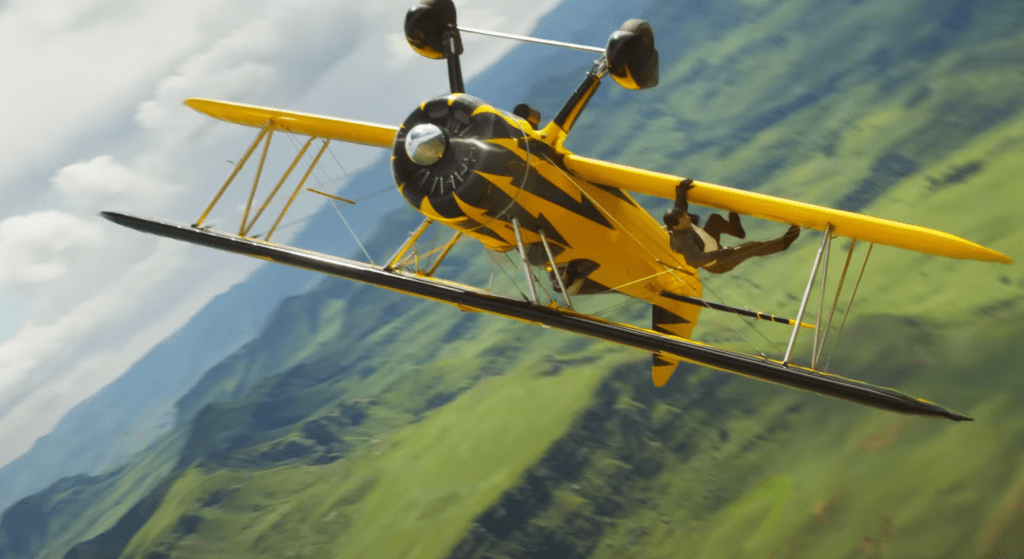
Thankfully, the film eventually finds its footing, gets back on track, and delivers greatly on what we’ve come to know and love the McQuarrie-era Mission-films for. The marketing has focused heavily on an extended biplane sequence where Ethan Hunt has to cling onto biplanes and move from one to the other while airborne. Some will perhaps feel this is too similar to, perhaps, the helicopter sequence in Fallout, but the biplane sequence is far more effective and memorable, given the incredible physical effort that Cruise had to put in to hang on and deliver a performance while the planes were flying at incredible speeds and making movements in the air that make your head spin. It is a jaw-dropping, death-defying stunt achievement that rivals any and every stunt that Cruise has ever done. It also helps that it looks stunning seeing the red and yellow planes fly through the air and above a gorgeous landscape. If I were to nitpick this, however, I’d say that the motivations on the part of Esai Morales’ character in this sequence can feel quite confusing, at least on first watch.
Final Reckoning puts Cruise’s Hunt to the test in the sky, but it also forces him into the deep blue sea in an extended underwater and submarine sequence that, I think, is also one of the best things that McQuarrie has ever come up with for this franchise. Not only is this the kind of sequence that I have a desire to study the behind-the-scenes footage of, but it was also the sequence that, for me, had the most amount of overwhelming tension in the inherent dangers of the storytelling mechanics. In particular, the Sevastopol sequence has this eerie haunted feeling running through it that makes it stand out as so different from anything else they’ve done. I’ve only seen it once, but I remember it being almost entirely silent. It is an effective silence in that the filmmaking on show perfectly communicates visually what Hunt is contemplating from minute to minute. What makes this sequence’s tension so excruciating is the ‘cliffhanging’ ticking clock element inherent in it (e.g., the way that the water moving from compartment to compartment changed the scenario), the way the stakes are raised again and again, and the way that Hunt has to navigate gravity shifts. For both of these highlight sequences discussed above (i.e., biplanes and U-boats), I found myself shifting in my seat, experiencing stress, wincing, and almost feeling the need to cover my eyes at the sheer thrill of it all. It also helps that the cross-cutting is just so precise and so well-done to maximize engagement in pivotal moments.
Given how focused on world-ending threats this is, it doesn’t find quite as much room for levity as previous entries have done, but it didn’t bother me all that much. It’s a film whose main problems are with the first act’s over-exposition, an unnecessary emphasis on tying things from other films together with this one, and the main villain being lackluster — this is the case with both the Entity (essentially a Skynet figure, whose presence was felt much more in Dead Reckoning) and Esai Morales’ Gabriel (who is one of the characters that it seems like they didn’t know exactly what to do with). But these issues, though fairly significant, were not enough to sink the ship (or U-boat) that is Mission: Impossible – The Final Reckoning. It’s a somewhat messy but undeniably entertaining entry in the film series that both sets new highs and new lows for the franchise. This, unfortunately, means that even though the film may feature two of the best sequences they’ve ever done, it doesn’t come close to being the best complete film they’ve done. Thankfully, though, it’s still a great time at the movies.
7.9 out of 10
– Review written by Jeffrey Rex Bertelsen.

 I'm Jeffrey Rex