
This is a recap and review of the fourth episode of the second season of HBO’s The Last of Us. Expect spoilers for season 1 and game 1 (and the episode itself, of course), but also some references to and comments about the second game (though without spoilers).
In the fourth episode of the second season — titled Day One — Ellie (played by Bella Ramsey) and Dina (played by Isabela Merced) explore Seattle, deepen their connection, and search for the W.L.F. crew that killed Joel. Elsewhere, we experience how far W.L.F. leader Isaac (played by Jeffrey Wright) is willing to go to fight back against the religious Seraphites. The Path was written by Craig Mazin (Chernobyl) and directed by Kate Herron (Loki: Season 1).
The startling cold open gives us a glimpse into the rise of the W.L.F.
One of the most exciting things about this adaptation is whenever the competent writers add in scenarios and scenes that are completely new to the story — whether it be the game or the show. The first season, for example, had, arguably, its greatest moment when the writers decided to show us Bill and Frank’s love life rather than to just talk about it (in the game, they only talked around it. However, in the game, it was a very different relationship they had). Of course, like I’ve mentioned over the course of these weekly recaps and reviews, there’s a difference between a change and an addition. For example, for season two, I am unsure about the ultimate effect of the restructuring of scenes and the reshuffling of characters in certain scenarios (like when Dina was with Joel when he died, instead of Tommy, who was with him in the game), though I’m hopeful it’ll all end up in a satisfying manner. These are changes that time will tell whether they will pay off or not. However, this episode included a cold open scene that is wholly new to the narrative and which I think was both startling and a wholly good addition.
The scene in question is set many years ago, in 2018. It opens with the guest appearance of Josh Peck, which, if I’m being honest, didn’t fully work for me, as it almost took me out of the world of the show for a minute there. I had a tough time immediately buying into him as being a part of the gritty narrative that I know and love. However, as the scene continued, I got over my initial ‘Josh Peck-jump-scare’ reaction. The scene features these heavily armed FEDRA soldiers joking around and mocking civilians, whom they call ‘voters.’ When a young FEDRA soldier asks why they call them ‘voters,’ Jeffrey Wright’s Isaac Dixon clarifies that they call civilians that because FEDRA has stripped them of their rights as citizens. It’s a startling reminder that even outside of the Fireflies, Seraphites, and WLFs, the government agencies in the quarantine zones weren’t exactly ‘good guys.’ Isaac then exits the FEDRA vehicle, tells the young soldier to go with him, confronts a WLF group, and then turns back to the vehicle, throws in grenades, locks the door, and kills his fellow soldiers. Isaac Dixon, who was also portrayed by Jeffrey Wright in the video game, is turning his back on FEDRA, jumping ship, and joining the WLF to become one of its primary leaders.
The image of seeing Isaac throw in the grenades without a care in the world is immediately shocking, and it makes for a strong reminder of the danger posed to our protagonists in Seattle. Moreover, however, it also serves to set up Isaac as an unpredictable character who will do what he thinks is right no matter the consequences or the casualties, and, by extension, it is an effective way of introducing an actor of the caliber of Jeffrey Wright to the TV-first viewers. But there’s also a third purpose to this scene, as it effectively sets up the idea that the battle lines are drawn between the various groups in Seattle and that some people are willing to cross the line — both by doing something shocking and by joining another side.
Jeffrey Wright commands the screen incredibly well in revealing ‘interrogation’ scene
The episode then jumps back to the time of the show many years later, and, later in the episode, we see Jeffrey Wright once more commanding the screen in what his character calls an ‘interrogation,’ but which seems more like torture. It’s a gripping and brutal scene wherein Isaac uses the cobber pan, which he had admired all his adult life, to burn the naked Seraphite man’s skin. Eventually, when it becomes clear that the Seraphite won’t reveal anything or show signs of weakness in spirit, Isaac shoots him dead.
The scene not only reveals that the Seraphites are regularly turning WLFs to join their cause, but also that it is something that bothers Isaac, who, as we were shown in the first scene, once jumped ship to the WLFs. Furthermore, the scene does a good job of getting us to know more about who Isaac was before the world became infected, which is an addition that I welcome. The showrunners definitely know that they have someone special in Jeffrey Wright, and I hope they find plenty of time to give us more of him than the game does.
I’ll be coming for your love, okay
This is yet another episode that spends a great deal of time furthering Ellie and Dina’s relationship, which I am very happy with. That relationship is such an important part of the second game, and, due to the reshuffling of characters in previous episodes, they have some lost ground to make up for in that regard, which they do a good job with here — but they also make some changes that I think will confound many game-first fans, but more on that later. The A-story this episode starts with Dina exploring a Seattle-based pharmacy, where she finds what we will later know to be a pregnancy test. This scene showcases a show version of the banter that you can sometimes hear in the video game as you explore buildings and loot.
Later, as they explore more of Seattle while on Shimmer, it’s interesting to note that the two girls don’t know what a pride flag is or what the rainbows symbolize. I guess you could say that, in the world of the show, the apocalyptic event happened all the way back in 2003 before everyone far and wide knew what that flag represented, but, at the same time, it’s not like the flag hadn’t already been invented and been in use at that point in time. What it does make me think about, though, is that FEDRA schools likely didn’t teach LGBTQ+ culture or history, and that seemingly no one mentioned it to Ellie in the meantime. It’s a little bit weird. You’d think Joel would mention that kind of thing, though; perhaps it didn’t occur to him.
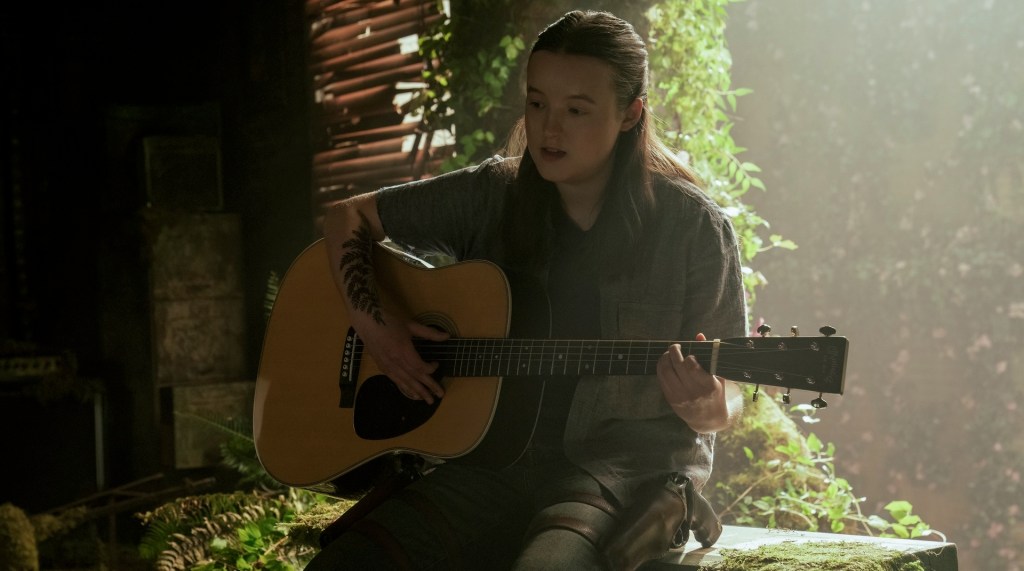
This early section of the A-story leads up to Dina and Ellie exploring a music store, wherein Ellie (finally!) starts playing the guitar. What TV-first viewers perhaps don’t know is that gamers have the option of playing the guitar multiple times throughout the game, as a way of communicating Ellie’s emotions or thinking back to Joel or the like. Many of these moments are quite impactful, and the moment in the episode where we see Ellie play a-ha‘s “Take On Me,” to Dina is one of the most beautiful and most iconic moments in the game, despite the fact that it is an optional moment. Although there are slight differences from the game to the show as to how this moment plays out, I am very happy with the way the show does it here. Bella Ramsey’s performance of the song sounds really nice, and Isabela Merced does an extraordinary job at communicating the heartfelt emotions that Ellie pours into her performance and which Dina reads out of it. I love how the show has, by way of the song’s inclusion in season one (in Left Behind), managed to tie this performance in front of Dina to both Ellie’s relationships with Joel and Riley as well.
In general, this episode features plenty of things that are taken straight from the game, such as the guitar moment, but also earlier when Ellie mentions her interest in astronauts. There are also entire sections of the game in this episode. Although I think it happens during the daytime in the video game, the scenes in the television tower are remarkably similar. This scene in the series does a good job of establishing that both the Seraphites and the WLF have moments of inhumane brutality, just as it establishes, for Ellie and Dina, how much out of their depth they are if multiple foes attack them. Similarly, their underground encounter with a large number of infected is also taken straight from the game, with the TV-version doing a good job of nailing the tension and claustrophobic nature of their situation. These sequences are both really well-executed from an action-thriller narrative, and the episode as a whole does a good job of balancing the darkness and bleakness with the beauty of blossoming young romance.
Early reshuffles and character exclusions make Ellie’s mood confusing to game-first viewers
The events underground lead to Ellie having to save Dina’s life by revealing her immunity to Dina in a way that is quite different from the game, and, really, I think the remainder of this episode has quite a few differences that some corners of the internet will have trouble with. I think Bella and Isabela do a phenomenal job of acting out the TV-version of events with regard to the immunity reveal. Given that Joel died in episode two, TV-first viewers no longer feel like anyone is safe anymore, so there is genuine tension about what Dina will do with Ellie at gunpoint, and, even though Ellie probably could’ve been clearer in her communication about her immunity, I think Bella does a strong job of communicating Ellie’s desperation.
Eventually, once Dina buys into the idea that Ellie is immune, she reveals to Ellie that she, too, has a secret — Dina is pregnant with hers and Jesse’s child. Dina and Ellie then embrace and consummate their feelings for each other. This is also more or less where we learn about the pregnancy in the game, but whereas Ellie reacts with love and jokes, the game version of Ellie is much harsher, as she blurts out that Dina is now a burden. It’s a pretty significant change from the game, and, without this moment here, it does feel like the showrunners are opting for a much less angry and ‘on edge’ version of Ellie than the version game-first viewers know and love. That said, I do think there is some logic to the changes having been made here. In fact, I think it is a somewhat reasonable development given the fact that the showrunners opted against having Ellie and Dina share the game’s iconic moments together in Eugene’s weed outpost. Since Dina was sent to go on patrol with Joel instead, the showrunners had to find time for their romance to deepen more in later parts of the narrative than in the game. Does that mean that the show version of Ellie won’t reach the level of anger as in the game? Does it mean that she won’t ever ‘see red’ in the same way that the game version of Ellie does? No, I don’t think that’s necessarily what it means. I just think it means the reshuffling of structure and characters naturally means that certain breaking points have also been switched around in the timeline. Perhaps Ellie’s thirst for vengeance will be felt in the coming episodes.
A-
– Recap and review written by Jeffrey Rex Bertelsen.

 I'm Jeffrey Rex