
Directed by Jake Schreier (Beef) — Screenplay by Eric Pearson (Black Widow) and Joanna Calo (The Bear).
When it comes to the Marvel Cinematic Universe (MCU), Marvel Studios and fans alike like to think of the series of films in distinct phases, with the first three being known as the Infinity Saga, which culminated in Spider-Man: Far From Home and Avengers: Endgame in the summer of 2019. Since then, the MCU has operated within the so-called Multiverse Saga, which, however, has largely struggled to recapture the spirit, enthusiasm, and success of the first three phases. Phases four and five have had incredible highs (e.g. Spider-Man: No Way Home) but also messy lows (e.g. Captain America: Brave New World), and with Marvel Studios’ latest release, Thunderbolts*, they’re hoping to end phase five on a high and right the ship before the sixth phase of the MCU, which is set to include major event films such as The Fantastic Four: The First Steps and two Avengers films. Whether or not Marvel Studios can recapture the prominent pop culture spot they once held is still very much up in the air, but Thunderbolts* (the asterisk is there for a reason) is definitely a step in the right direction.
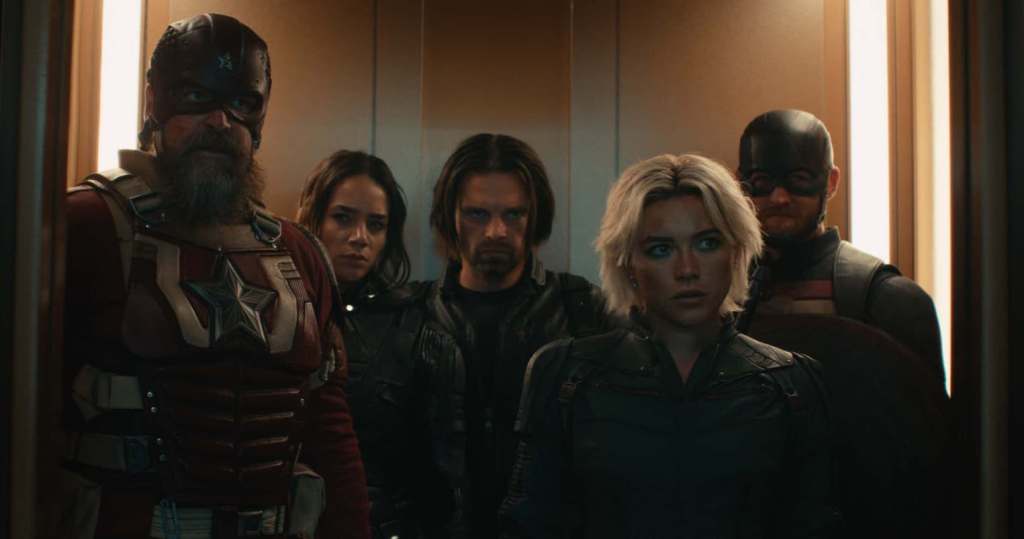
Jake Schreier’s Thunderbolts* follows Yelena Belova (played by Florence Pugh), the former Black Widow assassin and sister to Natasha Romanoff, as she is doing secret missions for CIA director, Valentina Allegra de Fontaine (played by Julia Louis-Dreyfus), who is facing impeachment for her work with the O.X.E. Group. In an attempt to hide evidence of her wrongdoings, Valentina sends Yelena to a covert facility where she is told she will need to stop a thief. Once there, however, it becomes clear that Valentina has hired all of her secret agents — these also include the super soldier John Walker (played by Wyatt Russell and last seen in The Falcon and the Winter Soldier), the highly skilled assassin Taskmaster (played by Olga Kurylenko and last seen in Black Widow), and Ghost (played by Hannah John-Kamen and last seen in Ant-Man and the Wasp) with the ability to phase through objects — to fight and kill each other, so that their existence can’t be used against Valentina either. As they realize that Valentina intended them to fight each other and kill each other in that facility, they decide to team up to get out and confront Valentina. However, they aren’t alone in the facility, as a test subject named Bob (played by Lewis Pullman) is also there and seems completely unsure of how he got there. Elsewhere, independent of one another, and for different reasons, Bucky Barnes (played by Sebastian Stan), the Winter Soldier who is now a congressman, and Alexei Shostakov, the Red Guardian and a father-figure to Belova, also seek out Valentina’s covert facility.
Whether it’s the Avengers or Guardians of the Galaxy, whenever Marvel Studios gears up to do a major team or group film, they usually get it right, despite the fact that, in the 2000s, conventional wisdom was that these types of films could easily be overcrowded. Like those Avengers and Guardians of the Galaxy films, Thunderbolts* is another strong team outing for Marvel Studios, despite the fact that it primarily features C or D-list Marvel characters, some of which have only barely left an imprint on the overall MCU previously. Like Guardians of the Galaxy, Thunderbolts* is a surprisingly rich film about an unlikely team-up of heroes or anti-heroes that somehow manages to have their cake and eat it too with both a mature and sincere way of dealing with its themes, as well as quite a bit of comedy that is sometimes quite silly. The MCU is, at this moment in time, at an unsteady place and its latest film mostly features characters that haven’t really made household names for themselves either due to them appearing as forgettable side characters and villains previously or because, frankly, they appeared on a series that didn’t have a huge audience. Thus, it feels so appropriate for this film to be what it is; namely, a film about characters feeling lost, unstable, and whose needs can only be fulfilled by coming together to do a little good again.
Moreover, with regards to its mature themes, it is a film about how you need friends and family to help bring you out of your own darkness, whether that is addiction, trauma, depression, loneliness, or the like. This film succeeds in large part because its strong cast can communicate those feelings incredibly well and because they play off each other in a way that is deeply moving. At the heart of the film, you find Florence Pugh’s Yelena and David Harbour’s Alexei, and it is their dynamic and their performances that elevate this from being an average superhero film all the way up to being a genuinely good one. Florence Pugh’s movie stardom shines through here, as she throws herself into the role (and herself off the top of one of the tallest buildings in the world in a much-publicised stunt) and nails her character’s deep sadness. Pugh brings sincerity and emotional heft to the film in one of phase five’s strongest performances. Harbour makes for a stellar comic relief through his winning performance as the slightly dorky dad with dreams of becoming a state-sponsored hero again, but whenever he is paired with Pugh, the film goes to a whole other level.
Though not to quite the same level of excitement, Lewis Pullman’s first introduction to the MCU as the mysterious ‘Bob’ is also built around a captivating performance from the young actor. Wyatt Russell and Hannah John-Kamen, thought with less to do, also make relatively good arguments for their characters’ continued involvement. Sebastian Stan, now an Oscar-nominated actor, is always a highlight in these types of films, though he has a political subplot with a lot of potential (given its focus on impeachment and some politicians’ feeble attempts to fight back against those who abuse power in America) that feels, disappointingly, underbaked. Although I’ve had mixed thoughts on the tone of her performances previously, I thought Julia Louis-Dreyfus makes her, as of yet, best outing in the MCU here.
Though the film is heavy on its character-focused themes, there is still plenty of room for action that, frankly, looks rather good here. It’s nice to see superheroes on the ground saving everyday people, and there are two extended action sequences wherein the characters get to show off their abilities and strengths against each other, including one impressive sequence where a hidden foe makes the vastness of his powers be felt. However, I think the third act scenes — including one Charlie Kaufman-esque sequence — that I will remember the film most for are those where the characters are desperately trying to reach out to one another to show that fighting your demons and your depression is much easier when you do it with your friends, who can help you take a step back. The action and the way the third act plays out are really inventive and different from most Marvel movies. It’s focused on internal battles and the void, or darkness, within, trying to overwhelm us.
The film isn’t perfect, though, and I can understand if some iffy elements bothered you. Because these characters are not that well-known (or were set up in a show that people may not have seen), the film sometimes has the duty of inserting quite unnatural expository dialogue into scenes. I also think it is fair to say that there are one or two leaps in logic that you need to take in the third act, as to why a character thinks something will work, as well as why other characters reason that this was why they did that. Also, while I do think the aforementioned Valentina character works better here, I still have my issues with the tone of the character, who I’m not quite convinced fits in seamlessly.
Jake Schreier’s Thunderbolts* features a ragtag group of mostly C-list heroes or anti-heroes, and therefore, their grouping seems like an odd choice as the big film to end a narrative phase on. Nevertheless, the film is a proper example of what Marvel does best, which is to create great dynamics and, in that process, frontload the development of an emotional investment in these characters, no matter how unknown they may be. Like Guardians of the Galaxy before it, Thunderbolts* deals with human themes in sincere and mature ways (this time with a focus on mental health and the importance of a support system), while still keeping a healthy dose of comedy that pairs well with it. Though it is a team-up film, it is also smartly built around an emotional movie star performance from Florence Pugh that elevates the film significantly. Surprisingly, this film basically makes you believe that the side characters from Cate Shortland’s Black Widow ought to be at the center of the MCU going forward.
8 out of 10
– Review written by Jeffrey Rex Bertelsen.

 I'm Jeffrey Rex
One thought on “Thunderbolts* (2025) | REVIEW”