
This is a recap and review of the third episode of the second season of HBO’s The Last of Us. Expect spoilers for season 1 and game 1 (and the episode itself, of course), but also some references to and comments about the second game (though without spoilers).
In the third episode of the second season — titled The Path — we get a three-month time jump, as the Jackson settlement and its wounded — including Ellie (played by Bella Ramsey) — recover in the wake of the tragedy in last week’s episode. However, when Dina (played by Isabela Merced) reveals a secret to Ellie, it sets in motion an appeal to gather up a crew to hunt down those who wronged them and killed Joel. The Path was written by Craig Mazin (Chernobyl) and directed by Peter Hoar (The Last of Us: Long, Long Time).
An aftermath episode that, in a sense, doubles as a new pilot
Following the tragic events of Through the Valley, it’s only natural that the follow-up episode would be required to serve as a ‘breather’ type of episode. It’s only natural that Ellie and Tommy (played by Gabriel Luna), etc., need a moment to breathe and properly react to and reckon with the fact that Joel is now gone. Furthermore, given the huge attack on Jackson in last week’s episode (which, at least the act of seeing it occur, is a new addition for the show), the settlement as a whole needs a breather, a chance to rebuild, and an opportunity to act as a community. As such, on an ongoing narrative level, this episode is, in a way, by the book. Some will undoubtedly feel like it’s a slower episode, but a filler episode it is not. Rather, it is a character-centric episode in the aftermath of an episode that you can’t just brush to the side. Nevertheless, given the seven episode order this season, it also presents some structural and pacing challenges for the showrunners given the fact that we’ve now spent almost half the season in the very early stages of the game this season is adapting (though, of course, Craig Mazin and Neil Druckmann have been upfront about the fact that The Last of Us: Part II will be broken into two seasons for HBO, so a lot will be saved for season three).
Some of these pacing challenges also exist due to the simple fact that this doubles as not just an aftermath episode but also as, essentially, a ‘new pilot.’ Perhaps ‘pilot’ is a little bit of a stretch, but I think you’ll see my point here. For TV-first viewers, losing the main character in what was absolutely not sold as an ensemble series is a big deal, especially given the star value and likability that Pascal provided. Of course, video gamers, like myself, had a similar shock way back when we first played Part II, but controlling someone and watching someone are not the same — video games and television series require different approaches. Here are a couple of reasons why the challenge of continuing the show without Joel is more difficult than with a video game: First of all, when you buy a video game, you’ve invested more than a TV viewer has, and TV viewers are thus more likely to abandon a show. Second of all, gamers actually control the characters and feel a more natural investment and involvement (especially given that gamers had already played portions of the first game as Ellie). Finally, the wait for what comes next is, of course, longer for viewers on a week-to-week viewing schedule. Then, of course, there’s the age-old truth when it comes to video game adaptations: gamers know that the remaining narrative is fulfilling, intense, and entertaining, but TV viewers don’t know if what’s coming is worth staying for.
Therefore, the immediate aftermath episode also had the difficult task of getting TV-first viewers to buy into the oncoming narrative. For this reason, Mazin appears to have felt that he had to restructure certain things to tease what comes next, the team-up that comes next, and the foes and groupings a new beginning will entail. It’s a difficult task that I think Mazin and Hoar mostly succeed with, but, in getting there, I think the episode does suffer from pacing issues and dialogue clunkiness. For this reason, while I think it’s a fairly good episode, I also think it’s the weakest this season, thus far.
Some major changes, as Ellie plans to go to Seattle
Throughout the series thus far, there have been some notable changes despite the fact that it’s been a mostly faithful adaptation. Notably, Peter Hoar directed the episode that deviated the most from the established narrative in his season one episode Long, Long Time (one of the best episodes of television in recent years), and now he’s also directed an episode of season two that deviates quite a bit. As it is my intention to not spoil future events, some of the major changes in this episode are of the variety that I can’t go into in great detail, other than to say that some quite serious changes have been made to Tommy’s reaction to the loss of his brother, which, I presume, I’ll be able to talk about more freely in a future episode.
Changes also sometimes lead to great scenes in these adaptations, and, frankly, we open the episode on one of these great additions. Seeing Tommy help clean his brother’s body, look at it with regret and sorrow, and then let out a piercing and affecting: “Give Sarah my love” is pitch-perfect character-centric storytelling that builds upon our understanding of the character while it, at the same time, feels perfectly in tune with the narrative and is deeply touching. Tommy knows that Joel’s deepest wound was the loss of his daughter, and I’m sure Tommy feels some responsibility for what transpired. I think Tommy, who is clearly hurting here, is trying to find some comfort in the fact that Joel is no longer suffering and that he and Sarah are now, depending on your religious perspective, together again. A beautiful moment.
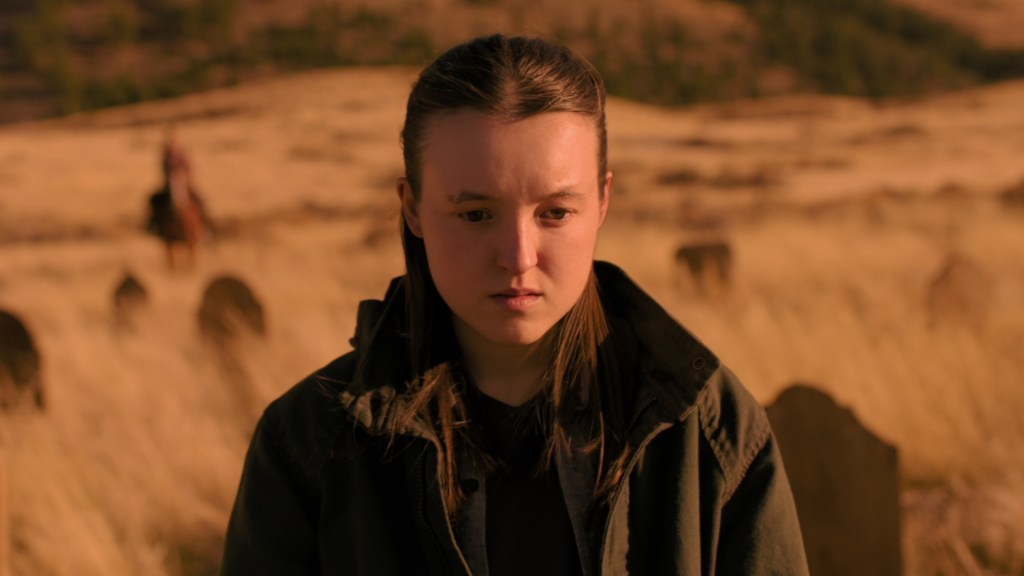
Ellie’s first moment in the show is much louder. We see her in the Jackson makeshift hospital suffering from, what I presume to be, a punctured lung as a result of a broken rib, and she immediately screams as she remembers that what happened to Joel wasn’t just a bad dream. Watching Ellie react to the loss of Joel in this episode is, frankly, the main focus of the episode. Characters, like Gail, know full well that Ellie is lying to them (and Ramsey plays those tricky scenes fairly well) about her last moments with Joel, about her true intentions when it comes to Abby, and how much she’s hurting. Later, seeing her walk through Joel’s empty home, her old room, and look at his wood carvings, his broken watch, his heavy gun, and then stop to touch his jacket is extremely emotional. I think we can all put ourselves in a similar headshape. She so desperately wants to have him hold her and tell her everything will be all right, and the jacket is an apt representation of him. It smells like him. It helps her think back to their moments together. It’s a heartwrenching scene with great cinematography, with moments of angelic lighting, and a great emotional performance from Bella Ramsey. It’s also taken directly from the game, where we also get to reminisce in his home and, like she does later in the episode, visit his grave.
For a moment, I’d like to go back to the first scenes, where we also learn that there has been a three-month time-jump, which, if I’m not mistaken, is a fairly significant deviation from the video game. However, this decision makes sense given the physical trauma inflicted upon the main characters and the disarray that Jackson is left in following the tragic events. One thing that this episode, however, made me quite conflicted about is how much space Catherine O’Hara’s Gail takes up on the other side of the time-jump. Don’t get me wrong, I think O’Hara is great and is an understandable show invention. However, I also think she takes part in two pivotal scenes in this episode that would’ve been better suited for Rutina Wesley’s Maria, whose presence is strangely limited in this episode. Also, given the fact that Dina is, in the show, the bearer of knowledge about Abby and her crew, I think it’s slightly strange that Dina has opted to keep this to herself for so long. It feels a little bit convenient or unnatural, even if her reasoning, as laid out in the show, isn’t without reason.
Heavy-handedness is a little bit of an issue in Jackson
Eventually, following conversations with both Tommy and Jesse about what comes next, Ellie goes to a town hall meeting where Jackson’s next step will be discussed, including the proposal to send more than a dozen individuals to Seattle so as to hunt Abby and her crew down and execute them. This is another show invention, and while there are parts about the scene that I like (e.g., Seth getting more to do on the show, and Bella Ramsey nailing how her speech has to be both competent but unconvincing and dishonest), I think the scene also suffers from some iffy dialogue. While the first episode did a good job of speaking to characterization through dialogue without being unsubtle about it, I found the dialogue from Seth and the Jackson inhabitant preaching forgiveness to be too heavy-handed. I find this scene to be layering the central themes of the narrative on too thickly, which I think is a shame, though I do understand why they’re doing it.
The council, eventually, votes against Ellie’s plan to send a group after them, which is, if we’re being honest, probably the right decision. Jackson needs to be built back up, and it’s been made clear that the attackers weren’t raiders; rather, they were explicitly targeting a single individual who had crossed them. Therefore, leaving Jackson exposed without that many capable fighters would be a mistake, even though it is also understandable why Ellie and others would want to have justice or vengeance. It just doesn’t make sense to weaken Jackson in that process. And so, as one would expect, Ellie decides to do it herself, but not before Dina can stop by, give her a wake-up call about what she needs and doesn’t need to accomplish this, and firmly insist that they will do it together. It’s a really good scene that emphasizes Ellie’s weakness, while at the same time speaking to the kind of advice that Joel perhaps gave Dina in between seasons one and two.
A new group, more on the new foe, and the team-up going forward
After Dina and Ellie, with some help from Seth but behind Tommy’s back, leave on Shimmer for Seattle, the show takes its first steps onto the path on which the majority of the second game is focused — namely, what’s going on in Seattle. Earlier in the episode, a curiously placed scene featured a group of individuals wielding hammers with cult-like identical scars on their faces (I won’t reveal the name of the group yet, but I think it’s fair to say that they are sometimes referred to as ‘scars’ in the game) walking through a forest and hiding from so-called ‘wolves,’ meaning likely the W.L.F. of which Abby and her crew are members. It’s a strong scene that humanizes these people despite their strange appearance, and it is all build-up for when Dina and Ellie eventually come across their dead bodies, the smell of which makes Dina puke. This, naturally, makes Ellie feel stronger in her belief that she is justified in hunting the W.L.F. down, seeing as they’ve brutally murdered a group of people that included children. However, in the last scene of the show, they reveal to TV-first viewers that the W.L.F., though relatively unknown to Jackson, is no small Firefly offshoot. Rather, they’re a huge and formidable militant group. The show seems to be saying that Dina and Ellie have no idea what they’re walking into. It’s a strong tease for what’s about to occur, and it feels deliberate that Dina and Ellie, who here share great scenes together that deepen their relationship, don’t encounter any infected on their journey. The duo is well aware of the fact that the infected could be anywhere, but their tunnel vision targeted at Abby may lead them to walk into a dangerous city with multiple potential foes, human and monster alike, that even Joel could’ve been overwhelmed by. Time will tell if this new show-reality is enough of a hook for TV-first viewers going forward. As a game-first viewer, though, I am excited to see how the show is going to tackle the pivotal first steps in Seattle, especially given the major structural changes they’ve already made.
B+
– Recap and review written by Jeffrey Rex Bertelsen.

 I'm Jeffrey Rex