
Like any season of Black Mirror, the hugely popular British anthology series based around the dangerous rapid development of technology and its influence on humanity, the recently released seventh season has both highs and lows. When I sat down to watch it and jotted down my initial reactions to each and every episode, I was met with, among other things, a solid sequel to one of the series’ most famous episodes, but also one of the most moving episodes of television/streaming I’ve seen all year. Below you’ll find my initial reaction to every episode of the seventh season of Black Mirror.
Common People
Common People is bleak, thought-provoking, infuriating, and occasionally funny, which, you know, is pretty much exactly what you watch this technology-focused anthology series for. It’s not exactly entirely original, which, I suppose, is why they referenced San Junipero a couple of times. There are parts of the episode that, kind of, reminded me of Severance‘s Chikhai Bardo, given the focus on a couple who wants to have a child but gets into an accident that changes everything. But Common People isn’t as ambitious or as stylishly designed. Nonetheless, it makes for a solid season-opener with a timely, scathing focus on how subscription services perhaps sometimes attempt to trap you or lock you in a vicious cycle of overspending and being downgraded (it also reminded me of Dream Scenario and its inclusion of ads in your sleep). Good start.
Bête Noire
I think that, for long stretches, this is actually really engaging. The central performances are well-tuned, and the episode is working with powerful and intriguing concepts like the Mandela effect mixed with gaslighting in a paranoid thriller, as well as a focus on a character getting back for how she was treated by the ‘mean girls’ in school. There’s a lot to like here, and yet it also ultimately feels a little bit too repetitive. I also think the technological aspect is underexplained, and the ending also could’ve been executed better, even with the somewhat silly direction it goes in.
Hotel Reverie
Given the tricky ethical issues with the technology in the episode and the fact that it appears to be a new technology that IRL stars reject in the episode, it would’ve probably been a good idea to touch on said ethical dimension. As it is, it’s an entertaining blend of San Junipero, one of the dreams in Inception, and the animus in Assassin’s Creed. I thought Emma Corrin was quite good here, as she tried to hit a certain classic cinema style of performance, but I thought Issa Rae’s modern manner of speaking and the like kind of worked against the episode’s assertion that she’s supposed to be this big star with love for the original film — it kind of breaks the illusion for the early scenes before the accident at the heart of the episode occurs and changes everything. After this point, though, Rae feels much more on target, as her breaking the style suddenly feels more appropriate. Awkwafina feels underutilized here, though. But, again, Corrin is tremendous from her first scene to her last in this one. There’s also this moment when Corrin’s character flashes through her Old Hollywood career, which I thought was super interesting and wanted more of. All of that said, I really enjoyed watching this, and the ending really worked for me.
Plaything
I, too, enjoy Tamagotchi, Stardew Valley, Sims, and Animal Crossing. I think the idea that how humans treat characters in video games can be revealing about our psyche or our entire species is a rich idea on which to build a sci-fi horror-esque narrative. This also makes sense as a quasi-sequel to Bandersnatch, though I would’ve liked more of Will Poulter in this one. This mostly rests on a creepy Peter Capaldi and an obsessed Lewis Gribben, who are both quite good. It’s a relatively short episode, and I think it would’ve been even more effective if it had been even darker. That said, I thought this worked relatively well, though I definitely prefer the similarly named Playtest from a few years ago.
Eulogy
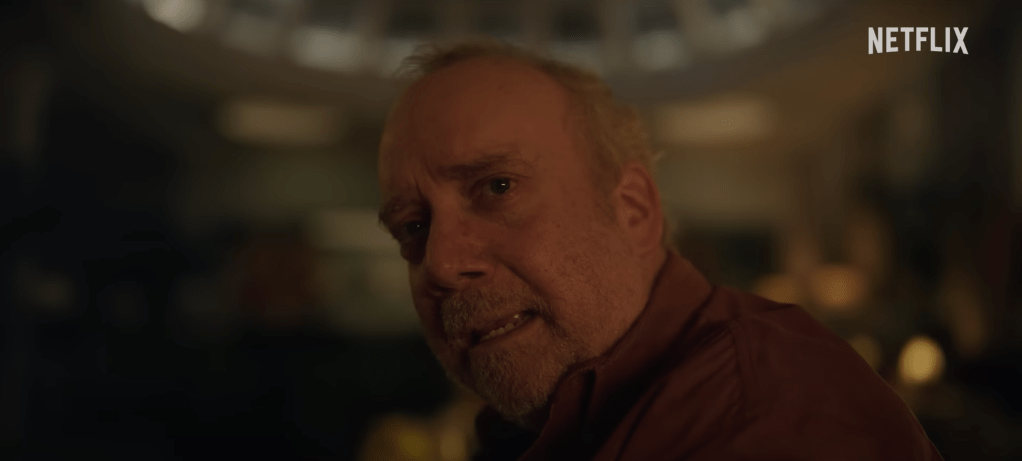
This is by far the best episode of season seven. Not only does it smartly put front and center one of the best actors of a certain generation in Paul Giamatti, who is absolutely sensational in the episode (relatable, occasionally self-centered, affecting, and throughout realistic), but it also treats its heavy subject matter with the kind of seriousness and thoughtfulness that it needs for it to work as intended. It’s a contemplative episode about memory, regret, longing, missed chances, misread interpretations, and putting back together ourselves by finally looking head-on at the memories that we’ve put away, the faces we may have crossed out, and the unkind truths we dare not face. Some may find it slow, but I found it to be rich and deeply moving. Unlike some of the other episodes this season, I couldn’t take my eyes off it. I also think it’s noteworthy how this episode is far less cynical about the technology at the heart of it than the previous episodes this season.
At its best, Black Mirror can speak to not just our troubling relationship with technology and its breakthroughs but also to our humanity. This episode does exactly that and with such emotional intelligence. Giamatti reaching out for the note that he can’t pick up damn near broke me, I could feel every ounce of emotion coursing through him. Frankly, I think his performance and the thoughtful and honest episode as a whole could end up as a personal favorite in the entire series. I don’t think an episode of the show has ever made as much of an emotional impression on me.
USS Callister: Into Infinity
I won’t lie. There is a part of me that is, sort of, considering whether I would’ve preferred another wholly original episode rather than a, if we’re being honest, unnecessary sequel episode. That said, I loved the original USS Callister episode, and I mostly really dug this sequel episode. I like that it puts Cristin Milioti and Jimmi Simpson front and center, as they’re both very good but for different reasons. I really like what they’re doing with their dual roles. While most of the episode is compelling enough, I definitely leaned forward and sat on the edge of my seat once Jesse Plemons returned to the screen and started his thrilling scene with Milioti in his ‘garage.’ Plemons is just so good at walking the line between intense, scary, and awkward, and he really shines here, again. It’s definitely not the best episode this season, but those performances really pulled me in and made this largely unnecessary sequel episode, eventually, super engaging.
– Reviews written by Jeffrey Rex Bertelsen.

 I'm Jeffrey Rex