
Directed by Pascal Plante — Screenplay by Pascal Plante.
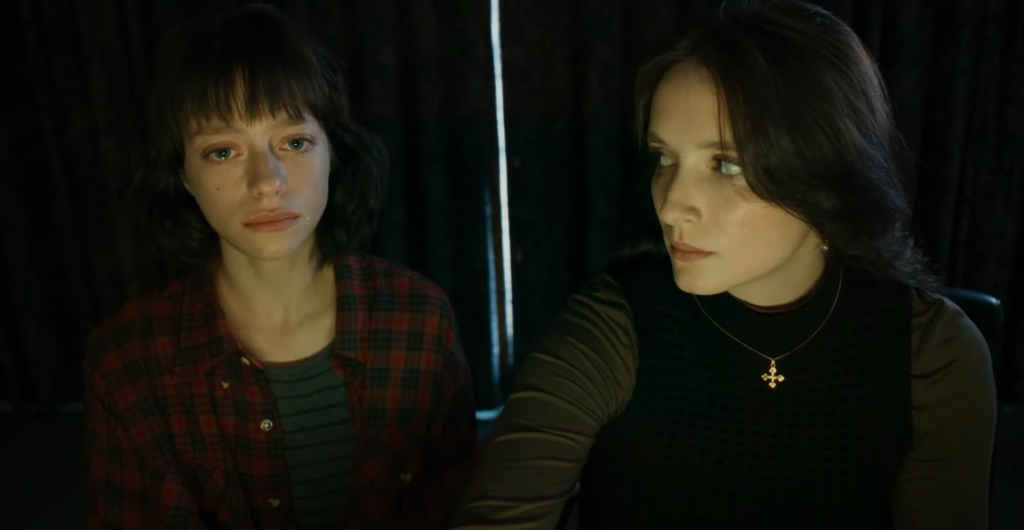
Pascal Plante’s Red Rooms (original title: Les Chambres Rouges) is a dark psychological thriller that follows a Montreal-based model named Kelly-Anne (played by Juliette Gariépy), who has an unhealthy interest in the trial of Ludovic Chevalier (played by Maxwell McCabe-Lokos), a man accused of having murdered three young women. The trial, which has become somewhat of a media circus, has attracted different kinds of people, including Clémentine (played by Laurie Babin), a woman who is portrayed as a fan of Chevalier and who believes he is innocent. As the trial moves forward, Kelly-Anne, who has an interest in computer technology, and Clémentine form a friendship, but their intentions don’t seem to align.
Red Rooms is a fascinating and very modern film about morbid fascinations, unhealthy obsessions, and how much you’re willing to throw away to go into the deepest depths of a particularly disturbing rabbit hole. Plante’s film is defined by a curiosity centered on the kind of true crime obsessiveness that has become quite common, and his film explores the lives of obsessives who are in it for different reasons, one of which is made to be quite ambiguous. His lead character, played with a mysterious, cold determination by Gariépy in what is a gripping performance, keeps her cards close to her chest when asked directly, and it is a film that invites discussions as to the true motivations of Kelly-Anne, a chronically online model, poker player, and hacker who even sleeps on the streets for a chance to get a seat in the courtroom. Babin, the actress portraying the groupie-esque individual who claims Chevalier is innocent, is passionate and direct, and she pairs well with Gariépy.
Plante’s film is cold, precise, and has a clear idea of what it wants to be. Although, yes, it spends a lot of time on attorneys’ statements explaining the events that have transpired, the filmmaker’s focus gradually fixates on the individual’s curiosity. This interest is seen early on when, during the opening statement from Chevalier’s attorney, the camera pivots away and instead slow-zooms on Kelly-Anne who, unlike everyone else, is staring directly at the man who is accused of being a serial killer. The film is particularly concerned with close-ups of Gariépy, as we seek to gain an understanding of a woman whose state-of-mind is difficult to fully understand (and deliberately so). Plante’s film, thankfully, doesn’t fall into the trap of showing the violence and murders that the trial is all about, as that would’ve been counterintuitive to the whole idea behind the film, but what he does instead — that is, rely on unpleasant sound effects and screams— is incredibly effective.
What is also quite effective is the film’s big scare. In a scene where Gariépy’s character dresses up, another character stares directly into the camera. Now, that doesn’t sound particularly unsettling, but the way it is executed is downright goosebump-inducing. Here the film’s score, which often has these drums and electric guitar noises, is blended with a terrifying shriek as the music kicks into overdrive. Gariépy’s reaction is also just so revealing here. It is one of the best and scariest moments of any film from 2023. This is where the film peaks, but it is not a one-trick pony. Rather, Pascal Plante’s Red Rooms is one of the most unsettling thrillers I’ve seen in quite some time.
9 out of 10
– Review Written by Jeffrey Rex Bertelsen.

 I'm Jeffrey Rex
2 thoughts on “Red Rooms (2023) | REVIEW”