
Directed by Robert Eggers (The Witch; The Northman) — Screenplay by Robert Eggers
Everyone knows the name Dracula. That name and character have become such an indelible part of horror fandom and popular culture since the original Bram Stoker epistolary gothic horror novel was published back in 1897 and forever put a name to the quintessential vampire figure. It’s a character that has been played by so many iconic actors through time including Bela Lugosi, Christopher Lee, Nicolas Cage, and Gary Oldman. You may not have seen all of those films, but, I’m pretty sure, even if you haven’t seen a ‘Dracula movie’ before, certain images instantly pop into your head due to cultural osmosis when you hear the name. I am, however, not as certain most people know about ‘nosferatu,’ and, unless you’re a cinephile or a horror aficionado, you almost definitely don’t know who, or what, Count Orlok is. Kids may dress up as Dracula for Halloween (and many probably do), but you’re going to have to search for quite some time if you want to find someone who dressed up as Orlok.
What am I getting at here? Well, while many have a fixed idea about what Dracula looks like — based on the iterations in the Universal Monsters classics or, frankly, the Coppola ‘90s adaptation — it’s so interesting that the very first iconic cinematic moment based on Dracula was actually F.W. Murnau’s Nosferatu, which was famously such a blatant, unauthorized rip-off that it was sued by the Stokers. Long before Halloween plastic vampire teeth, and even nine years before Bela Lugosi’s take on the character, it was the shadow and distinctly different figure of the rip-off vampire, Orlok, that planted a flag in cinema history. Nosferatu’s impact on modern popular culture may not be as significant as its impact on cinema history, but perhaps now is the moment in time where the iconic off-brand version of Dracula strikes back and shakes up our modern idea of the quintessential vampire. In any case, now is the moment in time for a remake, as The Witch and The Northman director Robert Eggers has been given the chance to bring Count Orlok back to the big screen. There’s a lot to like about Eggers’ remake, or reinterpretation, but does he successfully justify the existence of his remake? Well, yes and no.
Robert Eggers’ Nosferatu is set in 1838 and follows newlyweds Ellen (played by Lily-Rose Depp) and Thomas Hutter (played by Nicholas Hoult), who now live in a town called Wisborg. Despite Ellen’s protests, Thomas, an estate agent hoping to better his and Ellen’s financial situation, takes on a job that will require him to travel to the Transylvanian Carpathian Mountains, where he will meet the mysterious and reclusive but formidable Count Orlok (played by Bill Skarsgård). A stranger in a strange land, Thomas becomes immediately frightened by the Count upon his arrival in his castle. Unbeknownst to Thomas, the Count lusts for Thomas’ wife and the blood in her veins. Furthermore, Ellen frequently sleepwalks and suffers from wild seizures, and she feels a special and disturbing connection to the Count. Orlok is on his way to Wisborg, and, with him, he is both bringing bloodlust and the potential of a new plague.
As you may have gathered from that description of the plot, it does indeed follow the age-old Dracula story only with minor changes, meaning primarily the changes that the Murnau film featured, including the German setting, adjusted ending, and character names. If you watch this film with the hope that it’ll be starkly different from a story perspective, then you will be disappointed. It is very much an adaptation, with the occasional Eggers reinterpretation elements added in or designed so as to twist certain facets. Eggers’ film puts the spotlight on Ellen’s perspective, which here includes a heavier emphasis on sensuality and a psychosexual connection, but he also adjusts the inciting incident so that it is directly connected to his heroine’s actions. Eggers’ film also, importantly, makes certain bold changes to the distinct character design of Count Orlok, who, here, is less of a demonic goblin but rather a mustachioed zombified but powerful and menacing nobleman.
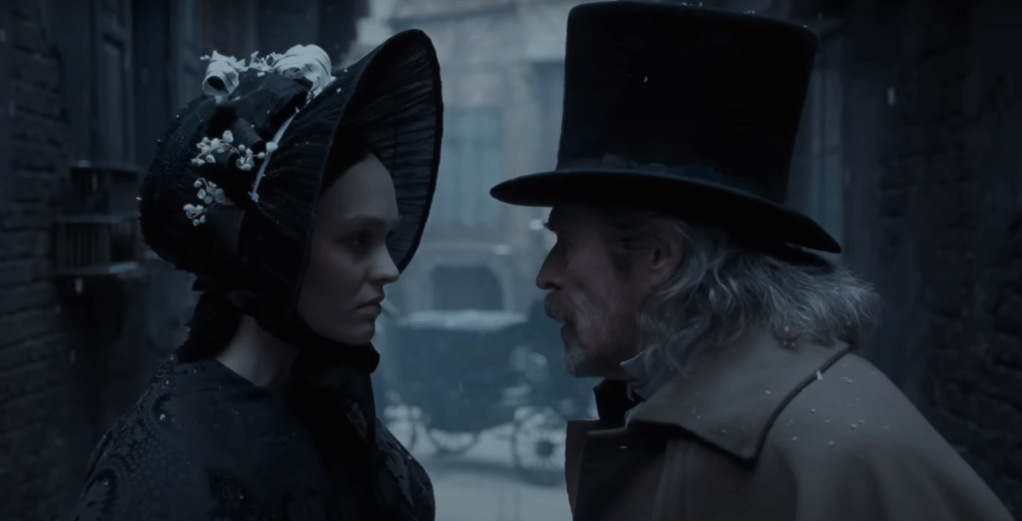
As is often the case with Eggers’ film, there is an attention to detail and mythology that makes it so that the film feels like it is purposefully paying homage to other adaptations of the story — whether Nosferatu or Dracula — and Eggers, to add to that, also clearly enjoys setting up the film’s darkest elements. Hand in hand with cinematographer Jarin Blaschke, Eggers has crafted a visually astounding film, and the costuming and production designs are similarly and predictably outstanding. Eggers nails an appropriate gothic horror atmosphere drenched in dread, and, as you would expect given its cinematic roots, the film features plenty of effective scenes with an emphasis on Orlok’s shadow. From a technical and atmospheric standpoint, it is an unquestionably rich film. The first act and the film’s final scenes are particular strong.
From a performance perspective, there is a lot to like about the film. Skarsgård is menacing but absolutely unrecognizable as the vampiric shadow artist who lusts for the film’s central heroine. Nicholas Hoult, who, coincidentally, has previously played Renfield (the servant of Dracula, or Orlok, here named ‘Herr Knock’ and played by Simon McBurney) in another film (Chris McKay’s Renfield), turns in a performance that gets the most out of his character’s sudden feelings of fear. Hoult makes for a solid Thomas Hutter, and Ralph Ineson predictably fits right in with the film’s era evocation. Aaron Taylor-Johnson and Emma Corrin don’t get to do a whole lot, however, and it would’ve been nice if they were given the opportunity to be less one-note. Then there is Willem Dafoe, who, coincidentally, once played Max Schreck (the actor who played Orlok in the 1922 original film) in E. Elias Merhige’s Shadow of the Vampire, and he definitely understood the assignment, as he got the most out of his character’s intense mythological fascinations with a delightfully passionate performance that may occasionally remind you of Sir Anthony Hopkins’s deliberately over-the-top performance in Francis Ford Coppola’s 1992 adaptation of Dracula. It’s not all zany and over-the-top, though. Dafoe and the film’s heroine share strong scenes emphasizing that he sees her for who she is. The central performance, on which the film relies heavily, is, of course, the one delivered by Lily-Rose Depp. Depp, whose career is still quite fresh and new, turns in what is inarguably the best work of her young career, as she nails the character’s frustrations, intense desires, and convincingly delivers a memorable physical performance.
So, to return to the question from earlier, does it justify its own existence? It depends on how you look at it. If you needed this film to merely be a good adaptation because of it updating the story with state-of-the-art filmmaking, then, yes, it definitely lives up to that expectation. If, however, you expected a thematic depth, wholly new perspectives, or many new story elements, then you may feel that Eggers’ film is a tad too shallow in its thematic adjustments and that the story is a tad too close to the skeletal structure or formula of previous adaptations. So, maybe, for some, it doesn’t justify its own existence, per se. But Eggers’ film, importantly, does do justice to the source material. It’s quite good. It is a great visual and technical achievement in horror, but he doesn’t have as much to say here as one might expect given the obvious potential of its theme of pandemic fear, given recent events, and he could’ve elaborated even further on the obvious gender issues and sexual repression of the era the film is set in than he already does. What Eggers does with these things feels surprisingly superficial, as he does make note of these things but perhaps fails to give them the appropriate fresh depth. It felt like there was untapped potential in these elements.
On the whole, Robert Eggers’ Nosferatu is yet another successful genre film from a fan-favorite director, who does a good job of updating a classic narrative with modern filmmaking standards and artistry. Although it maybe could’ve used more fresh elements or have had more depth in certain areas (including, but not limited to, characterization), as this vampire film perhaps doesn’t have a sufficient thematic bite to match its central characters’ desire and bloodlust, the film, nonetheless, is a strong adaptation that checks all the boxes while, at the same time, making interesting choices and featuring impressive visuals.
8 out of 10
– Review Written by Jeffrey Rex Bertelsen.

 I'm Jeffrey Rex
2 thoughts on “Nosferatu (2024) | REVIEW”