
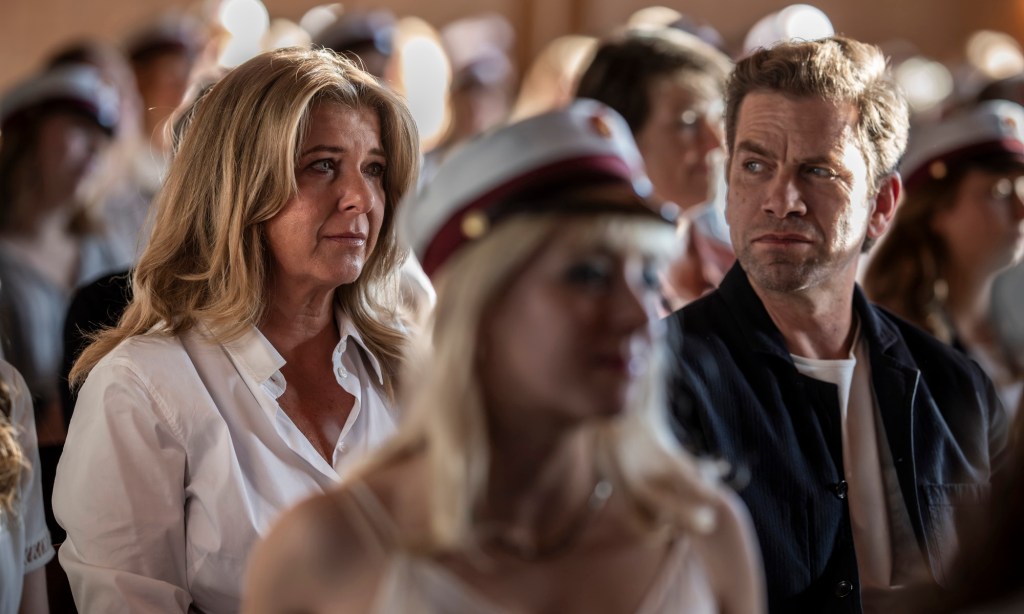
Series created by Thomas Vinterberg.
Dogme95 co-founder Thomas Vinterberg has had quite the career. He burst onto the scene with his sophomore effort, the Cannes-darling and Danish classic The Celebration, and, though he struggled in the early 2000s overseas, he rebuilt his career on home soil with Submarine and The Hunt, the latter of which was a particular international success critically and with awards bodies. In the mid-to-late 2010s, he took another stab at filmmaking overseas with Far From the Madding Crowd and Kursk (with the Danish drama The Commune sandwiched in between the two). Then, at the very beginning of the 2020s, his binge-drinking dramedy Another Round took him to new heights as he not only accepted an Oscar and a BAFTA for the picture but also became the first-ever Danish filmmaker to be nominated for Best Director at the Academy Awards. Now, he has turned to TV, as he has crafted a television series about the calamitous potential of climate change that works as an eye-opener and much more. For me, it’s been one of the most interesting shows of 2024.
Thomas Vinterberg’s scarily prescient series Families Like Ours takes place in the near future, when the irreversible effects of runaway climate change have caused sea levels to rise so much that certain countries have to consider total evacuation, these include the Netherlands. Early in the series, Nikolaj (played by Esben Smed), a Dane who works with the government, leaks to his family and closest friends that a decision has been made to initiate a total evacuation of Denmark before our streets are flooded. This sets in motion a mad dash for a small handful of families to prepare, both emotionally and financially, for everyone to be uprooted permanently. When the eventual announcement is made, complicated climate change refugee resettlement plans are revealed, and they are wildly impractical for the Scandinavian population. One example is that of Laura (played by Amaryllis August) who is about to graduate high school but has to make a decision as to which of her divorced parents she wants to follow: her father, Jacob (played by Nikolaj Lie Kaas), and his new family, who plan to go to France, or her mother, Fanny (played by Paprika Steen), who is alone and on sick leave due to excessive stress, and whose current employment status means that only Romania will take her. As anxiety grips the nation and new destinations are chosen, rash decisions are made out of love and fear.
Families Like Ours is arguably one of the most prestigious Danish series made in quite some time. Not only is it the brainchild of one of Denmark’s best and most celebrated auteurs, but it also includes a cast of actors that is quite extraordinary. Outside of perhaps 3 or 4 Danish stars (like the Mikkelsens, Trine Dyrholm, and Sidse Babett Knudsen, none of whom are in the show), the series contains many of Denmark’s most popular performers many of whom have worked with Vinterberg before. But in addition to his frequent collaborators, Vinterberg also turned to one of the country’s biggest stars in Nikolaj Lie Kaas, as well as some very gifted young up-and-coming actors like Albert Rudbeck Lindhardt, who had a small role in Vnterberg’s Another Round but here has what should be regarded as his breakthrough performance as Laura’s sweetheart ‘Elias.’ Lindhardt plays a relatively idealized, nationalist, and culturally conscious young man, and he plays him with such warm passion and palpable excitement. He’s a joy to watch. Meanwhile, Kaas plays his paternal character with the appropriate amount of anxiety. Esben Smed and Thomas Bo Larsen also make memorable appearances, with the latter of the two doing what he does best as a character only he, with his acting style and persona, could play credibly.
Vinterberg’s incredibly ambitious and prophetic work of fiction, which premiered at the Venice Film Festival (which is, kind of, perfect when you think about it), taps into our collective fears about climate change and immediately intensifies them. Although we only rarely see the water actually rising, whenever we do get shots of water either through extreme wide shots or nightmares or with rain and puddles, it feels more scary than it has ever felt before. A part of this is also, of course, because of how this series depicts a catastrophe in my home country, which, to be fair, doesn’t get a lot of apocalyptic films made about it.
I’ll admit that, in the early goings, I was worried about it being a little bit tone deaf or suffering from privilege blindness, because it largely depicts middle-to-upper-middle-class Danish families, who are better off because of their economic or occupational circumstances. However, I was happy to find out that Vinterberg does eventually reveal that he knows how this could be perceived, as one character, at one point, spells out exactly how spoiled some characters are behaving. Upon reflection, I think actually that one of the show’s greatest tricks is putting the well-off European Westerners in the refugee experience. Not only is that a scarily plausible future outcome if we don’t do anything about climate change, but we are not at all ready for that outcome. It’s a brilliantly thought-out and executed thought experiment from Vinterberg. Vinterberg’s show is also particularly concerned with the deterioration of empathy in crisis, the national and religious relics and culture, and finding hope in the next generation, even when despair grips you.
It should be said that among its many good and admirable qualities, the series also contains some elements that I’m not sure fully work, as well as one pivotal moment of flip-flopping that is quite exasperating. While, yes, I think it is gifted with a tremendous Danish cast of newcomers and local stars, I do think David Dencik is miscast as Nikolaj’s aggressive and homophobic brother-in-law. Whenever Dencik takes on the cartoonish over-the-top dialogue, he isn’t able to make it feel natural or authentic — his character stands out like a sore thumb due to the exaggerated, cartoonish performance. Its chief headscratcher, from a conceptual viewpoint, is the fact that Vinterberg includes a supernatural, precognitive element that, I think, works against its aims to be a conversation starter about the very real possible effects of unchecked climate change. The show, frankly, doesn’t need it, and it is the very slippery slope that leads to the aforementioned exasperating flip-flopping character decision-making. I won’t go into details about exactly what happens, but I will say that it is a moment of melodrama concerning the ‘Laura’ character, in which she is not only frustratingly indecisive but where she also makes some incredibly stupid decisions. It’s a moment that wouldn’t have been so offensive in another lesser series, but, because of the prestigious and excellent qualities here, it is something that really takes you out of the series in a pivotal moment. Thankfully, I do think the show eventually overcomes this moment of substantial melodramatic weakness from its fourth episode.
On the whole, Thomas Vinterberg’s Families Like Ours is an effective Danish prestige drama about the climate change refugee experience and the fight to avoid an erosion of national culture once your country ceases to exist. Although it does contain moments of weakness in its performance-work and its character decision-making, the good definitely outweighs the mediocre, and Vinterberg’s moments of gracefulness, beauty, and melancholy in the face of significant and scary societal change are really effective. Although it wasn’t without blemishes, there was so much to love about this prophetic mini-series.
– Review Written by Jeffrey Rex Bertelsen.

 I'm Jeffrey Rex
One thought on “Families Like Ours (2024) | REVIEW”