
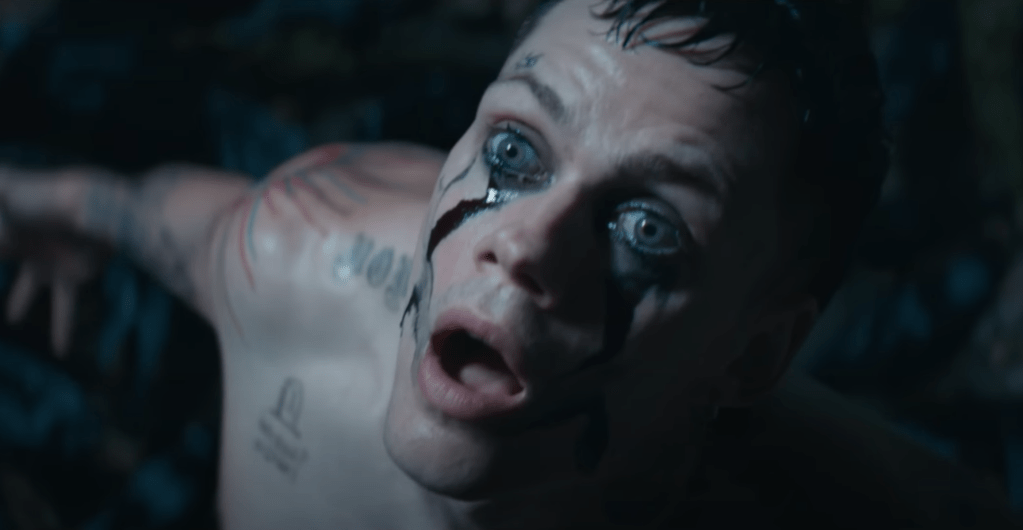
Directed by Rupert Sanders (Ghost in the Shell) — Screenplay by Zach Baylin (King Richard) and William Schneider.
It has been a long time coming, but, now, 30 years after the release of 1994’s The Crow — the original Alex Proyas’ film adaptation of James O’Barr’s iconic comic book series of the same name — a new film bears its title. The original film has a tragic reputation, as its star Brandon Lee was shot and fatally wounded by a prop gun while shooting the film. The original film went on to achieve cult status, Lee’s portrayal is similarly iconic, but, despite attempts to continue the franchise, it never really again got off on the right foot as it was followed by multiple critically derided sequels and a canceled series. The failed productions of potential future films would be infamous and often referred to as ‘cursed’ as directors, actors, and studios always failed to get a reboot off the ground despite actors like Mark Wahlberg, Bradley Cooper, Ryan Gosling, Jason Momoa, and Alexander Skarsgård having been attached or rumored for the principal lead role over the years. Despite the infamous development hell, a reboot or reimagining of The Crow is finally here from Ghost in the Shell (2017) director Rupert Sanders and it stars, how about that, Alexander’s brother Bill Skarsgård, of It-fame. Unfortunately, this new attempt at telling this story of vengeance and lost love isn’t, ultimately, very good, as the latest production only really kicks into high gear late in the film.
Rupert Sanders’ The Crow follows Eric (played by Bill Skarsgård) and Shelly (played by FKA Twigs), lovers suffering from drug addiction, who escape from a rehabilitation center, when a crime lord’s henchmen stop by with the purpose of forever silencing Shelly. On the run, together, their bond grows stronger, but their romance has a tragic end when, eventually, the henchmen find and kill Eric and Shelly. If you know the story of The Crow, then you know what happens next. Eric awakens in a mysterious purgatory-esque reality, where a stranger informs him that he has an opportunity to use supernatural abilities to come back to life and have his revenge on the people who took his and Shelly’s lives from them. As the film moves forward, there are certain choices made to make its approach to Eric’s ultimate goal and the lengths to which this film is about supernatural individuals feel markedly different to Alex Proyas’ film, but, on the whole, the narrative beats are mostly the same. However, they are told with a different pace to the overarching narrative and with more focus on the central love story that precedes the action.
When I, only recently, saw the iconic original adaptation, I was moved by the emotion pouring out of it, the music, the lead performance, and the sense of style and understanding of its own aesthetic. That Proyas film had a stylistic, distinct, and dark exaggerated cityscape version of Detroit, and, in general, an editing energy that felt indicative of the era in which it was released. However, Sanders’ reboot, or reimagining, doesn’t have as much of a sense of style. The rainy depiction of the city is bland, the soundtrack isn’t matched well to the film or its characters, and while Proyas’ film was straight and to the point, Sanders’ takes much too long to get going. Not only is it stylistically less interesting, it also isn’t as gripping as you’d expect. Again, though the narrative beats are well-worn, the time management is different. Although it, in theory, makes sense to frontload the central love story to maximize engagement, the execution is off.
Despite spending a lot of time on Eric and Shelly’s blossoming romance in the first act, it doesn’t hit as hard as you’d expect it to. The editing kind of makes the passage of time feel unclear. The film rushes past the initial attraction and bond and goes straight into generic montage-esque territory with characters that are a little bit too uncharismatic and who have very little chemistry. FKA Twigs’ part is underwritten, and this version of Eric is quiet, lanky, addicted, and hard to get through to despite the film’s flashback to his childhood experiences. The tattooed ‘Jared Leto-Joker’ look and the film’s superficial interest in their addiction are also drawbacks. I like Skarsgård, who often reminds me of Hayden Christensen, but his Eric feels too lifeless in the tedious early goings of the film. It’s difficult not to compare his work to the superior emotional, soulful, and sometimes even playful performance once given by Brandon Lee.
The film doesn’t really have the lead embrace the make-upped look of The Crow and become the vengeance-focused hero until the third act, which is just too late. With that having been said, the film does sometimes shine at this point, when Sanders’ film depicts the inventive and gory action that the film’s trailers had highlighted. It’s quite entertaining, but it’s a little bit too late into the proceedings. One of the film’s more interesting choices is the backstory of the principal villain played by Danny Huston. It is a mysterious and supernatural backstory that opens up the world of The Crow, but, unfortunately, it is only teased in exposition and never really elaborated on, which I think is a shame, as it is one of the film’s more interesting decisions. But, in the end and on the whole, Rupert Sanders’ The Crow is nothing more than a misshapen quasi-remake that can’t hold a candle to Proyas’ original adaptation. Despite spending decades in the pipeline, it has ended up as nothing more than a forgettable and unnecessary late-summer movie season update on a beloved 90s cult hit.
3.5 out of 10
– Review Written by Jeffrey Rex Bertelsen.

 I'm Jeffrey Rex