
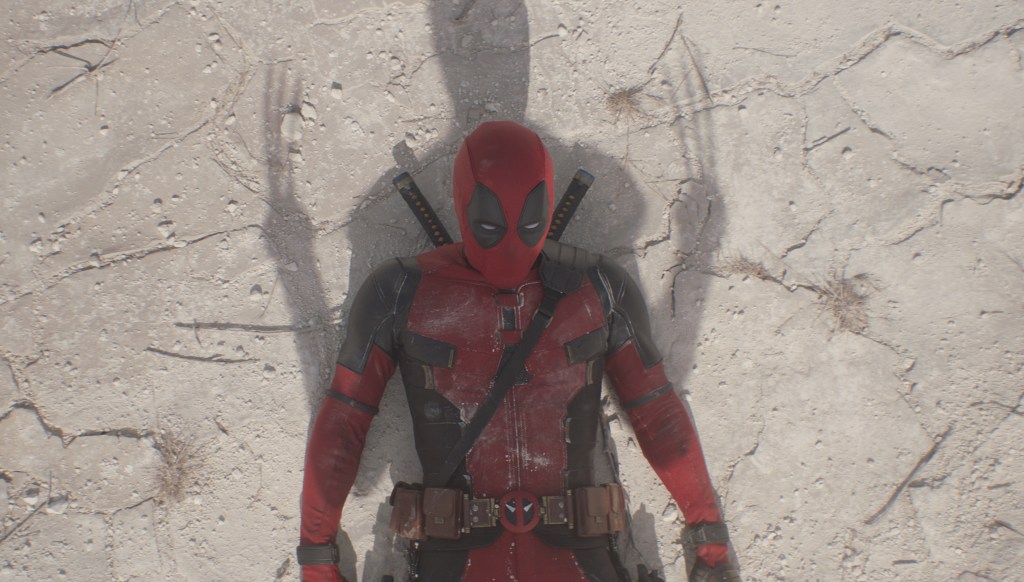
Directed by Shawn Levy (Free Guy; The Adam Project) — Screenplay by Ryan Reynolds, Rhett Reese, Paul Wernick, Zeb Wells, and Shawn Levy.
Later this year, it’ll have been 7 years since Disney’s acquisition of Fox was announced. Included in the Fox acquisition were its assets including ‘their’ portion of Marvel characters, which had long been unable to be a part of Disney’s immensely popular Marvel Cinematic Universe of stories. I think a lot of fans out there will have, at that time, thought that years later they would have all been integrated into the Disney-Marvel-connected universe of live-action films, but, in actuality, it’s been quite slow. Certain characters have popped up in relatively insignificant ways, the classic X-Men theme song has played once or twice, and, sure, Sam Raimi’s Doctor Strange in the Multiverse of Madness (2022) did have some non-committal fun with the characters that Marvel fans have been desperate to have alongside the Avengers. Now, though, a significant part of that wait is over. Shawn Levy’s Deadpool and Wolverine is the first Marvel Studios film to be explicitly about a Marvel-Fox character and his integration into Marvel Studios. And, as if that wasn’t enough, it’s the one character that is the least audience-safe Disney character of them all: Deadpool, who is known for his R-rated violence and crude humor. Going into this film the big question for many fans was whether or not Disney, through Marvel Studios, would allow Deadpool to actually be the character that fans have come to know and love. The answer, which I can now give after having seen the much-anticipated film, is a resounding ‘yes.’
Shawn Levy’s Deadpool and Wolverine is set sometime after the events of Deadpool 2, and, early in the film, we find Wade Wilson (played by Ryan Reynolds), Deadpool himself, retired from being the merc with a mouth. He now works as a car salesman and has sadly broken up with his long-time girlfriend Vanessa (played by Morena Baccarin). During a birthday party, Wade is apprehended by the Time Variance Authority (essentially, law enforcement for the whole multiverse, who first debuted in the Disney+ series Loki) and taken to meet a man known as Mr. Paradox (played by Matthew Macfadyen). Paradox informs Wade that, following the events of Logan, his universe is dying due to it having lost its anchor being, i.e. the Wolverine. Hoping to save his universe and friends from being wiped from existence, Wade Wilson suits up as Deadpool and heads out to multiple alternate realities in an effort to find another version of the Wolverine (played by Hugh Jackman) that could, hopefully, be a new anchor for his universe. And that is about as much I’ll go into detail about the plot of the film so as to not spoil this film for any of my readers.
A wise man, who happens to be my favorite filmmaker, once remarked that modern superhero films aren’t always cinema of emotion, in a classic understanding, but rather that they sometimes feel more like theme park rides that are projected onto the big screen. He was wrongly scolded for those comments by the chronically online corners of the internet, but I think it is fair to say that this kind of film is actually what he was talking about, to a certain extent. It is a nostalgia and exposition-filled superhero cinematic theme park ride that isn’t as emotionally fulfilling as the best superhero films. It is, however, still very entertaining for what it is, even though it can sometimes feel like a film-length version of the DiCaprio-pointing meme that Once Upon a Time in Hollywood spawned. I have no doubt that some will proclaim that this film — with all of its focus on fan service, nostalgia bait, and inside jokes — is indicative of a death spiral for cinema, but I don’t think it should be interpreted that way. Its inevitable success is expected and very much a good thing for the theater industry, and we need them to thrive for more conventionally accepted cinema to be produced and distributed to theaters. The aforementioned wise man had a very valid point, but I also don’t believe his comments necessarily insisted that theme park ride films cannot be engaging, entertaining, or even good. Rather, he classified them as belonging to a different category of experiences that weren’t to his liking, and he identified that their ambitions, aims, and methods are partially a product of market research and audience testing, which thus makes them different from his understanding of cinema despite whatever artistry and positive values these theme park ride films may contain, but I digress. This film works fairly well, even though it very clearly is a film with a clear aim to be a delivery system for nostalgia-inducing lines, characters, or moments.
I liked Deadpool and Wolverine quite a bit. It is the kind of film that knows exactly what it is and isn’t ashamed of being what some may deem to be lesser or inferior. Yes, it is a theme park ride of a film led by the lovable but immature, fourth-wall-breaking motormouth, Deadpool, who openly admits to being in a franchise that’s struggling as of late, and who criticizes what is going on in the film. This cameo-fest of a film is exciting to watch because of its pitch-perfect meta-comedy and the irreverent attitude of its red-and-black-suited star who makes sure that everything and every choice is made fun of with killer jokes. And, frankly, although some people may argue the film’s insistence on nostalgia is a problem, I would argue that it, ultimately, makes sense for this film to be a nostalgia act given that the film marks a future departure from Fox-Marvel (given the completed acquisition), is a tribute to the Fox-Marvel universe that made the titular heroes, and is, from a narrative standpoint, about the potential collapsing or erasure of the entire parallel universe that the Fox-Marvel films created. It is, however, not the type of film that will win over people who don’t like superhero films or even Deadpool films. In its opening moments, it reminds you exactly what it is, through its reference-heavy dialogue, crude humor, extreme violence, industry-attentive meta-comedy, and gleeful irreverence. For some, these aspects of the character can be quite grating, and, if that is the case for you, this film is not one that will remedy that. But people who enjoy Deadpool, his shtick, and Ryan Reynolds’ unmistakable wit and brand of comedy will be glad to know that this latest entry in the connected universe doesn’t hold back at all despite being a Disney production now.
Frankly, I found it to be more consistently funny than the previous entry. There is a level of self-awareness and self-deprecation to the comedy that is, honestly, admirable and delightful. If you thought Disney wouldn’t allow potentially the biggest movie of the year to make fun of its cinematic superhero moneymaking machine, then you were wrong. There are some deep-cut insider jokes in this film, and it isn’t afraid of delivering some pretty sharp jabs in its jokes. And even when it comes to its surprises and cameos, the film just keeps on having fun with them on a meta-level. Some of these jokes will definitely go over a lot of people’s heads around the world, and, frankly, one of those deep-cut industry jokes was probably my favorite because it featured some really effective humor that made it so that even if you didn’t know the whole story, then Deadpool’s running commentary ensured that you still got an earned laugh out of it. On the whole, I think this might be the funniest film in the Marvel Cinematic Universe, or, at the very least, it’s one of the films that frontloads the comedy the most and most successfully. I will say that the action, however, was nowhere near as effective as the film’s comedy. Sure, there’s an action sequence that is set up in a way that is similar to the iconic extended Oldboy fight sequence, which I thought was neat, but I found that most of the time the action didn’t really advance the story or characters as much they maybe should’ve. I also think one or two action scenes could’ve been edited in a way that allowed for more clarity in the actions themselves. Frankly, I thought the action worked best when it was designed to be a vehicle for jokes or the set-up for a comedic action pay-off. This is very much a comedy first, and an action picture second.
Obviously, it is tough to talk about why something is funny without going into specific joke details, which I won’t. But what I will say is that I think one of the reasons why I found this film to be so consistently funny was because of how effective Ryan Reynolds and Hugh Jackman were in this film. It is essentially a buddy comedy with a very zany funny man and a very cranky straight man who finds ways to numb his pain. Their double-act comedy works so well because their comedic delivery is on-point and their chemistry is note-perfect. They are so effortlessly good at playing these characters, and Jackman even gets the opportunity to do truly excellent dramatic work that is really effective in selling the emotional arc of his character, even though it is perhaps a tad underwritten. I also think it should be said that I had feared that the film’s inevitable surprise cameos would be cheap, but, frankly, the opposite was true in almost all cases. I think the writers managed to tie these surprise cameos into the overarching themes of the film, as well as the narrative as a whole, in a way that made their appearances feel relatively justified. One of the actors who makes a surprise appearance (and who I, of course, cannot identify, as I don’t want to spoil the film) also happens to deliver a really strong comedic performance with every word out of their mouth being perfectly chosen, even when they are difficult to understand.
There are, however, a small handful of things that hold it back slightly. I do think it is slightly uneven pacing-wise and that the third act has some issues with a lack of urgency. Generally, I think the film just features way too many expositional dialogue dumps. Now, those of you who have seen the film will know that Deadpool does sometimes point out elements of the film that are inelegant or slow. But while, yes, having him point out that a character speaks with expositional dialogue can be an effective joke (that in a way turns the prior exposition dump into a comedy setup), when it keeps happening, then that prior joke doesn’t excuse it anymore.
Deadpool & Wolverine is an entertaining and unashamed theme park ride of a superhero film that knows exactly what it is and has a lot of fun with what it is. It is not as deep as the best superhero films, and its emotional current is not as powerful or fresh as with the best superhero films, but its meta-comedy and obscene jokes earn plenty of laughs, the cameo-fest hits, is flat-out funny, and is relatively justified narratively. It can’t fully escape problems with pacing, exposition, or its third act, but it is a step up from the second film. Furthermore, it also works as a self-aware tribute to the Fox era, and it further cements Ryan Reynolds and Hugh Jackman as true icons of the genre who will always be synonymous with their characters. It doesn’t reinvent the wheel, won’t erase genre fatigue, or cure the connected cinematic universe’s issues. But it is both an extremely effective and funny superhero comedy, as well as exactly what its target audience will have wanted, and thus it should be a strong summer film with which to reinvigorate movie theaters around the world.
7.9 out of 10
– Review Written by Jeffrey Rex Bertelsen.

 I'm Jeffrey Rex
One thought on “Deadpool & Wolverine (2024) | REVIEW”