
Directed by Wes Ball — Screenplay by Josh Friedman.
The Planet of the Apes franchise is one of the most iconic and most beloved long-running science fiction film franchises. Despite it, admittedly, featuring a significant number of films and shows that the world has largely forgotten about (including Tim Burton’s 2001 remake), this franchise also happens to have a genuine science-fiction classic adaptation with one of the most famous and unforgettable movie endings of all-time (that is uniquely in the style of Rod Serling, i.e. the creator of The Twilight Zone who co-wrote the 1968 Apes-film), and every now and again these films represent massive leaps forward for the film industry either through prosthetics, visual effects, or motion performance capture. As if that wasn’t enough, despite failing to capture wide audiences’ interest for quite some time, the iconic franchise broke through once more with the reboot trilogy of the 2010s from directors Rupert Wyatt (of the strong and emotionally engaging Rise of the Planet of the Apes) and Matt Reeves (of the jaw-dropping near-masterpieces Dawn of the Planet of the Apes and War for the Planet of the Apes).
The reboot trilogy, which told the story of a special ape named Caesar and his journey from being brought up by humans to leading apes of the world in an all-out war against a human militia, was a critical and box office success that successfully reestablished the greatness of a historical and culturally significant film series for new generations. Now, seven years after the release of the reboot trilogy-capper, Maze Runner-director Wes Ball has been hired to take the story of the reboot trilogy and launch a new series of films, and it is with relief that I can say that despite my trepidations about having someone else take a stab at expanding upon a near-perfect trilogy of films, Wes Ball’s Kingdom for the Planet of the Apes is a successful and worthy continuation of the film series.
Set many generations after the tragic demise of Caesar in Matt Reeves’ War for the Planet of the Apes, Wes Ball’s Kingdom for the Planet of the Apes follows the apes of an ape clan of chimpanzees dedicated to bringing up and training eagles. This clan lives in peace far away from the feral humans they know as ‘echoes’ or any potential rivaling clan. In the beginning of the film, we meet Noa (played by Owen Teague), a young ape, who is trying to prove himself to his father, Koro (played by Neil Sandilands), who has a special bond with the eagles.
One night, when a human (played by Freya Allan) follows Noa home from one of his hunts to find an appropriate eagle egg for the upcoming coming-of-age ceremony, Noa encounters the human who, during a scuffle, inadvertently smashes his egg and then flees. Desperate to find a replacement egg, Noa leaves his clan at night only to spot a group of violent ape raiders from another clan heading in his clan’s direction. Despite Noa’s best efforts to save his clan, his family, and his friends, the raiders leave his home clan in ashes and abduct his surviving family and friends. Hoping to restore order and avenge his father, who fell in the attack mentioned earlier, Noa journeys out to find the tribe that the raiders belong to. On his way, he befriends a wise orangutang named Raka (played by Peter Macon), who tells him all he knows about the history of man and ape.
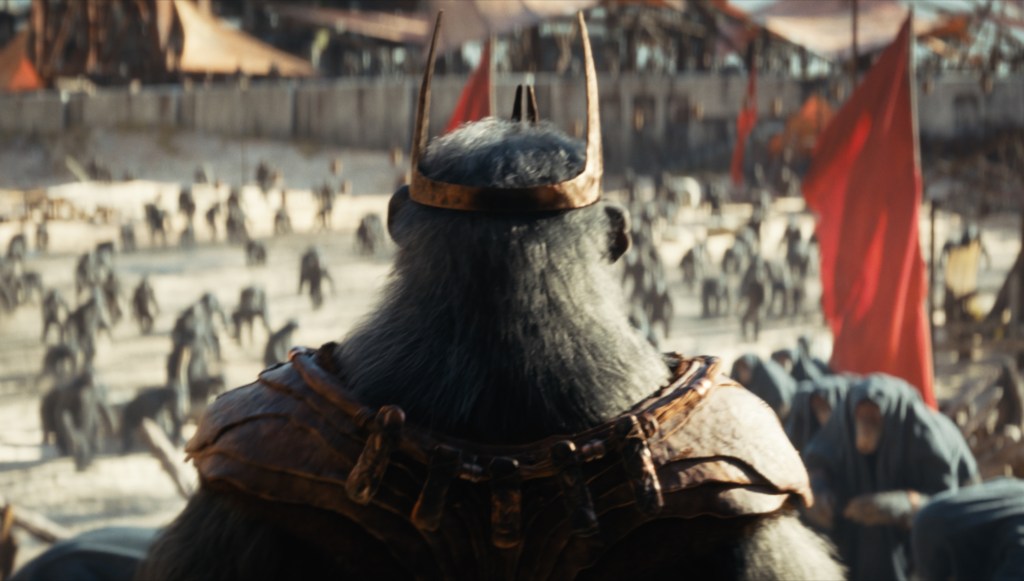
Like the films in the reboot trilogy, Kingdom features state-of-the-art visual effects from Wētā FX that, along with impressive motion capture performances (also in the style of the previous trilogy, and here with Andy Serkis, star of the reboot trilogy, as a special consultant), manages to reach a level of verisimilitude with the apes that help to get you completely enthralled by the action on-screen. The environments are designed to be quite post-apocalyptic, with nature overtaking human cities and leaving them almost beyond recognition. Whereas the reboot trilogy was concerned with the rise of Caesar paralleled with the fall of humanity, in Kingdom, the details of the story of humanity have been mostly forgotten by the apes, and only select information from the time of Caesar has persisted. One of the film’s most fascinating aspects is its exploration of how Caesar’s memory and teachings have rippled and been warped through time. We get a glimpse at what cultures his era has led to, and how quickly his words have been twisted using presentist perspectives. We experience how the ancestors of Caesar’s people have spread and interpreted his gospel. You could argue that this film is about how some leaders exploit religion and history to advocate for an elevation of their own status.
Although this is the most fascinating aspect of the new film, most of the scenes in which our new protagonist Noa learns of Caesar are paced languidly, which I suspect could be a problem for viewers if they aren’t already deeply invested in the reboot films. You see, following an impressive opening act in which the film does a phenomenal job of emphasizing the values of the Eagle clan, Noa’s friendship with two other members, and executing these tonally quite dark action and suspense scenes, the film takes its time before it gets to the mysterious ape kingdom ruled by Proximus Caesar (played by Kevin Durand), as is hinted at both in the title and in the trailers. Although this middle section of the film is too relaxed in its pacing, it wasn’t ever a significant problem for me, precisely because, as mentioned, this middle chapter is all about the memory of Caesar, which is often talked about by Peter Macon’s great ape.
Macon and Durand’s apes (and the performances delivered by them) are easily the most distinctive of the bunch, with Durand delivering something that is quite menacing. Owen Teague, who plays our new protagonist, does a solid job, but, by design, his character is a little bit of a noble but blank slate whose worldview develops over the course of the film. Freya Allan, as mentioned, plays the prominent human character, and I quite liked how she was given a character with complexities that aren’t immediately clear when we first meet her. As a quick side note — and, to be fair, I’ve only seen this once so perhaps I’m wrong, but — I will say that I think I spotted a continuity error immediately following a conversation at night in the final act, when two characters are interrupted by a third party, but when they cut back to the two characters, two other characters have magically appeared by the two aforementioned characters’ side.
I was, admittedly, worried about Kingdom of the Planet of the Apes as I didn’t want a phenomenal trilogy to be tarnished. Thankfully, Wes Ball (and co.) knocked it out of the park. It’s a more than worthy sequel with breathtaking VFX and action, as well as a gripping narrative. I thought the early scenes involving Noa and his clan did a terrific job of getting us invested in the new characters and world. Furthermore, the filmmakers made some very smart and fascinating decisions about how to have, essentially, Caesar’s gospel or memory be interpreted or exploited in different ways. I thought it was such a clever and organic way to continue the universe without references feeling forced. I’ll have to eventually see it again to determine if it is up there with Reeves’ two near-masterpieces, but I think it is definitely at the level of, or slightly above, Rupert Wyatt’s Rise of the Planet of the Apes. I can’t wait to see what comes next.
8 out of 10
– Review Written by Jeffrey Rex Bertelsen.

 I'm Jeffrey Rex
Another excellent review. This is another one of my anticipated films of the year. I’m a huge fan of the original POTA franchise starring the great Andy Serkis. Serkis set such a high bar for these films through his groundbreaking use of motion-capture technology. Since he isn’t in this latest installment, I am a bit worried about how it will turn out. I recently saw “Dawn of the Planet of the Apes” which I loved. One of the best sequels that set a high standard for the franchise. Here is why I love that movie:
Thanks for the nice comment! I had similar concerns about this film, but, even though I missed Serkis and his character, I think this film is a more than good enough sequel/spin-off, even though it has certain pacing issues.