
Directed by Gil Kenan — Screenplay by Gil Kenan and Jason Reitman.
Though not for want of trying, no one has been able to recapture the lightning in a bottle that was Ivan Reitman’s original 1984 Ghostbusters. Since that Saturday Night Live breakout ghostly adult comedy topped box office charts and won over the hearts and minds of many generations, many have tried and failed to make it work once more. This includes Ivan Reitman himself whose 1989 sequel did not reach the same success in part due to a lackluster story, reliance on the same structure of the original, being targeted more towards children, and a botched villain. Decades later, Paul Feig gave it a go with his female reboot also titled Ghostbusters in 2016 and caused uproar from both puritanical fans and misogynistic moviegoers. The film itself was neither particularly good or particularly awful, even though the mass hysteria may get you to imagine otherwise (it’s a hit-or-miss improv session with more misses than hits and a talented cast thrown into the fire of a fandom whose most vocal members were unprepared for even slight changes). It all became so toxic that Sony opted to go down the safe route of having Jason Reitman (yes, Ivan’s son) make a direct sequel to his father’s films with Ghostbusters: Afterlife, which relies on the safe and nostalgic formula of modern legacy sequels. The most original aspect of Afterlife, which I mostly really enjoy, was a new setting in the middle of nowhere as opposed to New York City, but it couldn’t resist teasing a sequel of its own that would abandon Afterlife‘s single-most fresh element. Because in Ghostbusters: Frozen Empire, in which Jason Reitman has returned as a co-writer (while Afterlife co-writer Gil Kenan has taken over the director’s chair), the titular paranormal investigators are back in New York City for a sequel that is just as safe as Afterlife. What holds Frozen Empire back, though, is a supersized cast and its structure.
Following a particularly ‘cool’ (pun very much intended) opening flashback set in the early 1900s, Gil Kenan’s Ghostbusters: Frozen Empire picks up the action with the Spengler family — the mother Callie (played by Carrie Coon), the son Trevor (played by Finn Wolfhard), the daughter Phoebe (played by Mckenna Grace), and teacher-turned-stepfather Gary (played by Paul Rudd) — a couple of years after the events of Ghostbusters: Afterlife. The Spenglers have now taken up residence in the NYC firehouse building that the original group of Ghostbusters once ran the business from, and they are trying to become the new faces of the Ghostbusters as they drive around in the Ecto-1 and try to catch ghosts all over the Big Apple. Like with the original team, though, their activities become the target of mayor Walter Peck (played by William Atherton), who, once again, wants to run the paranormal investigative group out of business, and, this time around, he is mainly emphasizing that Phoebe Spengler cannot be allowed to work for them due to her being a minor. The Spenglers are forced to comply with the mayor’s orders, even though the brainy Phoebe is the member of the new team with the kind of skills that would make her the ideal person in the family to don the jumpsuit, put on the proton pack, and chase apparitions. While being left out, Phoebe encounters and eventually befriends a teenage ghost named Melody (played by Emily Alyn Lind). Meanwhile, a random New Yorker named Nadeem Razmaadi (played by Kumail Nanjiani) stops by the occult shop owned by Ray Stantz (played by Dan Aykroyd) in an attempt to sell an orb that was passed down to him from his grandmother. Stantz and the Spenglers take this mysterious orb to a paranormal research center that is owned by Winston Zeddemore (played by Ernie Hudson), where they do further tests on the orb. Eventually, they come to understand that the orb contains a dangerous entity known as ‘Garraka’ (a fairly well-designed paranormal villain) that can control ghosts and has the power to potentially freeze everything and everyone that comes in its way.
My brief explanation of the basic plot of Ghostbusters: Frozen Empire as seen above only scratches the surface when it comes to characters. For the fifth film in the franchise — or fourth, if you don’t count the 2016 reboot, whose story doesn’t align with the events of the sequels mainly attributed to Jason Reitman — the creatives have brought back all of the new characters from the previous film (including Logan Kim’s Podcast and Celeste O’Connor’s Lucky), put them in place to once again interact with all but one of the original members of the Ghostbusters (as well as Annie Potts’ Janine, who also briefly appeared in Afterlife, but who gets to don the jumpsuit this time around, as the trailers revealed), and then, on top of all of this, they have also brought in a bunch of new characters (played by Kumail Nanjiani, Emily Alyn Lind, James Acaster, and Patton Oswalt), as well as other fan-favorite legacy characters like Walter Peck and Slimer, who also make notable appearances. Look, of course, most major motion pictures have a lot of characters, but Frozen Empire goes overboard with the number of characters that they expect us to care about, and, frankly, they only in rare cases get enough speaking lines and scenes to justify their inclusion in the narrative. Ghostbusters: Frozen Empire is so overstuffed, in fact, that the film barely has time to actually get to the Ghostbusting action that these films’ stories are built around.
The original Ghostbusters films are known to notably underserve certain characters — with fans and critics alike often remarking that Ernie Hudson was done dirty, especially, in the 1989 sequel — and the trend continued with Afterlife, in which it seemed like they didn’t really have all that much for Finn Wolfhard to do. Wolfhard has even less to do here, as his arc is nonexistent and since he is saddled with the Slimer subplot that has little to no bearing on the plot. Carrie Coon was so important to Afterlife as she helped to ground the paranormal narrative, but she has frustratingly little to do here. Now, it would perhaps be tough to write out members of the Spengler family (and they shouldn’t), but, even though I like these actors too, Logan Kim’s Podcast and Celeste O’Connor’s Lucky could’ve easily been written out of the film and made way for significant characters to have more of a presence in the overarching plot developments. And, frankly, at least three of the aforementioned ‘new characters’ feel superfluous, even though they all have their moments. I also think Sony and the creatives have to understand that the original films’ cast shouldn’t necessarily be actively passing the torch in every single one of these sequel films — they ought to, instead, start to trust the new cast that they have hired to move the franchise forward and only include the original core Ghostbusters cast when they serve a purpose for the story.
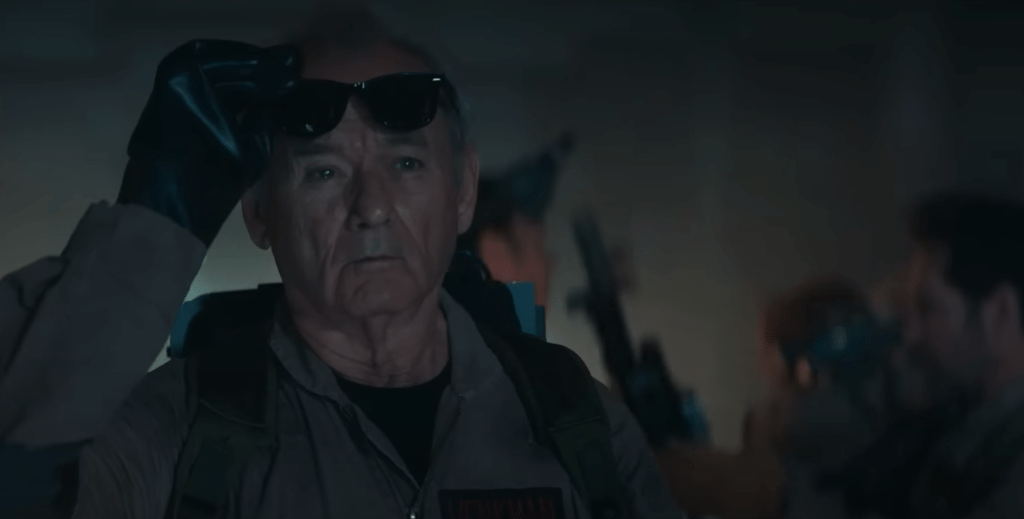
Now, of course, as a massive fan of the original film, I’ll never tire of watching Bill Murray or Annie Potts in this world, but it is Ernie Hudson and Dan Aykroyd that stand out among the legacy characters because they feel like they both want to be there and need to be there. Aykroyd is especially good, as there is this infectious glee to his performance. Aykroyd lights up whenever he gets to sink his teeth into a scene, and he is particularly fun to watch with the younger cast. Of the returning Afterlife stars, Paul Rudd and Mckenna Grace are once again the standouts. Rudd isn’t quite as good here as he was in the previous film, but he looks like he wants to be there and he earns laughs. Mckenna Grace, however, continues to be the shining star of the Jason Reitman-era, and thus it feels absolutely insane that they would want to write an entire film about her character being sidelined from the action. Mckenna Grace deserves better. The new additions to the film, though perhaps superfluous, are all fun to watch, but none of the more so than Kumail Nanjiani, who steals all of his scenes. Nanjiani delivers the kind of quick-witted comedic performance that reminds you what kind of comedy the original film succeeded with.
Afterlife and Frozen Empire are both littered with easter eggs, references, and nostalgia bait, and some of it kind of works against this film, wherein it feels more pronounced because this film is set in New York City and because someone like Walter Peck has returned to serve the exact same role in the plot that he did in 1984 (and other actors served in 1989 and in 2016). In spite of featuring the same villain plot as the 1984 film, Afterlife felt fresh because of the location change, its indie spirit or feel, and its Spielbergian influences that Jason Reitman added to it, while Frozen Empire has instead opted for a tone and look that feels more like a direct sequel to the more Saturday Morning Cartoon-inspired Ghostbusters 2 from 1989 (though not quite as goofy). The most interesting elements of the film are its very cursory discussions of what is after death for a human ghost in the world of Ghostbusters, as well as the new additions to Ghostbusters lore that are, in some cases, quite surprising and, in one case, pretty close to landing this film in the superhero genre, which I suspect might be controversial for the franchise’s die-hard fans. Frustratingly, this is also the kind of film that sets up elements that should lead to actual consequences for characters, but then it stops just short of having anything of real impact land. A stronger version of the film would’ve been okay omitting certain characters entirely from the film, had more time for its paranormal creature, and, on top of this, maybe it would have included less plot armor.
This is a film that is occasionally quite funny and which features several enjoyable performances, but which is also blatantly overstuffed. Although it, in a way, feels more like a straight Ghostbusters sequel than Afterlife and 2016’s reboot did, Gil Kenan’s Ghostbusters: Frozen Empire is, regrettably, not a step forward for the film series, but I don’t think it is a step back either. Frozen Empire is a relatively short, safe, and inoffensive but slightly cartoony (and definitely very nostalgic) so-so sequel to a franchise that needs to stop resisting change. It has too much on the agenda and takes forever before it actually starts to unleash the implied events of its subtitle — so long, in fact, that the paranormal events barely leave an impression or feel like they had a real impact on the world.
5.7 out of 10
– Review Written by Jeffrey Rex Bertelsen.

 I'm Jeffrey Rex
Great review! A shame that this one didn’t turn out to be that great. I’ve never been a big fan of the Ghostbusters franchise. Honestly, my main issue with these films is the waste of star-studded casts. For instance, Paul Rudd was once such a great actor in the past. I loved him in “Ant-Man and the Wasp”. Sad seeing he’s wasted here. Here’s why I loved the “Ant-Man” sequel: https://huilahimovie.reviews/2018/07/17/ant-man-and-the-wasp-2018-movie-review/
Thank you so much for the nice comment. You’re right about Rudd. He’s such a charming actor who deserves better material to work with. I, too, really enjoy seeing him in the Marvel films. It’d be interesting to see him do more dramatic work. I remember thinking he was quite good in ‘The Fundamentals of Caring’ and ‘The Perks of Being a Wallflower,’ though the latter is more of a supporting role.