
Directed by Ole Bornedal — Screenplay by Ole Bornedal and Steven Soderbergh.
A couple of months back, I decided to finally watch something that had been on my watchlist for such a long time, but which I was kind of dreading watching. I am referring to the English-language remake of Ole Bornedal’s Nattevagten, one of the most beloved and iconic Danish horror films. Although there are instances in which an English-language remake or reimagining of a Danish film can result in something akin to an improvement (see Michael Bay’s Ambulance), more often than not, though, English-language remakes of Danish films go one of two ways, either they result in A) a bland copy (though often with a more internationally recognizable cast) or b) an unnecessary remake that is so bad that it ruins the chances of the original reaching a larger audience by mere association. Make no mistake, Dimension Film’s English-language remake of Nattevagten, Nightwatch (also directed by Danish director Ole Bornedal), is not an improvement whatsoever. And, frankly, of the previous A and B options, Nightwatch is decidedly more in the A category. Nightwatch does have a more recognizable cast, but the American product is inferior, less interesting, and, yes, quite bland. This also means that it isn’t the Americanized abomination that I feared, but that, however, doesn’t mean that it is good.
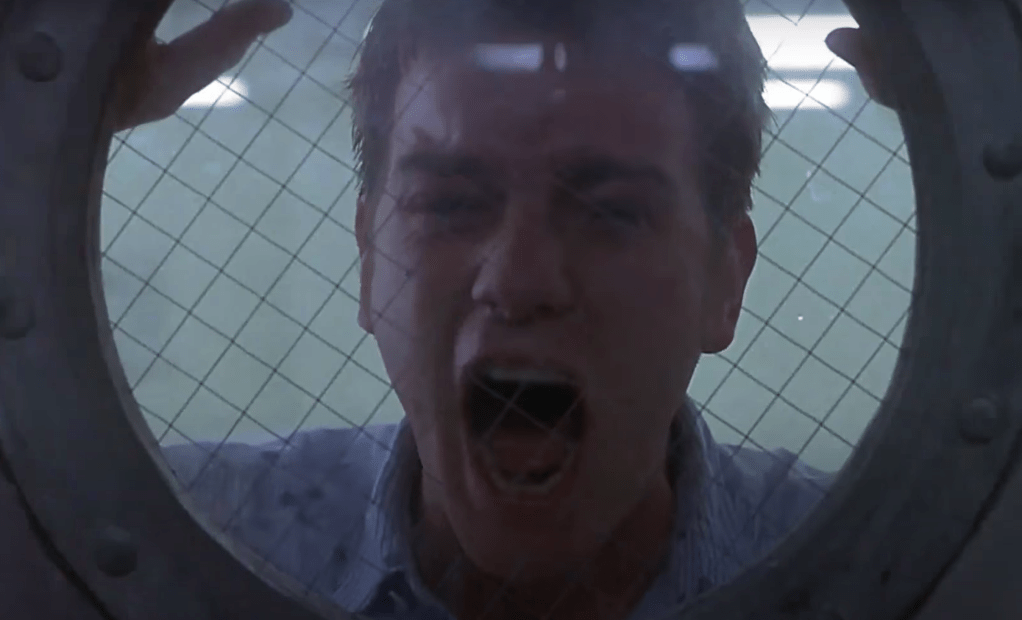
Like in the Danish modern classic, Ole Bornedal’s Nightwatch follows a young man named Martin (played by Ewan McGregor), who gets hired to be a night watchman at a medical institute that holds a chilling morgue. While Martin is getting increasingly weirded out by his new place of employment, a vicious serial killer is on the loose. Due to a series of events the authorities eventually start to suspect that this freaked-out night watchman may be involved in the series of murders that is shocking the local community. In significant supporting roles, the film also stars Nick Nolte as the veteran police inspector, Josh Brolin as Martin’s best friend ‘James,’ and Patricia Arquette as Martin’s girlfriend ‘Katherine,’ among others.
Having listened to a litany of podcasts and read a dozen interviews from filmmakers from Denmark who went to Hollywood to reach their dream of making a big international motion picture, I can say that most of the time what they find is an industry that isn’t as opening as the one they find back home. The grass often isn’t greener on the other side. This has very publicly been the case for Ole Bornedal. The filmmaker found himself with an American studio insistent on retooling the product that he had already tested in Danish waters. Although it is true that from the Danish original to the American remake there are many 1-to-1 scenes, it is very clear that it has been retooled. Some scenes feel missing, nuances that have been erased from characters, and then there are very American additions that make the entire thing feel less distinctive. At times it is very clear that not only the Danish filmmaker but also several Danish crew members went to America and made the same film but for a new audience, even though it was, eventually, reshaped by studios. What isn’t very clear, however, is what Steven Soderbergh brought to the table. Soderbergh is a renowned American filmmaker, whose influence should have been much clearer than it ultimately is. The only thing I can really imagine he did is the reported reference translations that he did, as you can’t really reference Danish culture in an American film, so you have to sort of update it for North American audiences. But, surely, that isn’t all Stephen Soderbergh helped Bornedal with. All of the additions and retooling feel like they stem from a studio demand, and so my big question upon watching this film was what had happened with Soderbergh’s co-writing credit. Unless you have a specific interview that can uncover more (and please send it my way in case you do), the only conclusion that I can naturally draw is that a lot must’ve been left on the cutting floor (in addition to the scenes that already feel missing or diminished when compared to the original film).
If I recall correctly (though I could be mistaken as it’s been a few months), a pivotal scene from the original — which is set inside of the morgue and features Martin engaging in something inappropriate with someone else (an activity that ends up biting him in the ass, so to speak) — is missing in the remake. Other notable issues include that it isn’t as humorous as the original, the red herring is not as nuanced as it ought to be, and the mood, atmosphere, and locations are also not as eerie and unsettling as in the original Danish film.
Other than studio system headaches, the one thing you expect to find in Hollywood when remaking an original European product is added funds or a bigger budget that can help to increase the scope or make the effect of it all more impactful. But, really, that isn’t the case here. The only thing of good value that the studio system of Hollywood added to the Danish film is the addition of rising English language stars and a bigger platform from which to release the film. Looking back on the film today, it is really fascinating to see stars like Nick Nolte, Ewan McGregor, Josh Brolin, Patricia Arquette, and others appear in this film. These are either stars of the time or stars of today appearing in an underseen botched American remake of a Danish modern classic. It is kind of incredible that it has essentially been swept under the rug of 90s US cinema. Why hasn’t there been a call for another American remake or reboot like there has been in Denmark (in which a sequel was finally released last year)? The two-pronged answer must be that 1) the Weinsteins’ involvement in the remake has tarnished the product even further and 2) the badmouthing of the film from those involved put a black stain over the entire property.
Let’s have a closer look at the performers and how they do in the film. Although I suspect some people who like the Danish original even more than I do may think otherwise, I actually think Ewan McGregor does a relatively good job as the titular night watchman. It’s not that I think it is this great performance, but I think it pairs well with the type of nervy performance that Coster-Waldau delivered in the original film. Josh Brolin was handed the role that, in theory, should be the most fun role to play — and which Kim Bodnia did a good job with — and while I think he was right for the part, I do think some of the nuances of his character have been sanded off to his and the film’s detriment. While I do think Nick Nolte is fine in his role, I will say that this film lacks the against-type surprise of his character that the Danish film achieved with Ulf Pilgaard. In my review of the Danish modern classic, I noted how I was particularly wowed by Sofie Gråbøl’s performance, but I have to say that I don’t think Patricia Arquette gets as much out of the role as Gråbøl did — partly due to the writing but I also think she was maybe slightly miscast. Lauren Graham doesn’t get as much to do in the already small role of ‘Marie,’ but I think Brad Dourif was perfectly cast in his role. Dourif’s note-perfect performance is one of the highlights of the remake.
Like I suggested earlier, I’ve also heard some of Ole Bornedal’s stories about his time in America, and his stories are far more fascinating than anything we’ve got in the remake. He once opened up about how David Bowie was initially lined up to do the music, but, ultimately, it didn’t go their way. Instead, the film has this generic score – in addition to unmemorable songs. So much of this remake is extremely similar to what we got in the original, but, when there are any slight alterations, something either feels missing, unsubtle, or very Americanized. It has a solid cast that with modern eyes is rather star-studded, which makes this remake all the more interesting when viewed from the outside looking in. But if you sit down to watch it and if you are somewhat familiar with the original film, then you’ll be left scratching your head as to what exactly Steven Soderbergh’s co-writing credit is there for. What exactly did he come up with, and was it all left on the cutting room floor due to studio meddling? What a shame. Well, at the very least, this remake probably helped to get cinematographer Dan Laustsen’s Hollywood career starting, which is a good thing.
Looking back at Nightwatch, Ole Bornedal’s English-language remake of the Danish horror favorite Nattevagten, it is, on its own, a relatively unremarkable horror-thriller film albeit with a surprisingly stellar cast, who were saddled with this unfortunate mishap. However, when viewed as a forgotten cultural clash artifact that speaks to how the American studio system chews up European original filmmaking, it is a fascinating film to watch for a comparative study of it and the Danish hit that it spun off from. It may not be a particularly stellar film by any means, but I had a much better time watching this than I imagined, as a fan of the Danish film. This is in large part because the film exists as this time capsule for a lot of young actors who would go on to do better things, as well as an example of how some films should just be left alone rather than be forced through the creatively unkind US assembly line studio filmmaking process
5.5 out of 10
– Review Written by Jeffrey Rex Bertelsen.

 I'm Jeffrey Rex
One thought on “Nightwatch (1997) | RETRO REVIEW”