
Directed by Nikolaj Arcel — Screenplay by Nikolaj Arcel and Anders Thomas Jensen (Retfærdighedens Ryttere).
Titles can be tricky. Titles are obviously an essential part of marketing as they clue audiences in on what they can expect to see. A poster can be manipulated. A trailer can be manipulated. But more often than not titles mean something to the creatives who worked on the film. Then, of course, there are International titles. In the case of this Danish historical epic, its original title is Bastarden, which literally means ‘The Bastard,’ but it is known internationally as The Promised Land. Frankly, both titles feel accurate. Then, of course, there is the title of the source material, which is a Danish historical novel from Ida Jessen titled The Captain and Ann Babara (originally Kaptajnen og Ann Barbara in Danish). Internationally, distributors went with The Promised Land, which I honestly think is a bit of a mistake as it is such a generic title that has been used over and over again. Now, The Bastard isn’t exactly completely original. Still, it feels less conventional and speaks to its two principal opponents, a person born out of wedlock and his despicable antagonist. Regardless of which title you find it under, this Danish epic is one that I highly recommend, as it features strong performances, gorgeous photography, and a fair bit of violence which keeps this period piece from ever feeling stuffy.
The film is set in Denmark in the 1700s, and it follows a poor soldier named Ludvig Kahlen (played by Mads Mikkelsen) who has a plan for how he can elevate his status. Ludvig makes the proposal to the Royal Treasury that he will personally cultivate the heath of Jutland for the King, who has long wished for such a settlement in that barren area of Denmark. The Royal Treasury considers it a fool’s errand but thinks of it as an ideal way to satiate the King — whose visage we never see, but whose voice, I believe, is that of actor Mikkel Boe Følsgaard — once Ludvig offers to pay for it out of his own soldier’s pension. In return, Ludvig wants to be a landowner with servants and a much-desired noble title. They agree to his terms.
However, this is a task that has proven to be too much for many men over the years, and once Ludvig makes his way from Copenhagen to Jutland’s heath he finds out why. Not only does the ground seem uncultivable, but the area is also close to a forest containing outlaws, and, even more problematic, is the fact that the county judge and wealthy landowner Frederik De Schinkel (played by Simon Bennebjerg) considers the ground to be his property no matter how steadfastly Ludvig insists otherwise. As Ludvig carries on with his royally approved undertaking, he makes an enemy of the aforementioned despicable aristocrat, but he also encounters other less-fortunate individuals who will help him, if he softens up a bit.
As I sat down in my seat at a local movie theater, I looked around and smiled. Cinephiles all over the world fear for the future of the theatrical experience at a moment in time when it feels like most people are only interested in major franchises and blockbuster filmmaking. But there I was looking at a mostly filled theater. Most of the people who had journeyed to the cinema to see a historical epic were of an older age group, but that is also a comforting fact, as people interested in the theatrical industry have worried that older audiences might be harder to convince to flock to heavily populated areas in the post-pandemic lockdown era. But here we were to see Mads Mikkelsen on the big screen as he tried to carry out his farming ambitions. And what a wise decision it was to go see it.
Bastarden, or The Promised Land, is the second period piece collaboration between director Nikolaj Arcel and star Mads Mikkelsen, who also teamed up in 2012 with A Royal Affair, which ended up earning the Danish film an Oscar nomination (something that the people behind Bastarden are also hoping for, as it has been announced as the official Danish selection for the international feature category). After the international success in 2012, Arcel journeyed outside of his native country and bet on himself by taking on the seemingly impossible job of adapting Stephen King’s The Dark Tower, which had been in development hell for more than a decade by the time Arcel was finished with it. His The Dark Tower adaptation, which he co-wrote with three other writers including Bastarden co-writer Anders Thomas Jensen (one of the most popular writer-directors working in Denmark due to his beloved dark comedies), was met with negative reviews. Meanwhile, Mads Mikkelsen earned plaudits far and wide and fairly successfully went through franchise after franchise in Hollywood. Together again, Arcel and Mikkelsen have accomplished something quite noteworthy — they’ve made a powerful Danish western, which should serve as a reminder for Hollywood that Arcel is far more than a director-for-hire, but also that even though Hollywood loves to make Mikkelsen a villain, his dashing and distinctive looks also befit a leading man, which he often is in Denmark.
No one will be surprised to learn that Mads Mikkelsen has turned in another strong, nuanced performance here, but it is worth mentioning. Mikkelsen is a powerful actor and veteran both at home and abroad, whose steely gaze works wonderfully for this stubborn character who gradually softens up and realizes that ambition isn’t everything. It is not a showy part, but it almost feels like his There Will Be Blood, only with a more morally sound character, but also with potato farming instead of drilling for oil. The showier part is the one taken on by Simon Bennebjerg, who plays a devilish aristocrat and landowner. Bennebjerg does an excellent job as the loathsome antagonist to Mikkelsen’s Ludvig, and he does a good job of balancing how his character, in certain scenes, is both crushed by how slighted he feels and pleasured by how wicked and powerful he gets to be. It should be a huge breakthrough role for Bennebjerg. Other notable performances in the film are delivered by Amanda Collin and Melina Hagberg. Collin plays Ludvig’s housekeeper who, alongside her husband played by Morten Hee Andersen, has escaped from De Schinkel’s capture, while Hagberg plays a sweet young girl who is a part of a group of outlaws that Ludvig begrudgingly has to work with. The terrific mostly Scandinavian cast also includes Gustav Lindh (Dronningen), Magnus Krepper (Før Frosten), and Kristine Kujath Thorp (Den Store Stilhed) among others.
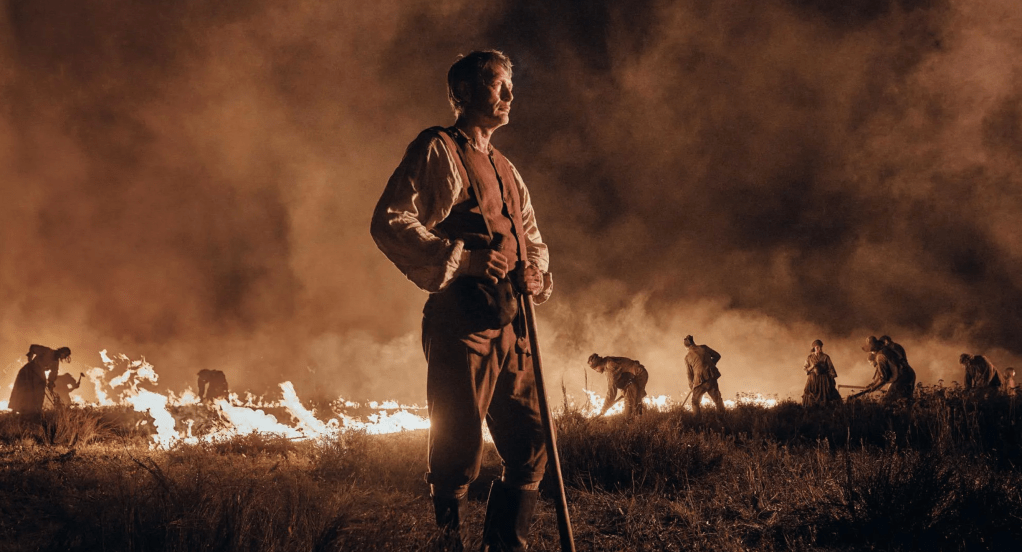
One of the main accomplishments for Arcel here is that he has crafted, or recreated, a well-realized world of 1700s Jutland. Arcel and cinematographer Rasmus Videbæk capture the harsh landscape well. It is a strikingly gorgeous film that invites you in through its visuals. There is a memorable sequence after the title has appeared on-screen when Videbæk shoots the surroundings to highlight Ludvig’s solitude and poor conditions. We switch with great haste from season to season or weather condition to weather condition, and later there is a short but noticeable long take as characters take on a surprise attack. It is, of course, to a certain extent a costume drama — with costuming that highlights how clearly divided the aristocrats are from those less fortunate — but at the same time it is also a film that is never afraid to lean into violence. It’s not quite Tarantino-esque (except for maybe one scene between Collin and Bennebjerg), but I was impressed and taken aback by how willing the film was to showcase sudden bursts of violence.
Admittedly, not everything works equally well. I feel that it has a little bit of an ending problem in that it feels like it ends three or four times towards the end of the narrative, and as it tacks on more and more endings it gradually lessens some of its impact. This could be an attempt by the filmmakers to be accurate to the source material, but I found that it ought to have ended perhaps five to ten minutes earlier. I also think that perhaps one or two characters are underserved with the wonderfully costumed Kristine Kujath Thorp landing a part that feels underwritten, for example. I’ll also add that Jacob Lohmann’s character, who regularly comments on how his backside is feeling, stands out in an unflattering way — the kind of broad comedy that I don’t think is appropriate for this film.
On the whole, though, Nikolaj Arcel’s Bastarden (or The Promised Land) is a gorgeous-looking film that is never dull. It represents a sharp and entertaining return to form for Arcel after his less-than-ideal time in Hollywood, but it is also somewhat of an achievement in Danish cinema, as this film about climbing the social ladder (and being faced with your own humanity along the way) is a skilfully-made Danish spin on the Western genre. Though, as a Western, it feels more distinctly Danish than the more traditional Danish western The Salvation, from director Kristian Levring, which took place in America but was shot in South Africa (and which also starred in Mads Mikkelsen). Time will tell if it can break through the tough competition at the Oscars like A Royal Affair (or En Kongelig Affære) once did, but, in my opinion, Bastarden is at least as good as Arcel’s 2012 effort, if not better.
8.7 out of 10
– Review Written by Jeffrey Rex Bertelsen.

 I'm Jeffrey Rex
3 thoughts on “Bastarden (2023) | REVIEW”