
Directed by Matt Shakman (WandaVision) — Screenplay by Josh Friedman (Kingdom of the Planet of the Apes), Eric Pearson (Thunderbolts*), Jeff Kaplan, and Ian Springer.
Although the Avengers are today the most well-known superhero group, even though the X-Men dominated the big screen in the 2000s, it was, in actuality, the Fantastic Four that were the original Marvel Comics team. Though Stan Lee and Jack Kirby created the Fantastic Four and found great popularity for the team often referred to as the ‘First Family,’ the team of four has long struggled to find the same success on the big screen that the Avengers and X-Men have enjoyed. Prior to this new live-action attempt at making a successful Fantastic Four film, there were four other films, none of which found success with fans and critics. There was the 1990s Roger Corman-produced, low-budget, and unreleased adaptation, then Tim Story got to release two fairly campy films about Marvel’s First Family in the mid-2000s both of which were largely dismissed by critics, before Chronicle-director Josh Trank got to sit in the director’s chair for 20th Century Fox’s Razzie Award-winning dark and gritty reboot, which Trank, notably, disowned publicly on Social Media during its week of release. It seems that it isn’t all that simple to make a good film about four of Marvel’s most iconic characters. Thankfully, this latest attempt succeeds where prior films failed. The Fantastic Four: First Steps is a strong superhero film that possesses a strong audiovisual identity and aesthetic, and it also does a good job of honoring the characters and the original creators.
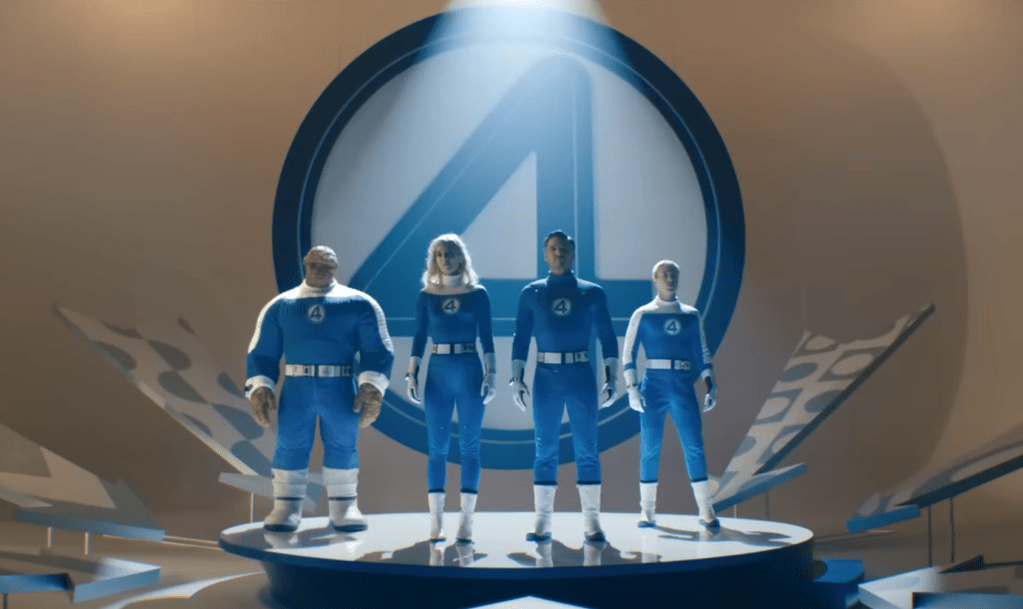
Matt Shakman’s The Fantastic Four: First Steps takes place in an alternate world from the wider Marvel Cinematic Universe. The titular four fantastic heroes — the stretchy Reed Richards (played by Pedro Pascal, known as Mr. Fantastic; his wife, the invisible woman, Sue Storm (played by Vanessa Kirby), who can also generate force fields; her brother, Johnny Storm (played by Joseph Quinn), the Human Torch who can fly and don flames all over his body; and Reed’s best friend, Ben Grimm (played by Ebon Moss-Bachrach), known as the Thing, who is now always covered head to toe in transformative orange rocks — gained their powers four years before the start of the film, when they, together as a team of astronauts, were hit with cosmic space rays while up on a mission. In this universe, this group, Marvel’s so-called First Family, are the main heroes and, in addition to saving the day, they fulfill major pop culture roles (e.g., Reed is a science expert on televisin, they have their own Saturday morning cartoon, and they frequently appear on television broadcast similar to the Ed Sullivan Show) and have political responsibilities.
So when, out of nowhere, the alien woman, Shalla-Bal (played by Julia Garner) — the so-called silver surfer covered head to toe in silver and capable of, among other things, flying on the silver surfboard on which she stands — arrives on Earth to announce that our planet will soon be devoured by, Galactus (voiced by Ralph Ineson), a giant mystical, cosmic alien from outer space. It is the Fantastic Four that Earth puts its faith in to go up into space, confront this foreboding giant, and save our planet and everyone on it. And so, our group jumps on a spaceship to boldly go where no man has gone before. But when they come face to face with Galactus himself and hear his cruel demands (that make things personal), they realize that they may be out of their depth. Ben, Johnny, Reed, and a very pregnant Sue must now think up a way of stopping a devourer of worlds or risk losing everything, including their world, while the public starts asking tough questions about how far they’re willing to go for them.
As it is the fifth film about these characters, and the fourth live-action group of Fantastic Four, it’s difficult not to compare what this film does to previous efforts. I’ll confess that I have yet to see the Roger Corman-produced 1990s film. But I have seen the mid- 2000s Tim Story films quite a bit, and I saw Josh Trank’s 2015 dark and gritty version in the theaters, during which I got very upset at its disturbing origin story for the iconic catchphrase “it’s clobbering time,” (don’t worry, that catchphrase works much better in the latest film). I find that Matt Shakman‘s film sits somewhere in between Tim Story’s and Josh Trank‘s films when it comes to balancing a tone. Whereas Tim Story’s films were very campy and sometimes even juvenile, Josh Trank’s film, though it had jokes, was very dark and tried to take a more serious and grounded version of the narrative to the big screen. Like the mid-2000s films, Matt Shakman’s film shows a deep affection for the kind of silver age comic book ideas that Jack Kirby and Stan Lee lovingly put to the page. But it is notably not as jokey or juvenile, even though there are certainly Marvel-esque jokes. Indeed, I found it to be a lot more serious than I expected it to be. It’s not that this is a grounded, realistic, and dark take on these characters like the Trank film; it’s more so that there are deep and serious emotional stakes to the narrative chosen here, which makes for a more serious, concerned, and heavy character-centric narrative. For me, the total balancing act really worked.
What also really worked for me was the effort to have this narrative take place in a standalone universe separate from the MCU, despite this film obviously being a part of those connected films. Way too often, I find that the necessity to connect Marvel films to other Marvel films bog down what the films are narratively trying to execute, but this film doesn’t have that problem. Instead, the storytellers are here given the freedom to craft a universe of their own, without the limitations of having to resolve dangling story threads from other films. Furthermore, it should also benefit the viewer that there are not that many things you need to know, or homework you have to complete, before you watch this, the 37th film in the MCU. I would argue that the origin story of the Fantastic Four is both well-known and easily explained with a hand wave. And so, instead of doing what both Tim Story and Josh Trank did, which is to tell the origin story in excruciating detail, this film opts for a briskly paced opening where their origin story is recapped swiftly by way of a television broadcast highlighting an anniversary of theirs. It is a very quick montage which displays their power sets, recaps their personalities and the way they got their powers, and also gives us an idea of what foes they fight. They even have room to include a visual reference to the iconic cover image of the original Fantastic Four comic book. That is just one of several deliberate and explicit ways of honoring the creators of the characters, as there’s even a brief shot of two comic book creators watching on as things happen just outside their window. I also greatly loved the way the credits honored Jack Kirby’s memory. As a sidenote, I thought the core message about working together as a family, across the globe, rather than letting the next generation pay for our lifestyle, was quietly powerful.
Earlier in my review, I praised the film’s audiovisual identity, so let’s now get into that. Although the Marvel Disney+ shows have been hit or miss, one of the greatest elements found in one of those shows was the production design of the Loki TV show. It had this stuck-in-time 1970s aesthetic that really did a lot for the vibe of the show, and this Fantastic Four film has employed the same production designer, Kasra Farahani, who has done a great job of creating this world. In this separate universe of the MCU, we find an Earth with this lovely blend of 1960s design and retrofuturist elements (Think the Jetsons). This retrofuturistic aesthetic pairs well with the earnest and colorful way the film is presented. In addition to having a great production design, the film also shines because of its sensationally good score from composer Michael Giacchino. It has this hopeful adventure quality that you’ve heard in trailers with a choir singing the title of the movie, in a way that sort of reminded me of the hopeful, earnest, and iconic score for 1978’s Superman: The Movie.
So it has a great audiovisual style, it honors the comic books, and it is generally a step above the previous adaptations. But what about the action? Well, I think they do a great job of showcasing the characters’ individual powers on screen. Admittedly, I wanted more of Mr. Fantastic’s stretchy ability, but I think it looks much better than the plasticky look of the 2000 films. I think a significant reason why it looks better is that the stretchy element is covered by fabric that often stretches with him, so that we don’t see his skin stretch. Also, there are glimpses of the kind of creative problem-solving during battles that the Fantastic Four are prone to in the comic books. However, I think the best and most intense sequence is the chunk of the film dedicated to space exploration. Here, it becomes clear that Christopher Nolan’s Interstellar is also a part of the film’s DNA. There is this great chase sequence in space that is incredibly thrilling, and I found myself holding onto my movie theater seat as the characters were stressed through it, and prior to this sequence, there’s also a quite dark and serious scene where they first meet Galactus. It’s some of the best Science Fiction that the Marvel Cinematic Universe has ever done.
I was also delighted by the fact that they really nailed these characters and have brought together a core cast with great familial rapport. I think, in previous adaptations of the source material, Reed Richards and Sue Storm’s relationship hasn’t ever felt as genuine as it does here. I think Pascal and Kirby have great chemistry, and, given the emotional stakes inherent in the narrative, it brings out the best of both performers, which is vulnerability and warmth, respectively. I think the writers and performers do a good job of portraying Reed as this individual burdened with intelligence, who is the smartest man in the room (or even the world), but who tends to put his foot in his own mouth because of his neurotic tendency to think out every single scenario, even if it is inhumane almost as if he lacks a filter. I also think the writers succeed with Johnny Storm, who in previous adaptations has been a little bit of a man-child. Now, don’t get me wrong, Johnny is still looking for a good time in this movie, but Joseph Quinn does a good job of establishing him as someone who is smart and can work out a solution to a problem on his own, but who is perennially under-appreciated for his smarts. Quinn and Ebon Moss-Bachrach’s characters’ sibling-like rapport is also one of the highlights of the film, but thankfully, it is never as mean-spirited as it was in the 2000s films. Moss-Bachrach had a particularly difficult job here as his character is covered in orange rocks, but through his vocal performance, he imbues his character with a warmth and loyalty that I thought really worked. Also, I think the visual effects team managed to get a lot of emotion out of the facial animations in certain scenes.
Although it is a massive improvement on previous films about these characters, it is not without faults. I’ve already indicated that the visual effects are a standout, but, without having been said, there are certain things in the film that stand out for the wrong reasons. There is a character that suffers from having this uncanny valley look in certain scenes. I’m specifically talking about a child in the film, who sometimes looks too computer-generated. It sticks out like a sore thumb, and, admittedly, it did take me out of a few scenes a little bit. Also, as the film had come to a close, and I exited the movie theater, I felt that there was a certain missing quality to it, a missing je ne sais quoi, that held it back from being a top-tier MCU film, even though it is definitely in the better half. I couldn’t quite put my finger on it initially, but, as I’ve had some time to ruminate on the film, I feel that it comes down to the pacing of the film. The opening act is very fast-paced, and I think the film is uneven in spots. For example, I think the third act climactic fight sequence is surprisingly short, given the buildup and the weight of that buildup. I also think it’s evident that there was a larger cut of this film at one point. In marketing, we saw John Malkovich appear, but he is absent from the film, and Natasha Lyonne plays a character in the film, who I thought added a great deal to every scene she was in, but I wanted more of her, and her plot involving Ben Grimm felt like it lacked a proper conclusion. Also, while I must praise Paul Walter Hauser’s performance for being a scene stealer, his performance definitely merited a greater involvement in the film. It does feel like Marvel and/or Disney were desperate to get the film under the two-hour mark, either to get more people to see it in theaters (to have more showings on opening weekend) or because they were afraid the film would get too unwieldy if it had maybe 20 to 30 minutes more to it. But, ultimately, I do think the film would’ve benefited from more breathing room in certain scenes and additional scenes with certain characters. However, I also think the film may suffer from a perception that the film’s macro-level premise is old-hat, given that the second Tim Story film was also about a Silver Surfer and Galactus, even if the character design of the latter back then left something to be desired.
On the whole, Matt Shakman’s The Fantastic Four: First Steps is one of the very best films in the MCU in the post-Avengers: Endgame era, as well as easily the best film about Marvel’s First Family. It succeeds partly thanks to its loving approach to the characters, the era of comic books that spawned them, and its creators, but it is also just an audiovisual feast with great sci-fi exploration, outstanding production design, and instantly iconic music. It definitely has some issues concerning narrative compression and individual VFX shots (even though the VFX is mostly terrific), but the film overcomes those issues and, ultimately, largely because these versions of the characters are so good together, it lays a strong future foundation for the Fantastic Four. I can’t wait to see what they get up to next, and, should we be so lucky that we get a proper sequel to this, I hope it gets to both keep its stylistic identity and remain relatively self-contained.
8 out of 10
– Review written by Jeffrey Rex Bertelsen.

 I'm Jeffrey Rex
A fantastic review. I am definitely looking forward to watching this one soon. I will be honest. I wasn’t a fan of the 2005 movie. I thought that film was an absolute disaster. The only thing I liked about it was Chris Evans who did a great job as the Human Torch. It seems based on the reviews that this film will be better. I’m curious to see how it fares in comparison to the 2005 movie.
Here’s my favourite Chris Evans films of all-time (Fantastic Four is number 10):
I have considered going back to review the 2000s Tim Story Fantastic Four films. Maybe I’ll do that in the next week.
Thanks for the nice comment 🙂